
‘Manoj Kumarji had tears in his eyes after hearing my dad sing Mera Rang De Basanti Chola. He said, “This is my voice for my desh bhakti songs”. ‘

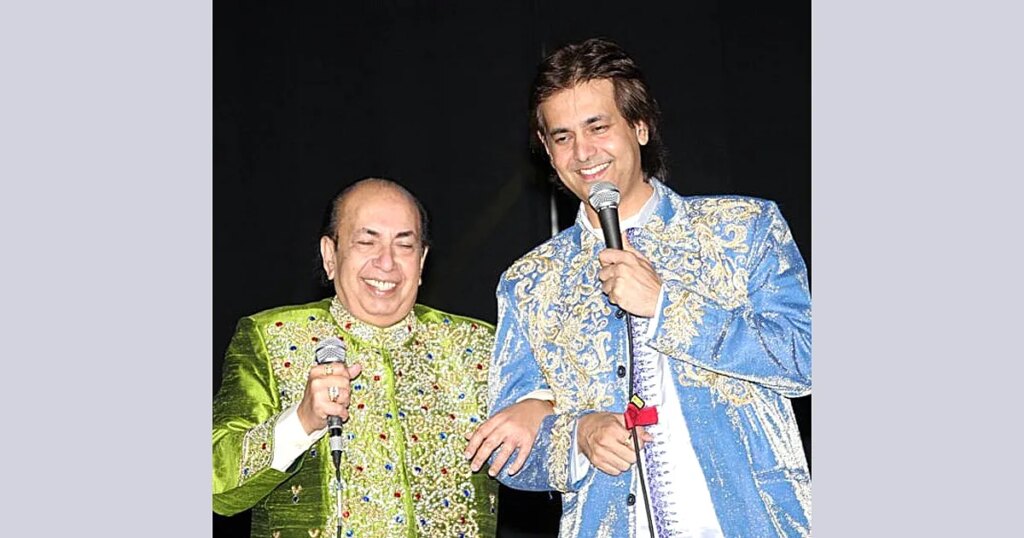
IMAGE: Mahendra Kapoor with son Ruhan Kapoor. Photograph: Kind courtesy Ruhan Kapoor/Instagram
Key Points
- ‘When Yash Chopra uncle offered me the lead role in Faasle, I initially said, “Give me some other film instead”! Imagine!’
- ‘The world knows him as a patriotic singer, thanks to Mere Desh Ki Dharti (for which he won the National Award) and Hai Preet Jahan Ki Reet. But I’ve heard so many people praise his romantic songs too, like Chalo Ek Baar Phirse, Neele Gagan Ke Tale, Tujhko Mera Pyar Pukare…’
- ‘In the same way that I went with my father for recordings, dad used to accompany Rafisaab for recordings.’
As Mahendra Kapoor’s only son, actor-singer Ruhan Kapoor has enjoyed a ringside view of his father’s eventful life and career.
Mahendra Kapoor consistently scored hits over four decades from Dhool Ka Phool in the 1950s to Nikaah in the 1980s and propagated the wonders of Hindi film music through innumerable shows at India’s border or in distant lands.
On Mahendra Kapoor’s 18th death anniversary on September 27, his son reveals details of his dad’s illustrious journey and his relations with stalwarts Manoj Kumar, Dilip Kumar, Mohammed Rafi and the Chopras.
“My dad became the only official student Rafisaab ever had. Rafisaab had told him, ‘Mahendra, you and I will not sing together because we both have high-pitched voices and people kushti ladayenge‘ (will pit us against each other),” Ruhan tells Dinesh Raheja.

IMAGE: Ruhan Kapoor and Farah Naaz in Faasle.
How has being Mahendra Kapoor’s son shaped your life? Did it lead to a biggie like Yash Chopra introducing you as a leading man with Faasle (1985)?
No. When Yashji decided to sign me, my father was undergoing heart surgery in the US. It’s good to be a noted artiste’s son, but the bad part is people believe a singer’s son should be a singer. Fortunately, my father encouraged my fascination with acting. At 16, I started assisting Manoj Kumarji, and did many plays for Shafi Inamdaarsaab.
I would visit Yashji‘s office to struggle for the small role of a brother in his production. I couldn’t meet Yashji so I went to his house. He was out, so I gave Pam aunty a VHS tape in which I had recorded a scene.
For the next 8-10 days, I kept calling her, asking whether Yash uncle had liked it. I am told that Pam aunty ultimately yelled at Yashji and he watched the tape. He found my look interesting. Because I was from theatre, my Urdu and diction was saaf (clean).
But when Yash uncle offered me the lead role in Faasle, I said, ‘Give me some other film instead’! Imagine a 21 year old saying this. I was disturbed because my friend Ashish Chanana was already signed for that film. But Yashji said, ‘I find you more appropriate for that role.’
How did you move from acting to following in your dad’s footsteps as a singer?
After Faasle, I did a handful of films as the hero including the hit Love 86. I remember my Faasle co-star Rekhaji, stopping her car to tell me she had loved my photographs in a magazine feature.
I was signed by the best producers, Mohan Kumarji, B R Chopra and Ghaffarbhai Nadiadwala, but it didn’t work out.
Simultaneously, music shows organisers would tell my father: ‘We know your actor son Rohan also sings. Please request him to join your show because the youth will like it.’
I was always a singer, a student of Pandit Sharmaji and Chhote Iqbalji, and that’s how I began touring the world doing music shows with my father. Dad would croon his hits while I sang the chulbul dance numbers.
When I was 14, I had already done several shows in South Africa, where I sang Mere Angne Mein Tumhara Kya Kaam Hai before it became famous. My father had seen Mr Bachchan sing this folk song at a show, so he taught it to me. Later, when the song was a part of Laawaris, people in South Africa, started calling up my father, ‘Mahendraji, your son’s song has been sung by Amitabh Bachchan in a film!’
Dad laughed and clarified it was Mr Bachchan’s song initially.

IMAGE: Prem Chopra and Manoj Kumar in Upkaar.
When your dad debuted in Hindi films in the late 1950s, there were six singing legends — Mukesh, Mohammad Rafi, Kishore Kumar, Manna Dey, Talat Mahmood, Hemant Kumar — already well established. How do you think Mahendra Kapoor was able to carve out a place for himself?
The world knows him as a patriotic singer, thanks to Mere Desh Ki Dharti (for which he won the National Award) and Hai Preet Jahan Ki Reet. But I’ve heard so many people praise his romantic songs too, like Chalo Ek Baar Phirse, Neele Gagan Ke Tale, Tujhko Mera Pyar Pukare…
Also, listen to his qawwalis. Very few people would sing with good qawwals like Aziz Nazan. My father was the only one who could reach that pitch without any strain until that final note.
Mahendra Kapoor was most associated with Manoj Kumar, from Upkar through Purab Aur Pacchim, Roti Kapda Aur Makaan, Kranti, right up to Clerk in 1989. Why did they click with each other?
My dad knew Manojji when he was a newcomer and had sung some romantic songs for him (Chhodkar Tere Pyar Ka Daaman from Woh Kaun Thi). Once Manojji had called dad for an appointment at 9 am, and when dad reached there, he saw the room had three khatiyas. One was occupied by a friend who later became a producer and the third khatiya had Dharmendraji! Dharamji used to share the room with Manojji because they were strugglers together.
Manojji‘s association with my dad started in earnest from Shaheed. I was sitting with Manojji once and he shared that he was shaken by the way Mahendraji sang Mera Rang De Basanti Chola, especially the stanzas on the terrace when Bhagat Singh is alone and singing to himself without music.
My father’s feelings for the nation were also very strong. Manojji had told my dad to imagine himself as Bhagat Singh and bring that fire to his heart.
Manojji had tears in his eyes after hearing my dad sing Mera Rang De Basanti Chola. He said, ‘This is my voice for my desh bhakti songs. I have found my singer!’

IMAGE: Dilip Kumar in the song Ramchandra Keh Gaye Siya Se from Gopi.
Did it become an issue when Manoj Kumar insisted on Mahendra Kapoor singing the Aadmi song Kaisi Haseen Aaj Baharon Ki Raat Hai even though Talat Mahmood had already recorded it?
Naushadsaab made Rafi and Talat Mahmood sing this duet in Aadmi for Dilip Kumar and Manoj Kumar respectively. Rafisaab had a mountainous voice, so it was difficult to score in front of him. Also, Talatsaab was not well while recording so he was low-key. Manojji and the entire unit felt this was affecting his onscreen character.
From the location in Chennai, the filmmakers called music director Naushadsaab and he quickly reached out to my father. Dad went to Naushadsaab‘s bungalow but refused to sing because Talatsaab had already recorded it.
When Naushadsaab called up Talatsaab and explained the situation, the singer called dad to his house.
My father told him, ‘You have a beautiful, honey-coated voice and I don’t want to replace you.’
Dad agreed only when Talatsaab himself told him: ‘Dekh Mahendra, tu nahin gayega toh koi aur gayega (if you don’t sing, someone else will) But only you can do justice to this song. So with my blessings, you go ahead and dub this song.’
In the 1960s, Dilip Kumar was exclusively voiced by Rafi but his Gopi (1970) had three Mahendra Kapoor songs. This was followed by Daastan, Bairag, Kranti, Shakti, Mashal, Mazdoor, Duniya. How did this happen?
The first song dad sang for Dilipsaab was Ramchandra Keh Gaye Siya Se. Before that, it was always Rafi singing for Dilip Kumar.
Om Prakashji, who played Dilip Kumar’s brother in Gopi, heard the song while the film was being shot in the South. He called up my dad to congratulate him and made Dilipsaab talk to him.
Dilip Kumar himself said that he wanted Mahendra Kapoor to sing the other songs. So Kalyanji-Anandji recorded the comedy song Gentleman Gentlemen Gentlemen which suited dad’s voice because it was very energetic. Dilipsaab would enact the song for my dad!
They formed a rapport because both were like-minded people. Dilipsaab would do a lot of work for the underprivileged, and would ask my father to accompany him.

IMAGE: Sandhya and Mahipal in the song Aadha Hai Chandrama Raat Aadhee from Navrang.
Mahendra Kapoor sang all of Sunil Dutt’s songs in his hit trilogy with the Chopras, Gumraah (1963), Waqt (1965) and Humraaz (1967). The actor had jokingly asking Mahendra Kapoor not to vocalise such difficult alaaps in his songs.
(Laughs) That was for Na Munh Chhupake Jeeyo. My father said the long alaap wasn’t there in Raviji‘s original composition. Dad added the alaap in the song, and held that high pitched note for so long.
The Sahir Ludhianvi-penned Chalo Ek Baar Phir Se from Gumraah is timeless.
Chalo Ek Baar is an iconic song. Sahirsaab had written a fourth antara which I sang in a show:
Kabhi Raste Me Mil Jao, Toh Katrake Guzar Jaana
Hume Is Tarah Takna Jaise Pehchana Nahin Tumne Humara Zikr Jab Aae, To Yun Anjaan Ban Jana
Ki Jaise Naam Sunkar Bhi Hume Jaana Nahi Tumne.
Tell us about your dad’s background. He studied in St Xavier’s College so presumably he come from a middle class family.
Lower middle class. My grandfather dealt in textiles but people took him for a ride. He migrated from Amritsar to Bombay.
Dad had a passion for music. Accordion player and musician K C Mistry supported my father. He took him to V P Bulsara, and they would perform at Radio Club. My father was 10-12 years old, and he would sing there and earn Rs 5 or Rs 10 which he gave to his mother.
When Bulsara got the chance to compose for Madmast, 1953, he gave dad a chance to sing but Dad was never paid for those songs.
Winning the Metro Murphy All India Singing Competition changed his life. The five judges were all heavyweights: Anil Biswasji, Naushadsaab, C Ramchandra, Vasant Desai and Madan Mohanji. The contestants could not sing any Hindi film song. My father sang the ghazal, Woh Saans Hoon Labon Pe Jo Aaya Nahin and was judged first in India.
All five judges almost immediately gave him songs to sing in their films. 1959 was when dad broke through in the film industry with four hit numbers in the C Ramchandra-V Shantaram film Navrang and four hits in Dhool Ka Phool.

IMAGE: Mohammed Rafi, left, and Mahendra Kapoor. Photograph: Kind courtesy Ruhan Kapoor/Instagram
Your dad was the most famous admirer of Rafi’s. When did his admiration begin?
Bahut chhote the tabse deewane the. My father was a musician from childhood. In school, the teacher would be teaching geography, but dad would be writing Rafi-Rafi-Rafi.
My dad loved Rafi’s song Yahan Badla Wafaa (Jugnu, 1947). A student found out Rafisaab‘s address Kitab Manzil in Bhendi Bazaar and dad went to meet him in the midst of the 1947 riots.
Rafisaab himself opened the door and invited this rolu-polu 13 year old inside. His brother Amirbhai started talking to dad in Punjabi since both were from Amritsar. My dad became the only official student Rafisaab ever had.
How did Rafi agree to tutor him?
His elder brother Amirbhai was instrumental in convincing him. In the same way that I went with my father for recordings, dad used to accompany Rafisaab for recordings.
Rafisaab would call up my grandmother, who he called Biji, and he would come from Bhendi Bazaar to our house in Princess Street (both in south Mumbai) to take dad to the recording.
Why didn’t Rafi and your dad sing together in films?
Rafisaab had told him, ‘Mahendra, you and I will not sing together because we both have high-pitched voices and people kushti ladayenge (will pit us against each other).’
Did your father’s career experience some turbulence in the 1970s?
Kaam kam hua. It was Kishore Kumar, left, right and centre. But my father was very fast in adapting. He recorded numerous songs in Gujarati, Marathi and Punjabi besides singing hits for new stars like Vinod Khanna.

IMAGE: Nimmi and Bharat Bhushan on the Sohni Mahiwal poster.
Fortunately, your dad’s association with the brothers B R Chopra and Yash Chopra steamed full speed ahead into the 1980s.
Ek camp ya team ho gaya tha. Right from their first film Dhool Ka Phool (1959), which was a hit. When dad’s Sohni Mahiwal song was being transferred, Yashji came to book the studio for his directorial debut Dhool Ka Phool. When he heard Dad’s singing, Yashji called him up and said I want your voice for Rajendra Kumar.
Your dad make a big comeback with the Nikaah (1982) songs.
He had to dub Dil Ki Yeh Aarzoo four times because of Salmaji (Agha). Every time they would make the pitch lower so dad had to go lower and lower (laughs). Salma and I have also performed together a lot. She is loved for her unique voice.
You worked alongside your dad on shows for years. Was he a strict father?
A disciplinarian, he would fire me if I made a mistake. Kaam unke liye puja thi.
Was he still singing right before he passed away in 2008 at the age of 74?
One year before he passed, we did a tour of the US and Canada. Vancouver was the last show he did in his life. He learned music till the end, from Pandit Murli Manohar Shuklaji.
On his birth anniversary, a lot of shows are invariably organised. I have been to places like Jakarta to celebrate his life.
His grandson Siddhant Kapoor is now continuing his musical legacy.
Siddhant started singing and playing the piano at a very young age. He played a farmer and sang Mere Desh Ki Dharti for a fancy dress competition. Siddhant has done his master’s in music composition from the extremely selective Trinity College of Music, London. Recently, he recorded for a British producer a beautiful track with 100 violins and cellos.
My son’s room was opposite dad’s, and till late at night, the two would chat about how songs are created.
Music remains integral to all our lives.
Photographs curated by Satish Bodas/Rediff