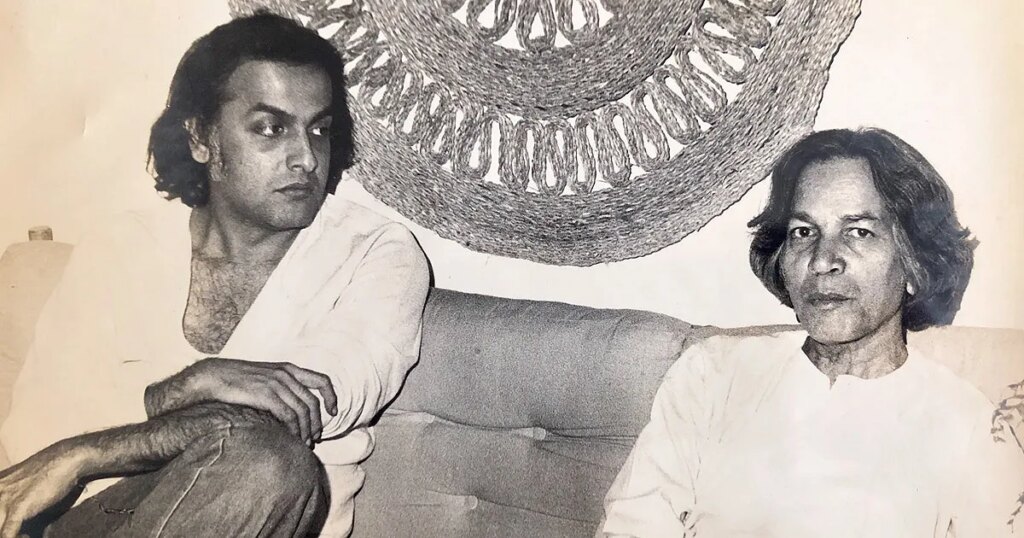

‘The greatest love story of my life was with this man. He cured me of the spiritual question and threw me back into the real world.’

IMAGE: Mahesh Bhatt and U G Krishnamurti. Photograph: Kind courtesy Pooja Bhatt/Instagram
Key Points
- ‘Not understanding UG is not a failure of the film. It may be the film’s final achievement.’
- ‘My relationship with him was different. I did not love him because he gave me enlightenment. I loved him because he drove me out of the marketplace of enlightenment.’
- ‘I cannot make sense of UG for you. Perhaps nobody should.’
The world premiere of the emotional documentary The Natural State, about the radical ‘anti-guru’ U G Krishnamurti was held at the Telluride Film Festival in Colorado on September 7.
The documentary explores the effect U G Krishnamurti had on his followers, and is built from hundreds of hours of previously unseen archival video footage and personal journals kept by Julie Thayer, a wealthy New York mother, who abandoned her family and life in 1989 to follow UG into the Swiss Alps, documenting their intense, often devastating psychological interactions.
It marks the ambitious directorial debut of composer Matt Dougherty and is executive produced by Oscar-winning filmmaker Jane Campion, who knew UG personally and modeled Holly Hunter’s character ‘GJ’ in the series Top of the Lake after him.
Mahesh Bhatt, a longtime friend of UG, who has authored a book on him, tells Subhash K Jha, “He threw me back into life. Into filmmaking. Love. Family. Failure. Desire. Death. The ordinary world. The real world.”

IMAGE: Mahesh Bhatt and U G Krishnamurti. Photograph: Kind courtesy Mahesh Bhatt/Facebook
Bhattsaab, I had the privilege of watching the documentary but came away drained, unable to understand U G Krishnamurti.
Not understanding UG is not a failure of the film. It may be the film’s final achievement. If the audience walks away saying, ‘Now I understand UG,’ the film has probably betrayed him.
What he leaves behind is not an answer but the collapse of our demand for one.
I was especially drained by his brutal treatment of Julie Thayer, the woman who loved him blindly.
What I say about Julie is crucial: His brutality was perhaps the last kindness.
When she came to him with that final offer to give him all her wealth, he said, ‘You can’t buy me’.
That cruelty contained the truth he had been telling her all along: You are not going to get anything here. What she was looking for, he did not have. Nobody has.
He never said, ‘I have something to give you.’
He said, go wherever you want, search wherever you want. You are not going to find it because it does not exist.
It is devastating because it destroys the final transaction — the hope that devotion, proximity, money, sacrifice, years spent beside him might purchase what she had come looking for. Nothing could. Because, according to UG, there was nothing to acquire.
‘After all these years, I still cannot explain him’

IMAGE: Mahesh Bhatt and U G Krishnamurti. Photograph: Kind courtesy Mahesh Bhatt/Facebook
Your relationship with UG was quite stormy. In the documentary, I saw you openly challenging him.
My relationship with him was different. I did not love him because he gave me enlightenment. I loved him because he drove me out of the marketplace of enlightenment.
He threw me back into life. Into filmmaking. Love. Family. Failure. Desire. Death. The ordinary world. The real world.
And still, after all these years, I cannot explain him.
The aftertaste UG leaves behind is the frustration of not being able to make sense of the magic and mystery of life.
He completely rejected and repulsed his devotees’ faith in him?
He tore everything down. But he never said, ‘Replace it with me.’
‘The messiahs have made a mess of this world,’ he said.
‘I cannot make sense of UG for you. Perhaps nobody should’

IMAGE: UG Krishnamurti on his death bed with Mahesh Bhatt. Photograph: Kind courtesy Mahesh Bhatt/Facebook
You were enamoured, then disillusioned by UG?
For me, the greatest love story of my life was with this man. He cured me of the spiritual question and threw me back into the real world.
Do I understand him? No. Do I love him? Yes.
I love him as I have loved nothing else in my life. He is the breath of my breath, and he disturbs me even now.
‘There are no thirst-quenchers,’ he said. ‘The thirst has to burn itself out.’
I cannot make sense of UG for you. Perhaps nobody should. If this film leaves you with that thirst — with the mystery still intact, with no answer to carry home — perhaps it has brought you as close to UG as anyone can come. Not to an answer. To the fire.
You heard Julie’s response to the question of why she loved him?
‘He was fire. He flows through my ‘veins’ like my blood.’
Photographs curated by Satish Bodas/Rediff