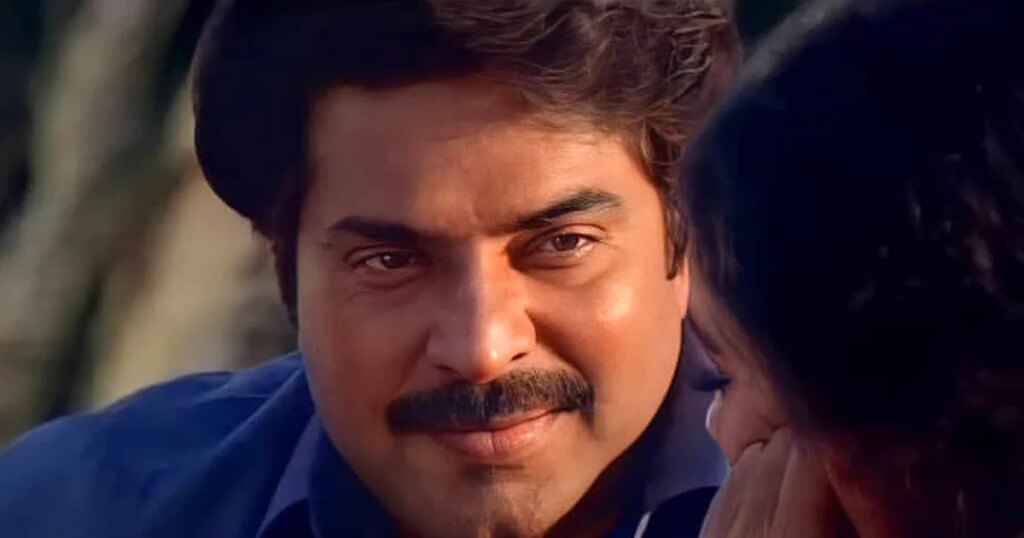

From tender romances to deeply conflicted relationships, these 10 films showcase Mammootty’s softer, more vulnerable side.

IMAGE: Mammootty in Mazhayethum Munpe.
Key Points
- Films like Thrishna (1981) and Kanamarayathu (1984) established Mammootty’s early romantic hero image, often exploring complex relationships and age-gap dynamics.
- Mammootty’s collaborations, such as Avidathepole Ivideyum with Mohanlal, and his chemistry with co-stars like Suhasini Maniratnam in Manivathoorile Aayiram Sivarathrikal, are noted for their impact.
We all know Mammootty as a powerhouse dramatic actor, a mass hero, a formidable action star, and, more recently, someone deeply invested in exploring complex anti-heroes.
But what about his softer side? What happens when he is busy wooing the girl next door?
Mammootty has starred in his fair share of romantic dramas, and some of them rank among his absolute best work, or, at the very least, provide highly entertaining repeat value.
We celebrate the legendary actor’s 75th birthday on September 7 with a special series, starting today.
In this feature, Sreeju Sudhakaran highlights 10 Malayalam films where the amazingly versatile superstar effortlessly charmed us with his romantic side. A fair word of caution: Most of these movies were made in the ’80s and ’90s, meaning certain aspects may not have aged well with time.
Thrishna (1981)

IMAGE: Mammootty and Rajyalakshmi in Thrishna.
Written by the legendary M T Vasudevan Nair and directed by I V Sasi, Thrishna is often considered as the film that gave Mammootty his breakout push as a solo hero.
His character, Das, comes with heavy shades of grey. He is a womaniser who lacks the mettle for a genuine relationship, arriving in Kodaikanal for a staycation with a call girl in tow. However, he falls hard for the beautiful woman in the next bungalow after they bond over a shared love of music. There is just one glitch: She is married, albeit separated from her husband.
Thrishna is best remembered today for its beautiful soundtrack, particularly the timeless songs Mainakam Kadalil Ninnuyarunnuvo and Sruthiyil Ninnuyarum.
Mammootty’s performance deserves huge appreciation for how he injects humanity into a shallow Casanova role, making the sequences between him and Rajyalakshmi incredibly tender.
A bittersweet climax, offering happy reunions for some while leaving others out in the cold, perfectly caps off this drama about a deeply imperfect protagonist.
Kanamarayathu (1984)

IMAGE: Mammootty and Shobana in Kanamarayathu.
Thanks to the recent success of Bethlehem Kudumba Unit, age-gap romances are currently a hot topic of discussion. Well, Mammootty has done his fair share of such films, a few of which made this list.
Directed again by I V Sasi and this time scripted by Padmarajan, Kanamarayathu is an adaptation of the novel Daddy-Long-Legs. Starring Mammootty, Shobana and Rahman, the romantic drama centres on an orphaned girl who develops feelings for her wealthy sponsor.
What starts as deep respect and gratitude eventually blossoms into something much more profound. The catch? She has never actually seen him in person.
Mammootty plays the sponsor, a middle-aged man who realises what his young ward feels for him but hesitates to reveal himself due to their significant age gap and the unequal nature of their equation.
Despite the inherently tricky dynamic, Kanamarayathu handles the central track with remarkable sensitivity, culminating in a sweet, happy ending. The film is also fondly remembered for its peppy dance number, Oru Madhura Kinavin.
Avidathepole Ivideyum (1985)

IMAGE: Mammootty and Kavita Thakur in Avidathepole Ivideyum.
Mammootty and Mohanlal have starred in plenty of movies together, so it is only natural that a few of their collaborations makes it to our specially curated lists.
Directed by K S Sethumadhavan, Avidathepole Ivideyum is a breezy, light-hearted family entertainer exploring friendship, love, marriage, and how aggressively combining all three can create a highly complicated mess.
The future superstars play housemates and close friends who end up falling for each other’s sisters (Shobana and Kavita Thakur). However, their stark class differences and contrasting upbringings spark big problems within their respective marriages, and even in their own friendship.
Fortunately, the movie does not get bogged down in heavy melodrama even when the marital troubles escalate. Things are handled in a consistently feel-good manner, even if the script somewhat glosses over fully confronting the male protagonists for their misogynistic tendencies.
Ultimately, the sheer joy of watching Mammootty and Mohanlal’s crackling bromance easily towers over their respective romantic tracks.
Yathra (1985)

IMAGE: Shobana and Mammootty in Yathra.
Written and directed by Balu Mahendra (marking his final film in Malayalam cinema), Yathra, an adaptation of the Japanese film The Yellow Handkerchief, is a heartbreaking tale of a man wrongfully imprisoned for years, completely cut off from the woman he loves.
The first half unfolds as a sweet, sweeping romance about a newly transferred forest officer who falls deeply for a local village belle. The second half plunges into a much darker prison drama, yet his desperate yearning for his lover provides Yathra with its beating emotional heart.
The final scene, where he tentatively returns to the village, unsure if she is still waiting, only to be greeted by hundreds of lit lamps and her standing exactly at their favourite meeting spot, remains one of Malayalam cinema’s most overwhelmingly joyous and iconic reunions. Grab those tissues when you can!
Manivathoorile Aayiram Sivarathrikal (1987)

IMAGE: Mammootty and Suhasini Maniratnam in Manivathoorile Aayiram Sivarathrikal.
Drop Mammootty’s character in a misty hill station like Ooty or Kodaikanal, and there is a very high chance you are in for a bittersweet romantic drama.
While he shares solid chemistry with most of his female co-stars, the magic Mammootty and Suhasini Maniratnam create on screen is on another level. A perfect example is Fazil’s beautiful Manivathoorile Aayiram Sivarathrikal.
It follows a deeply in-love couple who marry against her family’s wishes; despite actually liking the guy, her relatives fiercely object to their religious differences. It is a tenderly told relationship drama that gently reflects the lovely highs, the conflicting lows, and the ultimately tragic outcome of their love story.
Manivathoorile Aayiram Sivarathrikal is elevated by the crackling chemistry between Mammootty and Suhasini, along with a hauntingly lovely soundtrack by the late M B Sreenivasan.
Mathilukal (1990)

IMAGE: Mammootty in Mathilukal.
Mammootty won his first National Award for Best Actor for his phenomenal work in two distinct films: Oru Vadakkan Veeragatha and Mathilukal. Both served as a true showcase for the actor’s sheer versatility within that one year.
Written and directed by Adoor Gopalakrishnan, a pioneer of Malayalam parallel cinema, Mathilukal is a slow-moving, atmospheric prison drama rooted in biographical history.
It narrates the time legendary author Vaikom Muhammad Basheer was imprisoned for sedition, focusing on the tender romance he strikes up with an unseen female inmate over a towering prison wall.
Their sensitive love story progresses entirely through spoken conversations across the cemented barrier, occasionally veering into highly intimate, sexual territory.
Mammootty is nothing short of excellent as Basheer, while KPAC Lalitha, despite never once appearing on screen, lends magnificent voice work as the unseen female prisoner. The film marches towards a poignant climax that brilliantly subverts how a character ultimately views his own freedom.
Mazhayethum Munpe (1995)

IMAGE: Mammootty and Shobana in Mazhayethum Munpe.
Directed by Kamal from a screenplay by Sreenivasan, who also plays a crucial supporting role, Mazhayethum Munpe is a love triangle involving Mammootty, Shobana, and Annie’s characters.
Mammootty plays a college professor deeply in love with his partially paralysed fiancée (Shobana), while constantly fending off the aggressive advances of a deeply infatuated student (Annie).
After a relatively light-hearted first half, the narrative shifts into heavy dramatic territory when the student resorts to twisted manipulation to marry the professor, a choice that eventually destroys their marriage from the inside out.
The performances are universally strong, though Annie shines brightest in a grey-shaded role that retains just enough vulnerability to keep her character from becoming entirely unlikable.
Mazhayethum Munpe also boasts a timeless, melodious soundtrack composed by Raveendran, featuring absolute gems like Enthinu Veroru Sooryodayam, Aathmavin Pusthaka, and Chicha Chicha.
Azhakiya Ravanan (1996)

IMAGE: Mammootty in Azhakiya Ravanan.
Let’s address the elephant in the room first: I am not a fan of Sreenivasan’s screenplay placing so much dramatic weight on a woman’s virginity purely to force a third-act conflict.
If you can push past that, this romantic dramedy serves as a highly fascinating spin on the Ramayana. Here, Ravana, as the title suggests, is actually the protagonist Shankar Das, an arrogant, wealthy man who returns to a village simply to show off his success, driven by a hidden history with the place.
Mammootty is exceptionally good as the rich man with a massively inflated ego. His desperate attempts to flaunt his wealth are hilariously embarrassing, but the narrative takes a much dramatic turn when he manipulates a delicate situation just to marry his childhood crush.
The memorable comedic set pieces and the genuinely surprising turns in the final act make this a highly likeable entertainer for family audiences. We also cannot ignore Vidyasagar’s spectacular soundtrack, featuring absolute classics like Vennila Chandana Kinnam and Pranayamanithooval.
Udhyanapalakan (1996)

IMAGE: Mammootty and Kaveri in Udhyanapalakan.
Harikumar’s Udhyanapalakan released the exact same year as Azhakiya Ravanan, and sadly, both had underperformed at the box office. While Azhakiya Ravanan eventually found cult love through endless television reruns, Udyanapalakan still feels like an underappreciated gem in Mammootty’s filmography.
It is a genuinely moving watch, an unconventional age-gap drama about a middle-aged, unmarried, former army man carrying a permanent limp as a physical reminder of his past, he proudly and obsessively tends to the garden surrounding his house. He slowly develops a bond with a mischievous young girl staying with her grandparents.
What begins with her playfully stealing his flowers evolves into a soft affection born out of deep sympathy for his crushing loneliness. The friendship deepens into something far more profound, but their relationship is harshly rejected by the highly judgemental society around them.
Udyanapalakan might be far from perfect, but there is a profound warmth in the great Lohithadas’ script. It asks you to feel for a protagonist desperately trying to grasp a fleeting chance at the companionship he has yearned for his entire life.
Both Mammootty and Kaveri deliver superb performances that make this unconventional pairing work, backed by excellent supporting work from Oduvil Unnikrishnan, Nedumudi Venu, Kalabhavan Mani, and Biju Menon.
Ore Kadal (2007)

IMAGE: Mammootty and Meera Jasmine in Ore Kadal.
Shyamaprasad’s highly acclaimed drama is based on Sunil Gangopadhyay’s Bengali novel Hirak Deepti. It explores a unconventional, deeply messy relationship that develops between a married woman and her cynical, self-absorbed, alcoholic neighbour.
The highlight of the film is the raw portrayal of its two central characters. Mammootty’s Nathan is an intellectual who wields his intelligence to project an air of superiority. He firmly believes that feelings are entirely superfluous, treating relationships as purely transactional, surface-level encounters.
He thrives on anarchy in his own life, a chaos that disturbingly spills over when he initiates what he assumes is a casual sexual relationship with Deepthi. She, however, desperately tries to find an intimate meaning in their forbidden affair, something she fundamentally lacks in her own marriage.
Ore Kadal remains one of Mammootty’s boldest, most boundary-pushing roles to date. He is phenomenal here, matched beat for emotional beat by his younger co-star, Meera Jasmine.
Narain, playing her oblivious and slightly opportunistic husband, is also superb. Ore Kadal is absolutely not an easy watch, but it remains essential viewing for anyone craving a mature, highly conflicted relationship drama.
Photographs curated by Satish Bodas/Rediff


