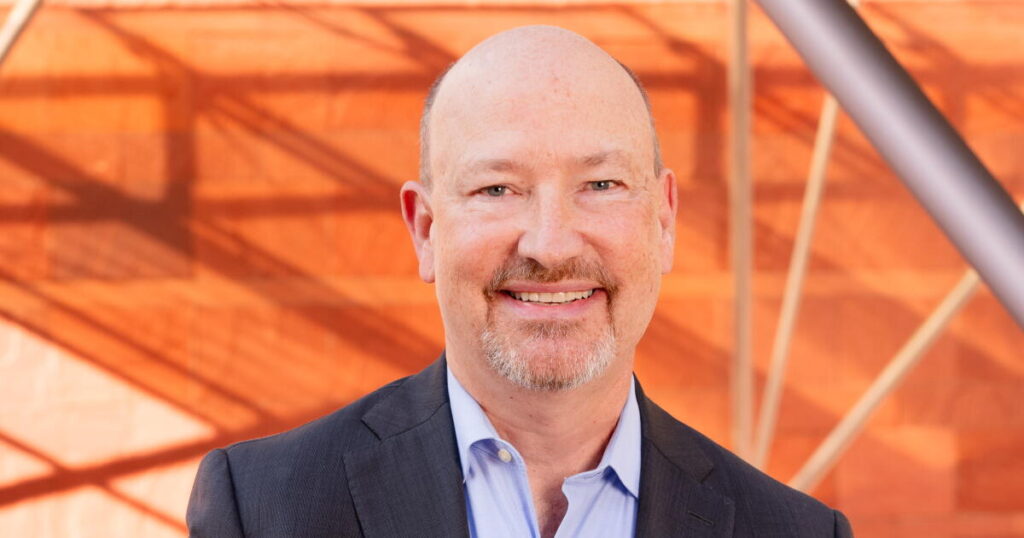

After almost two decades of high leadership turnover and a more than year-long search, the Museum of Contemporary Art has appointed Jonathan Abbott as its new director and chief executive. Abbott replaces interim director Ann Goldstein, who stepped in last July when Johanna Burton left somewhat unexpectedly for the Institute of Contemporary Art at the University of Pennsylvania.
Abbott, who begins work immediately, joins the museum as its sixth director since 2008. He formerly served for 15 years as president and chief executive of the PBS-affiliated public broadcasting station GBH in Boston.
“I’m spent my whole career around creatives,” Abbott told The Times. “I’m fundamentally a builder, and it’s fulfilling to me to work in an environment with a vital, vigorous mission, and where people on the staff and on the board and the community can align around making exciting things happen.”
MOCA, which is about two years away from celebrating its 50th anniversary, has been plagued by controversy and turmoil — despite staging many notable exhibitions including last year’s “Monuments,” considered by many critics at the time to be the most significant American art museum show.

Laura Gardin Fraser’s “Lee-Jackson Monument” at the “Monuments” exhibition at MOCA.
(Carlin Stiehl / Los Angeles Times)
The latest spate of upheaval began in 2018 when the museum hired Klaus Biesenbach. Biesenbach, who vowed stability, was MOCA’s sixth director in its nearly 40-year history. He was brought on board about eight months after MOCA’s previous director Philippe Vergne fired the museum’s chief curator Helen Molesworth, only to leave a few months later. That same year, MOCA canceled its annual gala amid controversy over a lack of diversity among former gala honorees — all straight white men.
The COVID-19 pandemic exacerbated an already difficult situation, when, after making general admission free at the beginning of the year, the museum was forced to lay off 97 part-time employees, while 69 full-time staffers took full or partial furloughs or salary reductions.
Biesenbach left MOCA in 2021 to become director of the Neue Nationalgalerie and future Museum of the 20th Century in Berlin. His unexpected departure came mere days after MOCA announced Biesenbach would share leadership responsibilities with Burton, who was subsequently and unceremoniously named the museum’s new leader — its first female director.
With a collection of more than 8,000 objects and a history of staging some of the city’s most memorable shows and highlighting some of the world’s most influential contemporary artists, MOCA is an institution that culture-watchers in the city have long rooted for.
“I have been so saddened, like many have, that MOCA has had a very tough run,” said philanthropist and art collector Jarl Mohn, who, as the former president and chief executive of NPR, has known Abbott for years. “Not necessarily from a programming standpoint … but from a management standpoint, with turnover and turmoil. I think everybody universally in the city wants MOCA to do well.”
Mohn said he unreservedly recommended Abbott to MOCA’s search committee.
“He has such a steady hand,” Mohn said of Abbott. “He is going to calm the waters and help right the ship in terms of stability.”
With his long history in public television, Abbott might not seem an obvious choice to lead one of L.A.’s major art museums, but Mohn noted that his track record of fundraising and innovation is precisely what is needed by MOCA at the moment.
During his tenure at GBH, Abbott was instrumental in helping launch the PBS on-demand platform PBS Passport, and oversaw nearly 800 employees. He also spearheaded a $215-million fundraising campaign, and helped grow GBH’s assets from around $225 million to $1 billion.
Two of L.A.’s most effective museum leaders, Los Angeles County Museum of Art’s Michael Govan and the Hammer Museum’s recently departed director Ann Philbin, are well-known for their fundraising prowess that helped transform their respective institutions over a period of many years. Mohn believes that Abbott fits this same mold.
It’s one thing to hire a great artistic leader who knows how to curate shows and put together great projects, Mohn said, adding that part is “necessary, but not sufficient.”
“The institution needs someone to work with the board and with the management team to think through, ‘What is the place of MOCA today and for the next 20 years?’ A strategic thinker, someone that can also work with the management team and mentor them and bring them along,” Mohn said. “John is a guy that I know can lead that process.”
Abbott moved to L.A. four years ago with his wife after his daughters left for college. He said he is a city lover and noted that L.A. is “the most exciting city in the country, and that’s reflected in food, in culture, in style and expression. We just love being here.”
He is also an art lover and spent quite a bit of time getting acquainted with the city’s thriving arts ecosystem. When he learned of Burton’s departure, he decided to throw his hat in the ring. Putting MOCA back on steady footing was not only a challenge he was up for, but one he felt committed to for the love of it.
“Being in creative industries, and around creative and artistic people has been a great joy for me,” Abbott said. “It’s never felt like work. I just love helping realize the potential of these social enterprise organizations.”
His goal is to broaden the museum’s reach, not just show by show, but by connecting it to a larger community of civic leaders and arts organizations.
“When the MOCA opportunity came available with 8,000 pieces in this extraordinary, groundbreaking collection, and a whole set of questions about how are we going to invite new audiences to be excited about these artists and what they’re communicating, it felt very much like things I’d tackled before within public media,” Abbott said.