
‘Ashaji has not left the human heart. That is her true mehfil. That is where she resides — unfading, unending.’

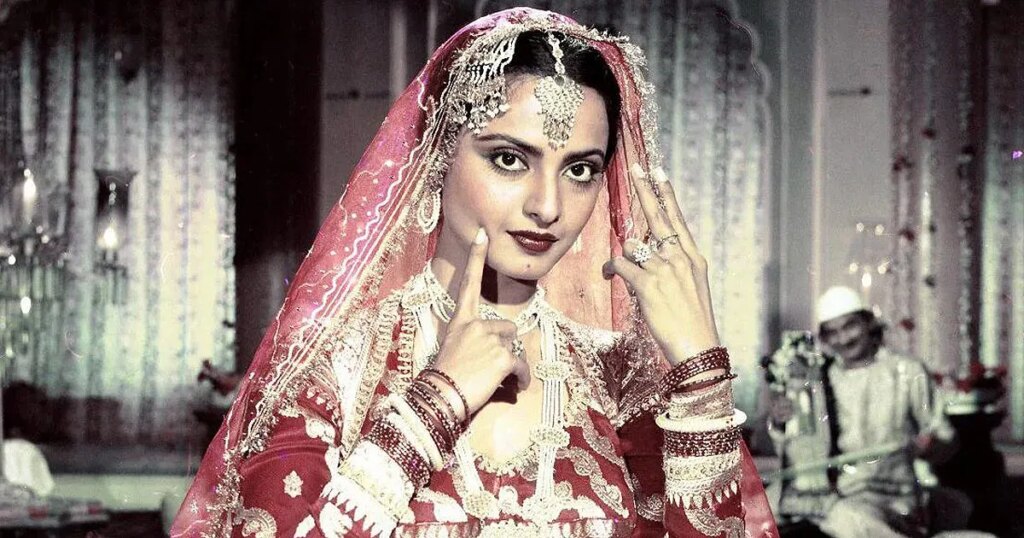
IMAGE: Rekha in and as Umrao Jaan.
Key Points
- ‘She was a presence — one that entered a moment and made it eternal.’
- ‘Voices fade, but hers has only withdrawn into a deeper chamber of memory, where it will continue to resonate for those who have known longing through song.’
- ‘Each time she sang, something unseen was summoned — an alchemy of sur and soul that refused to belong to time.’
Asha Bhosle’s voice has lived far beyond time, generations and changing musical trends.
On what would have been her 93rd birthday on September 8, filmmaker Muzaffar Ali remembers the legendary singer, whose unforgettable collaboration with him on Umrao Jaan gave the film its most enduring musical moments.
“She did not sing the character; she yielded to it. Such truth is rare in the architecture of commercial Hindi cinema,” Muzaffar Ali Ali tells Subhash K Jha.
‘Asha Bhosle gave Lucknow a permanence that cinema had long denied’

IMAGE: Farooque Shaikh, Rita Rani Kaul and Rekha in Umrao Jaan.
Ashaji would have been 93.
93, 90, 80, 60… all these are mere numbers. Ashaji‘s voice is timeless.
Asha Bhosle was never just a voice; she was a presence — one that entered a moment and made it eternal.
Voices fade, but hers has only withdrawn into a deeper chamber of memory, where it will continue to resonate for those who have known longing through song.
How would you describe her voice?
Each time she sang, something unseen was summoned — an alchemy of sur and soul that refused to belong to time.
When I approached her for Umrao Jaan, with Khayyam shaping the music and Shahryar giving it language, to inhabit the world of Rekha, she sensed immediately that this was not a recording — it was a reckoning.
She understood that she would have to travel beyond craft. That she would have to become the voice of a civilisation that once lived in tehzeeb, in restraint, in unspoken ache. She gave Lucknow a permanence that cinema had long denied it. In an industry often without place, she created one.
She seemed to inhabit the world you created in Umrao Jaan?
To bring her into Awadh was not direction — it was invocation. The only distant echo was Begum Akhtar. Yet even that was not imitation, but inheritance. Both carried that rare, unnameable gift — the ability to dissolve and become. She knew this without being told.
What lay before us was a shared challenge, though its solitude rested with me. And she met it with something that cannot be rehearsed — surrender.
She did not sing the character; she yielded to it. Such truth is rare in the architecture of commercial Hindi cinema. It is rarer still to be recognised, as it was, at the National Film Awards.
‘It had to be music that gets into the listener’ bloodstream’

IMAGE: The incomparable Asha Bhosle. Photograph: Kind courtesy Asha Bhosle/Instagram
Originally, Umrao Jaan was to be voiced by Lataji and composed by Jaidev?
It would have been too close to Pakeezah then. What Lataji did in Pakeezah couldn’t be replicated. Why even go there? It was going to be Ashaji for Umrao Jaan.
The music by Jaidev Saab added immensely to my film Gaman. I am a poetry-driven artiste. I looked at the whole film as a poem.
In fact Faiz Ahmed Faiz said that Gaman was a poem in visual form.
I was trying to use two kinds of poetry, one was the poetry of tradition as represented by the thumris and ragas like Bhairavi.
The other is the poetry of the city as penned by Shahrayar which have an insinuated connectivity with the village.
Jaidev was the original choice for Umrao Jaan. He had done some songs for Umrao Jaan, but he wanted to use the voice of his protégée Madhurani.
Also, I thought I had got the best out of Jaidev in Gaman. I was fascinated by Jaidev’s music from the time I heard his composition Abhi Na Jao Chhod Ke in Hum Dono.
He could create a haunting quality I needed in the songs. It took me about a year to work on the music.
It had to be music that gets into the listener’ bloodstream. For that you have to think deeply and think hard and not be in a hurry to get the tunes.
‘Ashaji has not left the human heart’

IMAGE: Dimple Kapadia and Vinod Khanna in Muzaffar Ali’s Zooni.
After Umrao Jaan, Ashaji did Zooni with you.
Yes after that, in Zooni, where she gave voice to five songs, I found myself unable to imagine another.
With Shehryaar and Khayyam, a certain language had been found — fragile, exact, complete.
In Daaman, she returned once more to that language, recording five songs that remain unheard, like unopened letters addressed to time itself.
Ashaji may no longer step into the light of the silver screen. But she has not left the human heart. That is her true mehfil. That is where she resides — unfading, unending.
In the end, some voices do not fall silent. They simply choose to be heard from within.
Photographs curated by Satish Bodas/Rediff