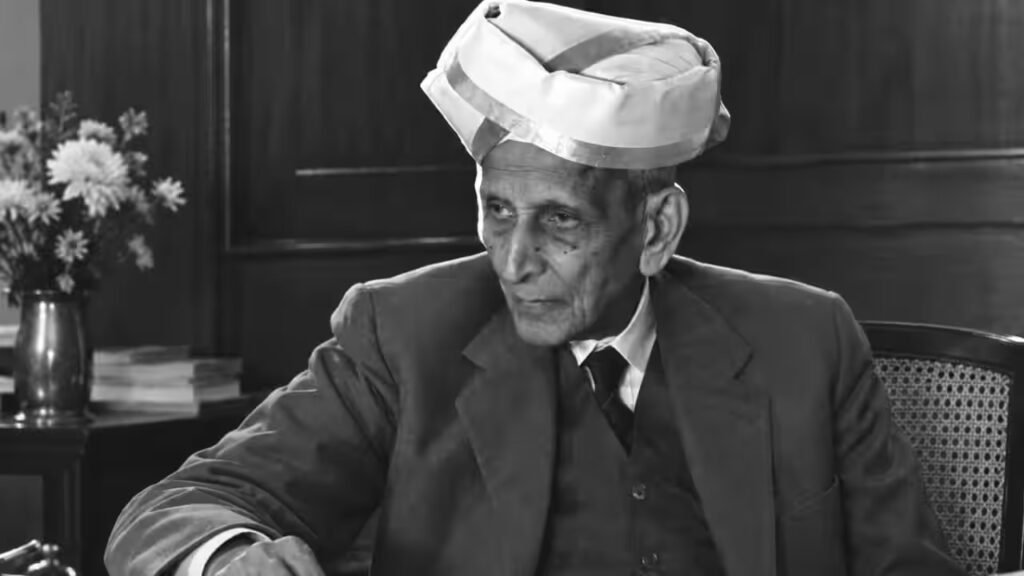


Every 15 September, India pauses to honour its engineers, and it is no accident that the date falls where it does. It is the birthday of Sir Mokshagundam Visvesvaraya, born on this day in 1861, and the country decided long ago that no better day existed to celebrate the profession than the birth of the man who came to embody it. To understand why a single engineer earned an entire national day, you have to look at what he actually built.
Also Read: Who Is Sidharth Babu, The IFS Officer Spotted Beside Modi, Putin and Xi At BRICS
The Boy From Muddenahalli
Visvesvaraya was born into a modest Telugu-speaking family in the village of Muddenahalli, in what is now Karnataka, and lost his father while still young. Money was scarce, and he is said to have funded his own studies by tutoring other children. He took a degree from Madras and then trained in civil engineering at the College of Science in Pune, before joining the Public Works Department of Bombay in 1884. It was an ordinary start for a decidedly extraordinary career.
The Gates That Made His Name
His first great contribution was an idea about water. He designed and patented a system of automatic weir floodgates, first installed in 1903 at the Khadakwasla reservoir near Pune, which allowed a dam to store water at a far higher level without risking damage during floods. The design worked so well that it was adopted at other dams, including the vast Krishna Raja Sagara reservoir on the Kaveri, one of the largest in Asia when it was completed, and a project for which he served as chief engineer.

The City He Saved
It was Hyderabad, though, that turned him into a household name. The city had long been ravaged by the flooding of the Musi River, and Visvesvaraya devised the flood-protection system that tamed it, combining reservoirs and drainage to shield the population. It was engineering in its truest, most humane form, the quiet, unglamorous work of keeping ordinary people safe from disaster, and it sealed his reputation across the country.
Also Read: Who Is Mahant Swami Maharaj, The Spiritual Leader Of BAPS Amid The Eiffel Tower Controversy
The Engineer Who Governed
His gifts were not confined to dams. Appointed Diwan of Mysore in 1912, he governed the state for six years and reshaped it, founding the University of Mysore and the Bank of Mysore and laying the ground for its industrial future, which earned him the title Father of Modern Mysore. King George V knighted him, and in 1955 India awarded him its highest civilian honour, the Bharat Ratna. He worked and thought with the same discipline until his death in 1962, at the remarkable age of a hundred.

Why The Day Endures
There is a reason his birthday, and not some grand engineering monument, became the marker for the profession. Visvesvaraya stood for something larger than any single dam, the belief that engineering is at heart an act of service, a way of turning knowledge into clean water, safe cities and better lives. When India celebrates its engineers each 15 September, it is really celebrating that idea, and the barefoot village boy who spent a hundred years proving it true.