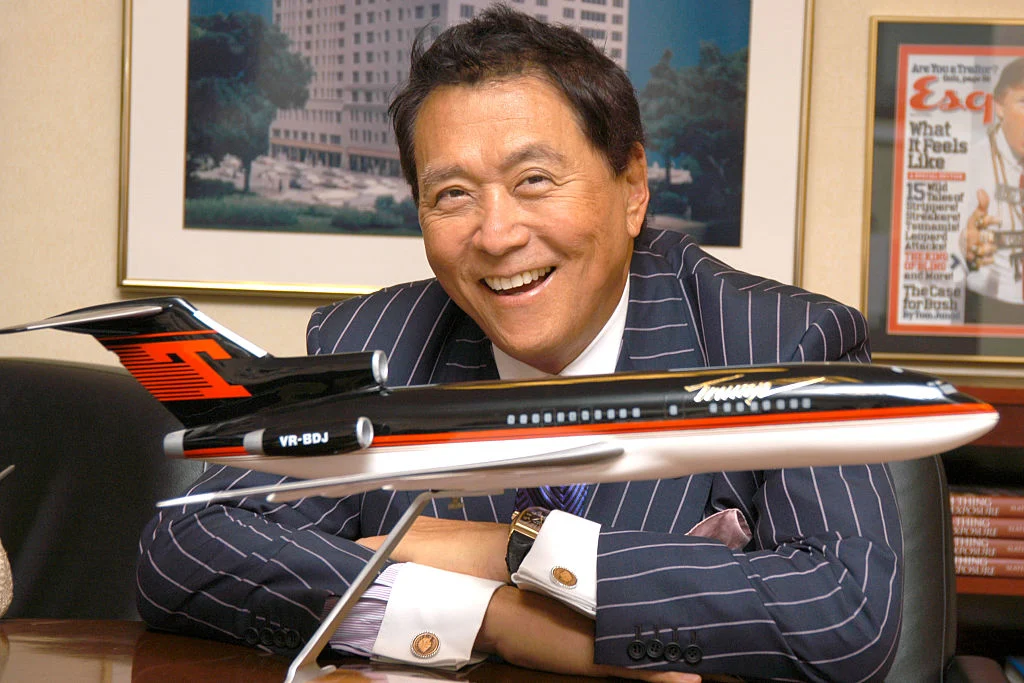

If you’ve been anywhere near financial news or social media over the last few days, you may have seen a rather astonishing headline: Robert Kiyosaki, the author of “Rich Dad Poor Dad,” is supposedly $1.2 billion in debt. The irony is irresistible. One of the most famous personal-finance authors of the last 30 years, a man who built an empire teaching people how to accumulate wealth, is apparently buried under more than a billion dollars of liabilities.
It’s almost too good to be true. Because it is not at all true.
This month, Vanity Fair published a profile that examined Kiyosaki’s finances. The article is titled:
“Poor Dad Author Goes Bust: How Robert Kiyosaki Went Into Debt, to the Tune of $1.2 Billion”
Given that headline, I could understand why you might walk away thinking Robert is in debt to the tune of $1.2 billion. Because that’s what the headline literally says.
But then, much later in the article, Robert’s ex-wife and longtime business partner, Kim Kiyosaki, clarifies that the number is “widely misunderstood” and that Robert “doesn’t personally owe that amount.” Instead, the $1.2 billion represents debt held by a group of real estate investors who collectively own around 1,500 apartment units. Kim says Robert’s personal share of that debt is relatively small. Vanity Fair then extrapolates that his portion could potentially be somewhere in the range of $30 million to $60 million. And, crucially, the debt is “attached to real assets.“
What are we even doing here, Vanity Fair? This is like me buying one share of Google and announcing, “I used this simple trick to acquire a $4 trillion company.“

(Photo by Matt Carasella/Patrick McMullan via Getty Images)
Why Kiyosaki Loves Debt
Kiyosaki has long argued that there is an important distinction between “good debt” and “bad debt.” In his view, borrowing money to acquire cash-producing assets such as apartment buildings can make an investor wealthier, provided those assets generate enough income to cover the debt and other expenses.
In a 2025 interview, Kiyosaki summarized the philosophy bluntly: “Debt is money.” Unlike financial personalities who urge people to eliminate debt as quickly as possible, Kiyosaki argues that investors should learn how to use borrowed money to acquire assets they otherwise could not afford.
Vanity Fair described how that philosophy works in practice. When one of Kiyosaki’s properties appreciates, he may borrow additional money against the increased equity rather than selling the property and triggering a taxable gain. He also says individual investments are generally held inside separate LLCs, creating financial firewalls between different properties and ventures.
That strategy can obviously become dangerous if property values fall, borrowing costs spike or rental income dries up. But the mere existence of tens of millions of dollars in debt does not mean Kiyosaki is broke. It means he operates the way many aggressive real-estate investors do: with substantial leverage.
So What’s Robert Kiyosaki Worth?
CelebrityNetWorth currently estimates Robert Kiyosaki’s net worth at $100 million, and nothing in the Vanity Fair reporting gives us a reason to dramatically change that estimate.
“Rich Dad Poor Dad,” first published in 1997, has sold more than 44 million copies and has been translated into at least 43 languages. Kiyosaki used that success to build the Rich Dad brand into a much larger financial-education business encompassing additional books, seminars, courses, speaking engagements, games, licensing, podcasts and online content.
Kiyosaki told Vanity Fair that his businesses and investments currently generate roughly $250,000 per month, or about $3 million per year. He also owns an Arizona home that he reportedly purchased for $4.5 million, and he has interests in a substantial portfolio of apartment buildings and other investments.
The biggest unknown is the amount of equity he actually owns in those real-estate partnerships. If Kiyosaki and his partners have $1.2 billion of debt secured by properties worth considerably more than $1.2 billion, there could be hundreds of millions of dollars of equity spread among the investors. Without knowing the portfolio’s total value or Kiyosaki’s ownership percentages, there is no way to calculate his share precisely.
What we can say is much simpler: Robert Kiyosaki does not personally owe $1.2 billion. He is one investor in a group that owns roughly 1,500 apartment units financed with approximately $1.2 billion of debt.
That’s a much less sensational story than “Rich Dad Poor Dad Author Goes Bust.” It’s also a much more accurate one.