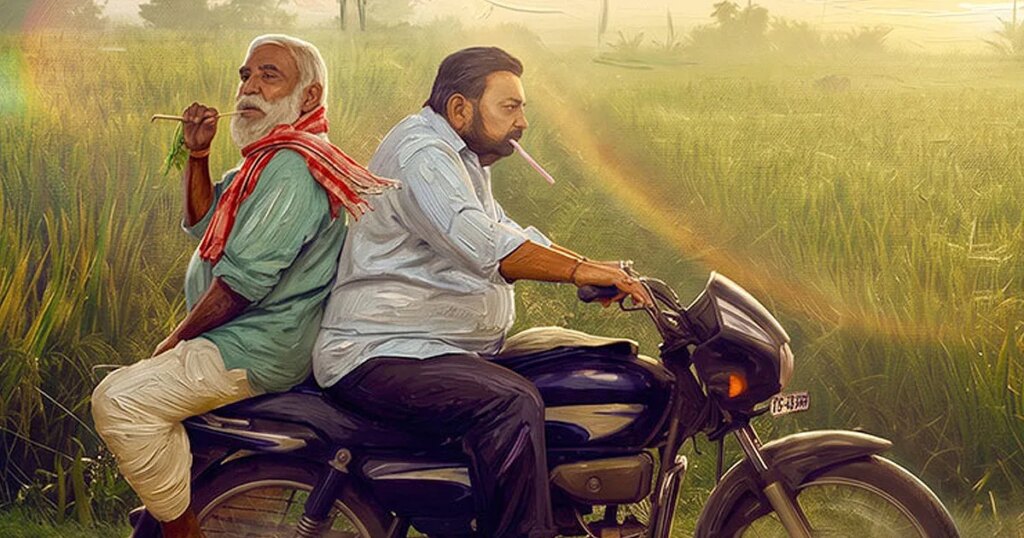

‘I was thinking how can I do something for these lonely, aging people in the villages. The parents stay and the children leave for a better future.’

IMAGE: A scene from Pallaburusu.
Key Points
- Uday Chauhan’s mainstream debut Pallaburusu addresses the poignant issue of parental neglect, particularly in rural settings.
- He found casting challenging for the specific age group required but ultimately selected Sudhakar Reddy and Muralidhar Gaud for their authentic portrayal.
- Chauhan aims to create ‘feel-good’ and ‘sweet’ films, offering a refreshing departure from typical Telugu cinema’s focus on spectacle and mythology.
Uday Chauhan has gained widespread attention and critical acclaim for directing the slice-of-life Telugu drama film Pallaburusu, which released in theatres on August 14.
Before making his mainstream debut, he honed his storytelling skills through photography and worked as an assistant director and executive producer.
Chauhan previously helmed the film Season of Innocence (2022), which travelled to various film festivals.
“I have grown up on spectacle and mythology kind of films. That has its own kind of audience,” Chauhan tells Subhash K Jha. “I respect that but feel there should also be some feel-good, sweet films.”
Palaburusu is a very assured debut. Did you always want to direct films?
I told my mom that I want to become a film director in 2011.
I joined mass communications in Hyderabad, affiliated to Osmania. After that, I acquired a camera and started practicing photography. I was learning lighting then.
Slowly, my interest got developed more into writing, so I started writing.
I always wanted to be in the arts. I used to participate in theatre in school and also give stage performances as a dancer. I wanted to make films as cinema affects people largely.
‘The parents stay and the children leave for a better future’

IMAGE: Naga Chaitanya with Uday Chauhan. Photograph: Kind courtesy Uday Chauhan/Instagram
Your film addresses the perennial problem of parental neglect. How much of it is inspired by your life and experiences?
I was not ignored as a child; my parents were always there with me.
They made sure I chose the right things. I have seen parents who are neglected in villages. An image that has stuck with me is once, when I was going back to home, I saw an old man, around 70, who sat in a graveyard, crying. I discovered that his wife had died a few days ago, and he was sobbing so much.
That image stayed with me for a long time.
That image made me start think about it subconsciously. I was thinking how can I do something for these lonely, aging people in the villages. The parents stay and the children leave for a better future.
‘There should be some feel-good, sweet films’
Was it hard to find your cast?
When I write, I don’t think about who should I cast. Eventually, it was difficult for me to find actors in the Telugu industry, who are in this age group. So, it was challenging for me but somehow when I was jotting down the options, I felt these two actors — Sudhakar Reddy and Muralidhar Gaud — were just right. They knew the language of Telangana and what we wanted to do.
Once I felt this was the combination, there was no looking back. I thought these two people were the best for the film and they delivered the best. We did 12 days of workshop.
Your film is a refreshing departure from Telugu cinema’s obsession with spectacle and mythology.
I have grown up on all those kinds of films. That has its own kind of audience. I respect that but feel there should also be some feel-good, sweet films.
‘Before the digital era, people were more peaceful, more empathic’
Do you think the urban India is losing his connection with its family roots?
As a millennial, I have grown up in the village. I preserve those memories from before the digital era.
Before the digital era, people were more peaceful, more empathic. The generation is losing its family roots but maybe our Indian festivals are there to make them get together.
Was it difficult for you to put together the project?
When I wrote it, I saw it as a challenge as to how to approach production houses because this film doesn’t have commercial elements. I was sceptical as to how I should find the right producer. The journey improved as when I started pitching it to Annapurna Studios. So, patience was the key for me.
Your next project?
I don’t know. That would be something that triggers me. There are a couple of concepts that I have and I’m going to seem very different again, my voice is going to be very different, the topics that I’m going to choose are going to be very different.
Photographs curated by Manisha Kotian/Rediff