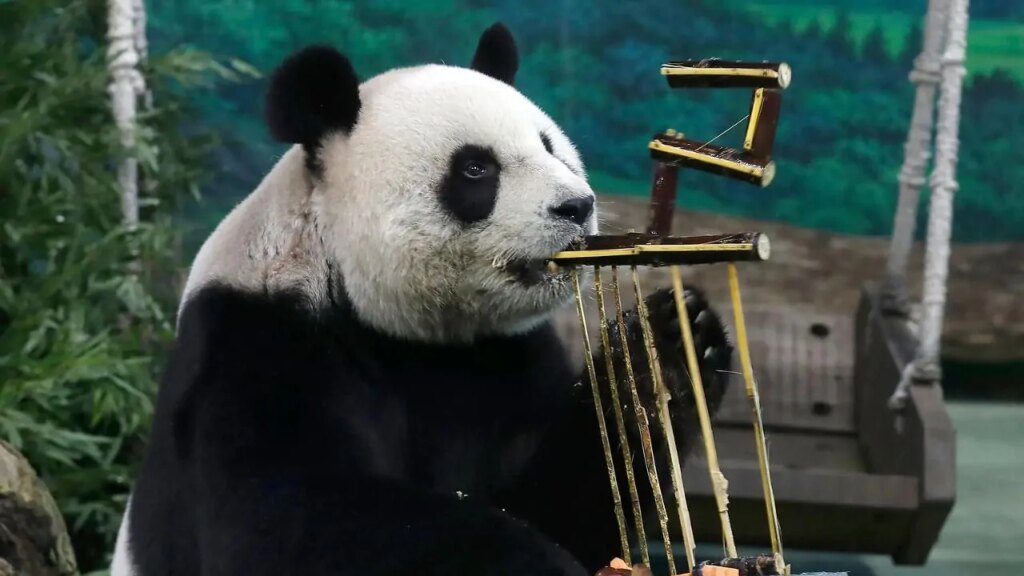


Two giant pandas on loan from China have arrived at Zoo Atlanta, marking the return of the animals to the US zoo after a year-long absence. The male panda, Ping Ping, and female Fu Shuang arrived on a FedEx flight from Chengdu in south-western China on Sunday.
They are the third pair of giant pandas to arrive at a US zoo in the past two years, at a time when the animals have become increasingly rare in American zoos.
Zoo Atlanta president and chief executive Raymond B King said: “We are elated to welcome Ping Ping and Fu Shuang and could not be more excited about sharing that joy with our Members, guests, city, and community in the coming weeks.”
The pandas will remain in a biosecure area of the zoo’s new giant panda complex for about a month as part of a routine quarantine period before visitors can see them.
Pandas Arrive After 16-Hour Journey
The pandas left Chengdu at 02:55 local time on Sunday, China’s state news agency Xinhua reported. At Hartsfield-Jackson Atlanta International Airport, two large crates carrying the animals were unloaded from the aircraft and placed on FedEx trucks.
🐼 Ping Ping and Fu Shuang are on their way from China to Atlanta
The two giant pandas departed Chengdu for the United States, where they are set to spend the next 10 years at Zoo Atlanta.
Ping Ping and Fu Shuang, both born in 2020, left the Chengdu Research Base of Giant Panda… https://t.co/SS2NZfqzEn pic.twitter.com/ZfJXL2qnil— NEXTA (@nexta_tv) September 27, 2026
The vehicles travelled the 10-mile journey to Zoo Atlanta under a police escort.
At the zoo, the crates were lifted from the trucks by forklift and taken inside the new panda complex. China has also sent veterinarians and breeders to Atlanta to remain with the pandas during their quarantine, according to Xinhua.
Zoo Atlanta said its staff had worked with their Chinese counterparts on improvements to the pandas’ facilities.
“What Zoo Atlanta has been working hard for the past year is making improvements to our enclosures, where our enclosures are a lot bigger,” said Sam Rivera, the zoo’s vice-president of animal health. “We’re ensuring that we have plenty of bamboo for them to eat. We have experienced keepers that are trained on taking care of giant pandas.”
Return After 2024 Panda Departure
The arrival comes after Zoo Atlanta returned four pandas to China in 2024, ending a 25-year agreement between the zoo and the Chinese government. The new pair are also arriving shortly after Chinese President Xi Jinping’s state visit to Washington, where he met US President Donald Trump.

During the visit, the two countries extended a trade truce and agreed to establish an AI hotline, amid efforts to ease tensions between Washington and Beijing.
China’s decision to loan the pandas to Atlanta is part of its long-running practice of what is commonly known as “panda diplomacy”.
The tradition dates back more than half a century. In 1972, Chairman Mao Zedong sent pandas to the US shortly after then-President Richard Nixon became the first US president to visit China after the Communist Party came to power in 1949.
“The giant panda has been an envoy of friendship between the Chinese and Americans,” Xi said on Thursday, referring to the decades in which pandas have lived in US zoos on loan from China.
Meet Ping Ping and Fu Shuang
Ping Ping was born on 17 March 2020. His name means “peace”, the same name given to the first panda Mao sent to the Soviet Union in 1957.
According to China’s National Forestry and Grassland Administration, Ping Ping is particularly good at climbing trees.
Fu Shuang, whose name means “double blessings”, was born on 18 October 2020, seven months after Ping Ping.
She has a small tuft of fur on the top of her head and a slightly protruding forehead. The administration says she is particularly good at finding food.
Giant pandas once lived across large parts of China, as well as areas of northern Myanmar and Vietnam. Their natural habitat has since shrunk considerably because of human activity and climate change.
Today, wild pandas are found in six mountain ranges above the Sichuan Basin in south-western China. Chengdu, the capital of Sichuan province, is home to the Chengdu Research Base of Giant Panda Breeding, which houses more than 240 pandas – around a third of the world’s captive panda population.