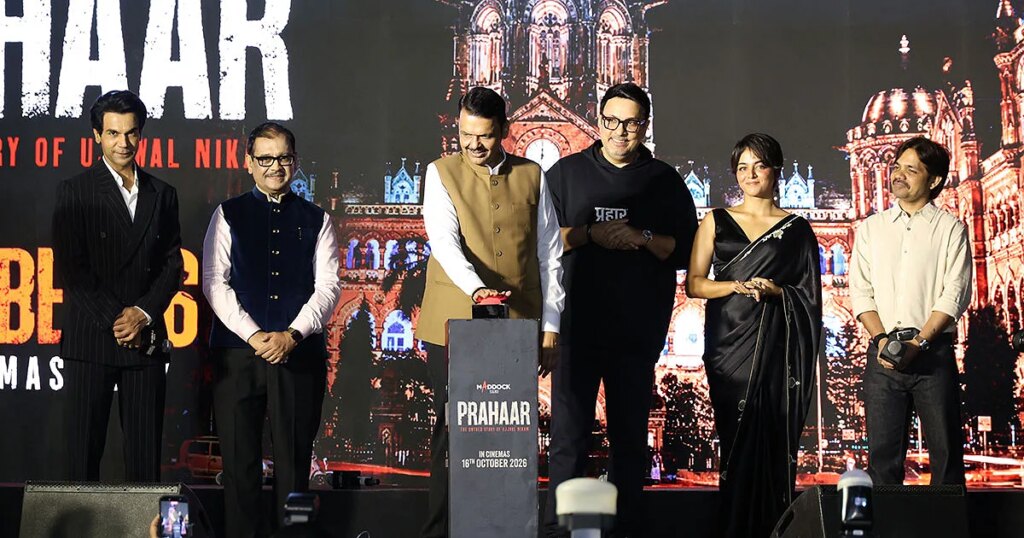

The moment it became clear that Maharashtra Chief Minister Devendra Fadnavis would launch the trailer of the Hindi film Prahaar: The Untold Story of Ujjwal Nikam it became obvious that the spectacle was more political than cinematic.

IMAGE: Maharashtra Chief Minister Devendra Fadnavis presses a buzzer to launch the trailer of Prahaar: The Untold Story Of Ujjwal Nikam as actors Rajkummar Rao, Wamiqa Gabbi, Maddock’s Dinesh Vijan, Ujjwal Nikam watch at Mumbai’s CSMT railway station on September 29, 2026. Photographs: Panna Bandekar
When a filmmaker decides to make a film on Ujjwal Nikam, the public prosecutor who represented the State in the trial of Mohammad Ajmal Amir Kasab, the lone Pakistani terrorist captured alive during the 26/11 Mumbai terror attacks, and then decides to launch its trailer at the Chhatrapati Shivaji Maharaj Terminus — the very railway station where Kasab and Abu Ismail Khan opened fire on scores of defenceless commuters — it certainly makes sense from a cinematic point of view, even if one is left wondering whether a busy railway station during peak hours was really the place to stage what was essentially a commercial film event.
Producer Dinesh Vijan, Actors Rajkummar Rao and Wamiqa Gabbi, Ujjwal Nikam and Maharashtra Chief Minister Devendra Fadnavis gathered at CSMT on the evening of September 29 for the trailer launch of Prahaar: The Untold Story of Ujjwal Nikam, with the emcee repeatedly reminding everyone that this magnificent railway terminus is a UNESCO World Heritage Site and, more importantly for the occasion, one of the places where the 26/11 terrorists had carried out their deadly attack.
And yet, there was an irony which seemed to escape everyone at the event.
When Iqbal’s Song Kept Playing

IMAGE: Rajkummar Rao, who is essaying Ujjwal Nikam’s role in Prahaar: The Untold Story of Ujjwal Nikam, in intense conversation with Nikam.
While speaker after speaker spoke about Pakistan, terrorism and the manner in which the Kasab trial established the Pakistan connection to the Mumbai attacks, Muhammad Iqbal’s Sare Jahan Se Achcha kept playing on loop.
Now, there is nothing wrong with Sare Jahan Se Achcha, one of the most loved patriotic songs in India, and Iqbal’s contribution to India’s literary history cannot simply be reduced to what happened after Partition; but Iqbal is also regarded as an important ideological figure in the development of the idea of Pakistan, and is widely described as one of the intellectual fathers of that country and to play that song’s instrumental seemed a bit off for the event.
So here is a film about 26/11, being launched at the very place attacked by Pakistani terrorists, with almost every important speaker talking about Pakistan’s role in the attack, while a song written by the man who would later become associated with the ideological foundations of Pakistan played repeatedly in the background.
Watch: Ujjwal Nikam On How Devendra Fadnavis Helped Him Expose Pakistan
Perhaps the organisers and Maddock Films did not notice this irony, or perhaps they simply did not think it was important enough to worry about.
Later, when Arun Jadhav — the policeman who survived the attack on the police vehicle carrying ATS chief Hemant Karkare, Additional Commissioner Ashok Kamte and encounter specialist Vijay Salaskar — spoke, the instrumental version of Vande Mataram began to play.
The change in soundtrack could not have been more appropriate.
Why turn CSMT into a film venue?

IMAGE: Rajkummar Rao and Wamiqa Gabbi.
The question, however, is not whether CSMT was a dramatic location for the trailer launch; of course it was, because two of the 10 terrorists who entered Mumbai on the night of November 26, 2008 began their killing spree at this very station, and that makes the venue almost irresistible for a film about the subsequent prosecution of Kasab.
The question is why a public railway station, used every day by lakhs of Mumbaikars, had to become the venue for a commercial film launch at a time when ordinary commuters were trying to get home and remind them of the tragedy that were heaped upon them by Kasab and Abu Ismail.
Watch: What Makes Chief Minister Devendra Fadnavis Happy (‘We Could have Killed Kasab, But…’)
Dinesh Vijan spoke about his personal connection with CSMT, recalling that the station was an integral part of his college life because he travelled by train from there every day, until “overnight that changed on 26/11”.
He recalled how Mumbai stopped, and yet the following morning the city woke up, took the trains and went to work, describing it as “the professionalism” and “the spirit of the city”, while adding that this did not mean Mumbai could forget or forgive the terror that had taken over the city.
That is perhaps what made the choice of venue slightly uncomfortable.
If Mumbai’s resilience is what one wanted to celebrate, why inconvenience the very Mumbaikars whose resilience is being celebrated?
Tragically enough, another hero of the evening, the Railway Protection Force constable Jillu Yadav, who had the guts to grab a .303 rifle of his fellow cop and fire at the two terrorists — Kasab and Abu Ismail — was mentioned only in passing. He was just referred to as an ‘RPF constable’. Nobody sadly remembered his name.
Also, naming another hero of the evening, suburban train station announcer Vishnu Zende, who continuously urged commuters to clear the station without fearing for his life, would not have taken much time but such heroes, naturally, are forgotten as years pass by.
Kasab’s attempts to hoodwink the police

IMAGE: From left: Rajkummar Rao, Maddock’s Dinesh Vijan, Maharashtra Chief Minister Devendra Fadnavis, Ujjwal Nikam and Wamiqa Gabbi, at the CSMT railway station.
But then, the story of Prahaar: The Untold Story of Ujjwal Nikam is far more compelling than the trailer launch, particularly when Ujjwal Nikam recalled how Kasab tried to mislead the Mumbai police after his capture following the extraordinary bravery of Assistant Sub-Inspector Tukaram Omble.
ASI Omble had grabbed the barrel of Kasab’s AK-47 even as the terrorist fired at him at close range, and although ASI Omble was killed, his courage enabled the police to overpower Kasab and capture him alive and expose Pakistan’s hand in the planning and execution of the Mumbai terror attacks.
And Kasab, according to Nikam’s recollections, had a story ready.
He claimed he had come to Mumbai to see Amitabh Bachchan’s bungalow.
He also carried a fake identity card bearing the name Samir Dinesh Chaudhary, apparently a Bengaluru resident, in what was part of an attempt to create a false Indian identity for the attackers.
Kasab even claimed to be a minor, forcing the authorities to establish his age, but all these attempts to hoodwink the police eventually collapsed under the weight of the evidence gathered by the investigators and presented in court.
And that is where Kasab’s survival became important.
Had he been killed that night, India would have had the bodies of terrorists and the accounts of survivors; because Kasab was captured alive, India had a courtroom in which the conspiracy could be examined, evidence presented and the Pakistan connection established.
Rajkummar Rao has a difficult job
Rajkummar Rao knows he has a difficult job because he is not playing a fictional public prosecutor but a living man who is sitting across from him and watching the actor portray his life.
“I didn’t want to simply recreate a public figure; I wanted to understand the man behind the name; his conviction and his sense of duty,” Rao said, adding that he wanted audiences to see Ujjwal Nikam rather than Rajkummar Rao.
Nikam, meanwhile, described the 26/11 prosecution as a responsibility because behind every file, every piece of evidence and every argument in court were real lives that had been affected.
Fadnavis put it even more bluntly when he said India could have simply killed Kasab but instead chose to demonstrate that it was a nation where justice was delivered through the rue of law, while praising Nikam for exposing what he described as the conspiracy behind the attacks and Pakistan’s role in them.
That, really, is the story Prahaar: The Untold Story of Ujjwal Nikam has to tell.
Watch Rajkummar Rao speak about his role as Ujjwal Nikam
Not merely how Kasab was caught, not merely how Nikam argued the case and not merely how a terrorist was eventually sentenced to death, but what happened after Mumbai had been attacked, how the evidence was painstakingly put together and how a courtroom was used to establish what had happened.
Perhaps that story did not need the CSMT to become a film set.
Because while the cameras, celebrities and politicians occupied the station for the trailer launch, ordinary Mumbaikars were doing what Dinesh Vijan had so fondly recalled — taking their trains and getting on with their lives.
Prahaar: The Untold Story of Ujjwal Nikam
Prahaar: The Untold Story of Ujjwal Nikam tells the story of the public prosecutor who fought the legal battle against Mohammad Ajmal Amir Kasab, the lone terrorist captured alive after the 26/11 Mumbai attacks, and the painstaking investigation and courtroom proceedings that followed one of India’s worst terror attacks.
Watch: ‘Ujjwal Nikam Is So Strong-Headed’
The trailer, however, suggests that the film will look beyond the final verdict and delve into how Kasab tried to mislead the police after his arrest, the evidence that eventually exposed his identity and the larger conspiracy behind the attacks.
Rajkummar Rao plays Nikam (those who covered the Kasab trial can surely vouch that Nikam would have shared lot of creative inputs with Rajkummar Rao not only about how he prepared and fought for Kasab’s conviction but also about his tete-a-tete’s with Kasab during the trial) the trial and the trailer gives glimpses of the courtroom battle, the investigation, Kasab’s interrogation and the emotional toll of a case involving hundreds of victims and witnesses, including Nikam and his family.
Watch: Rajkummar Rao, Wamiqa Gabbi, Ujjwal Nikam, Dinesh Vijan Discuss Prahaar: The Untold Story Of Ujjwal Nikam
What also comes through is that Prahaar: The Untold Story of Ujjwal Nikam is not being presented merely as a courtroom drama. It attempts to tell the story of what happened after the terror ended — how a traumatised city sought justice, how the prosecution built its case and how Nikam — lauded by all present on the dais for his painstaking efforts — became one of the most recognisable faces of the legal battle that followed one of the most deadliest terror attacks on Indian soil.
Videos: Afsar Dayatar/Rediff