
‘If you do that, you automatically make him one-dimensional.’

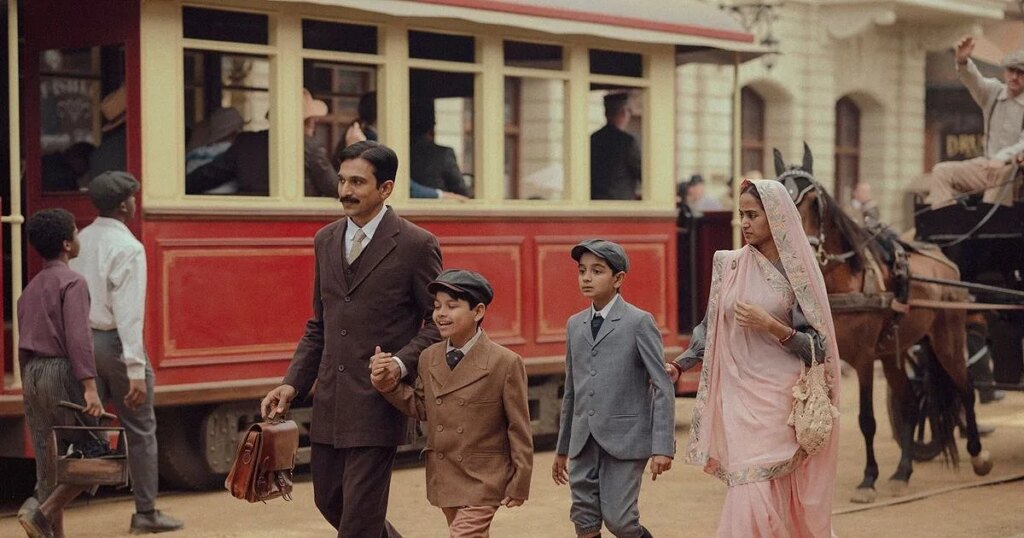
IMAGE: Pratik Gandhi as Mohandas Karamchand Gandhi in Hansal Mehta’s forthcoming series on Gandhi before he become the Mahatma, here and below. Photographs: Kind courtesy Hansal Mehta/Instagram
Key Points
- ‘We often look at Gandhi only as the Mahatma, but before that he was Mohan — a young man who was constantly learning, questioning himself and evolving. That journey is very relevant to every generation because none of us is perfect and none of us has all the answers.’
- ‘Gandhi’s ability to find clarity and simplicity in the way he lived is something I deeply admire. I don’t think anyone can completely live by another person’s philosophy, but there are certain values you can consciously try to imbibe in your own life.’
- ‘Gandhi himself was a reminder that human beings are layered and constantly evolving. So I don’t think playing him means that I have to restrict myself to Gandhian characters or characters who think like him.’
“Playing Gandhi has made me even more curious about playing people who are completely different from him,” Pratik Gandhi, who plays the Mahatma in Hansal Mehta’s coming series on Gandhi, tells Subhash K Jha.
One more Gandhi Jayanti, how relevant do you think Mahatma Gandhi is to today’s generations?
I think Gandhi is perhaps more relevant today than he has ever been. When you look at what is happening around the world, the qualities that he spoke about — simplicity, self-control, acceptance, equality, mutual respect, hope and love for humanity — are things we desperately need today.
What I find interesting is that we often look at Gandhi only as the Mahatma, but before that he was Mohan — a young man who was constantly learning, questioning himself and evolving. That journey is very relevant to every generation because none of us is perfect and none of us has all the answers.
The willingness to keep learning and to change your own truth with your experiences is something I find very powerful.

You not only belong to Gandhiji’s state, you are also playing him in Hansal Mehta’s series. How close do you feel to the Gandhian ethos?
Being from Gujarat definitely makes the association feel more personal, but I wouldn’t say that being a Gujarati automatically makes you closer to Gandhi.
For me, that connection has developed through the years of playing Mohan on stage and now on screen, and through reading and understanding his life.
The quality I connect with most is simplicity. In today’s world, everything is becoming more complicated — even the way we communicate with each other.
Gandhi’s ability to find clarity and simplicity in the way he lived is something I deeply admire. I don’t think anyone can completely live by another person’s philosophy, but there are certain values you can consciously try to imbibe in your own life.

How difficult was it for you to get into character as Gandhi? Did you focus on the externalities or just the Gandhian spirit?
The external appearance is important, but I never wanted the physical resemblance to become the performance. If I tried too hard to look like Gandhi, the audience would start looking at the makeup, the body language or the mannerisms instead of the person.
For me, the mindscape was much more important. I had already been playing young Mohan on stage for many years, so that preparation gave me a strong foundation.
With Hansal and the writing team, we went much deeper into the person — his insecurities, his fears, his mistakes, his relationships and the way his thinking evolved.
I think the most important thing was not to put Gandhi on a pedestal before playing him. If you do that, you automatically make him one-dimensional.
I wanted to empathise with him as a human being and discover him through his journey. The appearance then becomes one part of the whole picture.

Who is your favourite onscreen Gandhi?
I have grown up watching Ben Kingsley in Richard Attenborough’s Gandhi, so that performance obviously has a very special place in my memory. We used to watch that film on television around Independence Day and Republic Day when I was growing up.
But I don’t really look at the different portrayals as a competition. Every actor has approached a different period or aspect of Gandhi’s life, and that is what makes the character so fascinating.
Rajit Kapur’s portrayal in The Making of the Mahatma, for instance, explores a very different Gandhi from what Ben Kingsley did. I think each interpretation tells us something different about the man.

After playing Gandhi, would you think twice before playing a non-Gandhian character?
Not at all.
In fact, I think playing Gandhi has made me even more curious about playing people who are completely different from him. As an actor, my job is not to judge a character before I play it. My job is to understand the person, their circumstances, their contradictions and what drives them.
Gandhi himself was a reminder that human beings are layered and constantly evolving. So I don’t think playing him means that I have to restrict myself to Gandhian characters or characters who think like him.
If anything, it has made me more open to exploring different shades of human behaviour. I would love to continue surprising myself as an actor. That’s ultimately what keeps the craft exciting.
Feature Presentation: Mahipal Soni/Rediff