
One would think that the biggest threat of a franchise based in part on George A. Romero’s zombie films (in particular Dawn of the Dead) would be the undead flesh-eaters themselves, but in the case of Resident Evil, there are worse things to be terrified of in the dark. Starting back with the release of the original in 1996, there have always been zombies in the franchise, but the biggest threat is the escalation of biological warfare, and the grotesque mutations left behind in the wake of continued experiments by the nefarious Umbrella Corporation.
There have been multiple different branched-off strains of the original “T-Virus” that led to the Raccoon City outbreak, and as a result there are multiple different mutated “bio-organic weapons” (or BOWs) in the Resident Evil franchise, and some of them have even made their way to the big screen. The infected zombie dogs that have shown up in multiple games throughout the series also appear in multiple of Paul W.S. Anderson’s live-action films. Lisa Trevor, the T-Virus’s tragic first victim, appears in the remake of the original Resident Evil and also in Johannes Roberts’ Welcome to Raccoon City. And now Zach Cregger, with his brand new reboot of the live-action Resident Evil film franchise, has introduced his own spin on one of the myriad of mutated creatures in the franchise.
Warning! Spoilers ahead for Resident Evil.

Although it’s arguably the premiere zombie franchise in gaming, there is so much more to be afraid of in Resident Evil.
Sony Pictures Entertainment
Resident Evil’s Ending Explained
The biggest point of contention in regards to Zach Cregger’s 2026 Resident Evil film is the perceived lack of overt connections to the characters and story of the games — and that doesn’t change by the time the credits roll. Bryan (Austin Abrams), the unlucky medical courier tasked with delivering a crucial component of the T-Virus antidote to Raccoon City General Hospital, doesn’t run into Leon Kennedy or Chris Redfield on his journey, even though it would’ve been the best stroke of luck he received throughout the entire movie. Cregger’s film ends on the ultimate feel-bad ending, but that tragic twist of fate creates the conditions for what is probably one of the movie’s most overt references to the worldbuilding of the games.
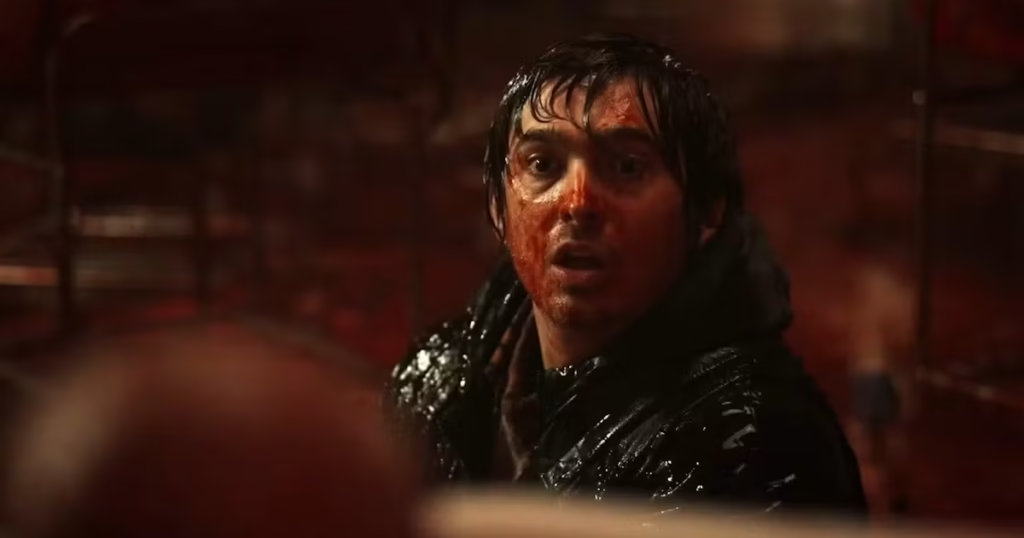
Early on in the film, before Bryan truly understands the stakes facing him during the final drop-off of his shift, he’s bitten by an infected little girl in a tunnel on the way to Raccoon City. The movie makes sure to overwhelm viewers with setpiece after setpiece until they forget about it, but naturally, it comes back around in intentionally upsetting fashion at the very end of the movie, after Bryan has successfully delivered the final ingredient to a team of scientists waiting eagerly to create the antidote.
As the magic cure-all finally finishes cooking, Bryan succumbs to his bite and transforms: flailing tentacles sprout from his back, a ravenous second mouth bursts from his chest, his infected arm transforms into a claw-like appendage, and one-by-one Bryan picks off each member of the research team totally against his will, until the virus has completely claimed his mind and body, and he’s left a roaring, hulking beast on the top of the hospital.

After spending the entire movie becoming endeared to him, Bryan ends up being the architect of Raccoon City’s doom.
Sony Pictures Entertainment
What’s Next For Resident Evil?
While Zach Cregger has expressed a disinterest in making any other IP adaptations after his experience promoting this one, it’s obvious the finale of Resident Evil doesn’t bode well anyway, and effectively brings to life one of the most notorious monsters from the entire series. Without it ever being spoken aloud, it’s safe to assume that our loveable aloof everyman Bryan has fully transformed into a BOW, one of the living weapons created by the Umbrella Corporation in the series for the purpose of using them as super-soldiers. There are numerous types of BOWs in the Resident Evil franchise, and Bryan’s distended proportions and assimilated body parts merged into him closely resemble a combination of Nyx from the game Resident Evil Outbreak: File 2 and the final form of William Birkin from Resident Evil 2.
Seeing Bryan succumb to the throes of the T-Virus is immensely rewarding for anyone familiar with the Cronenbergian walking brutes that frequently serve as enemies in the Resident Evil series, but what’s worse is that by the end of the film, Raccoon City is left unsalvageable as the only copy of the cure is destroyed after Bryan mindlessly kills the final scientist trying to help him.
In the lore of the games, Raccoon City is overwhelmed by the outbreak and eventually wiped off the face of the map by an experimental thermobaric missile dropped by the United States government, an event that transforms the series into one of globe-trotting espionage for the next few installments. Zach Cregger’s Resident Evil might not feature an appearance from any key characters, and it might change the canon in incredibly miniscule ways (like a modern-day setting or a snowstorm during the outbreak), but the one aspect that’s identical to the games is the fact that Raccoon City is certainly beyond the point of saving.