
2026 is the year of the horror video game adaptation, from Christophe Gans’ Silent Hill Returns (the less said about this one, though, the better) to Iron Lung, Backrooms, The Mortuary Assistant, and The Convenience Store. The one title most gaming fans have been excited for, however, is Resident Evil, the latest reboot of the iconic Capcom franchise from Barbarian and Weapons director Zach Cregger.
While Cregger has enjoyed acclaim in the horror sphere thanks to his previous features, the latter being an Oscar winner at that, the Resident Evil franchise’s film success has been notoriously rocky. The live-action Resident Evil movies are widely considered bad adaptations of the game, prioritising generic action spectacle and doing away with the nerve-shredding survival-horror atmosphere of the video games. Cregger’s adaptation is also barely an adaptation of the game – and yet, in this instance, that’s exactly why it works.
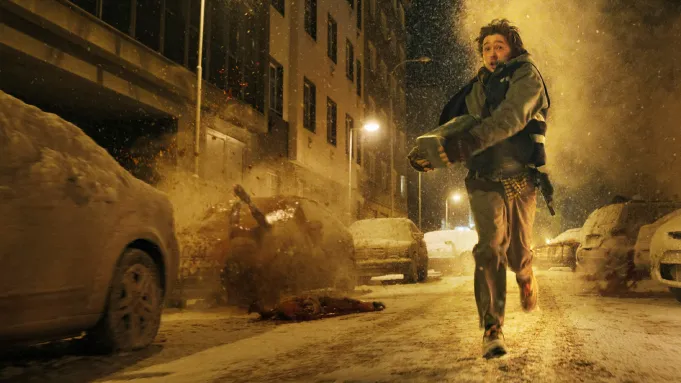
Resident Evil doesn’t focus on any of the characters you may be aware of in the game franchise, simply taking place in the same universe. Instead, we follow Bryan (Austin Abrams), an affable yet somewhat dopey medical courier as he takes a job to urgently deliver a mysterious package to Raccoon City General Hospital. His brain isn’t quite on the job, though, as he is forced to confront the idea of impending parenthood after finding out his girlfriend is expecting a child. While trying to drive through the remote, snowy passage on the way to Raccoon City, he collides with an old woman who is behaving strangely. This is the catalyst that sees his evening explode from a run-of-the-mill job offering double pay to an all-out fight for survival against rapidly mutating creatures that he carries the key to stopping.
Resident Evil doesn’t replicate any of the characters or the storylines from the game, but that’s not the only thing that makes it feel miles away from a Resi film. Its character design, though suitably gooey and repulsive, feels miles away from the monsters we’ve come to know and fear, and its set pieces, although incredibly impressive, don’t feel part of the universe until the third act. Cregger’s signature humour is worlds away from what Resi fans are used to and can become grating at times. All of this said, there is one element that has been missing from previous adaptations that means this one works in droves.
Resident Evil channels the spirit of survival horror from the moment Bryan first tracks down the woman he hit with his car. The film is a masterclass in escalation and one man bumbling through the worst day of his life armed with a gun and a litany of curse words to throw at the creatures hellbent on wreaking destruction. Just like in his previous films, Cregger showcases his expertise in creating an atmosphere so wrought with tension, it is the definition of an edge-of-your-seat good time. While much of the humour garners little more than a few chuckles, the scares hit hard, thanks to steadily building tension that never lets up as it hurtles toward its grand, hospital-set finale of all-out pandemonium.
Compounding this is Abrams as Bryan, who is a great deal of the reason Resident Evil works. His frantic screaming and swearing through the dark corners of each building, missing every shot he takes and cursing every comically huge padlock he comes across, brings to life how most Resi fans experience the games. Who among us hasn’t screamed aloud and swore violently when pursued by a zombie, or wished the ground to swallow us up when aiming, firing, and missing that crucial kill shot? It’s more relatable than a film set in the universe would have been, and channels the frustration and fear we experience watching survival horror films or playing survival horror games: making a mistake and it costing us greatly.
Abrams is, simply, adorable as Bryan, an immediately likeable lead that just can’t seem to get anything right. He’s far from the ass-kicking, wise-cracking action hero of Resi films previous, instead spending most of his time screeching or sobbing over the predicament he has found himself in. His physicality makes some of the film’s more tense moments almost unbearable to watch, while the simplest of facial expressions cut through the terror with incredibly comic timing. It’s impossible not to be sucked into his plight to deliver that green cooler intact, no matter how rough around the edges some other elements may be.
Resident Evil brings a video game sensibility to the big screen without compromising Cregger’s flair seen in his previous big-hit horror features. He made the smartest decision possible not tackling any in-game characters or narratives, instead taking the film in his own direction and focusing on the franchise’s survival-horror heart and how that struck fear into generation after generation of gamers. At a cool 90 minutes, the film doesn’t outstay its welcome or give fans long enough to grow tired of some of its elements that don’t work, packing plenty of impressive set pieces, snarling monsters, action-packed fight scenes, and buckets of blood into what is undoubtedly the best film of the franchise thus far and another hit under Cregger’s belt.
Resident Evil is in cinemas from September 18.