
Resident Evil is in theaters on September 18.
Whatever your idea of what a good Resident Evil movie should be, I have to recommend to the skeptical to put that to one side and lock in for what Zach Cregger delivers with this new adaptation of the Capcom games. With a clear appreciation for odds stacked against the protagonist and all manner of freaky foes to stand against them, Cregger ably adapts the spirit, if not the letter, of the Resident Evil games into a jet-fueled horror experience that has room for lots of tension, some great laughs, and a strong central performance from Austin Abrams.
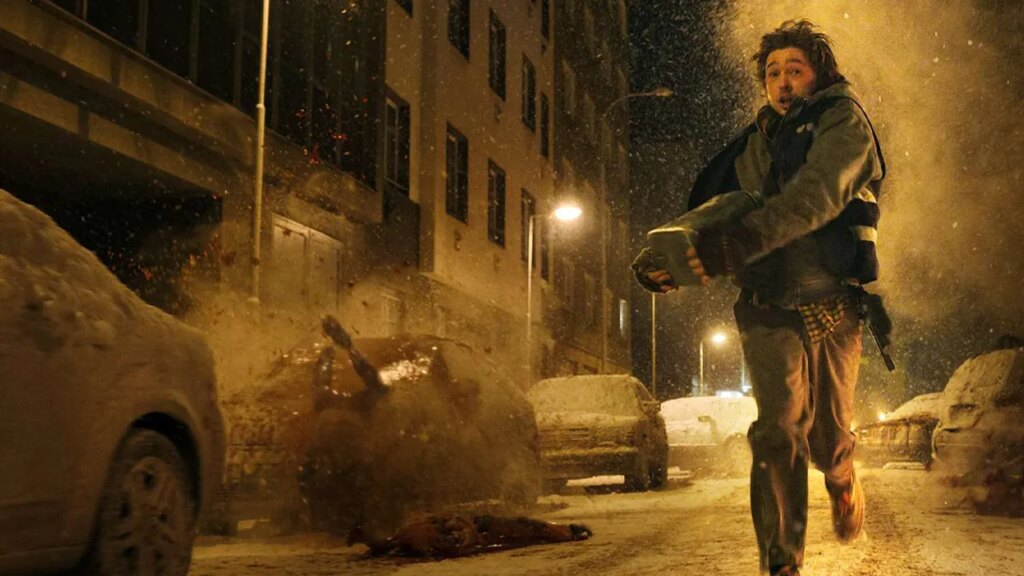
What’s clear about Resident Evil from the first frame is that it’s got some serious pep in its step. At 95 minutes, Resident Evil is here for a good time, not a long time, and it hits the ground running as Bryan (Austin Abrams), a medical courier, accepts a last-minute assignment to bring a high-priority delivery through the mountains to Raccoon City General Hospital. We encounter our first zombie less than 10 minutes past that point, and from there, Cregger doesn’t ever let too long go by without putting Bryan through some funhouse maze of grotesquery he’s ill-equipped to contend with, and to frequently hilarious effect.
Yes, Resident Evil is often very funny, but never in a way that feels at the franchise’s expense. Cregger is broadly successful in judging how and when to lean into the campy nature of Resident Evil’s pedigree for comedic effect, or to what degree Bryan’s ineptitude should detour the action into a less predictable direction. Cregger is adept at building tension in a way that makes it impossible to get a read on if that tension will pay off in a laugh or a scare, and that unpredictable energy permeates Resident Evil. This dark comedic streak is a signature of Cregger’s at this point, and it’s a surprising and effective counterbalance to the world-shaking ramifications of the Raccoon City incident currently underway. Ironically, it’s only the handful of Resident Evil’s meta jokes about its video game heritage that ring a little hollow and dated; other than that, Cregger is largely very successful at understanding how to adapt a video game into a movie in a way that serves both mediums well, even when that means subverting expectations.
And as far as heroes go, Austin Abrams’ Bryan is definitely one for subverting expectations. Far from the Leon Kennedy or Chris Redfield action-hero mold, Bryan is an everyman just trying to make a bit of extra cash and navigate some high-stakes relationship issues with his offscreen girlfriend Michelle. After his scene-stealing turn in Weapons, Abrams easily shoulders his promotion to leading man here in a performance that’s a lot more skillful than the simplicity of the character first suggests. Abrams spends long stretches of Resident Evil as the only (human) actor onscreen, and Cregger pushes him into numerous scenarios where Bryan has to narrate his way through what he’s doing, often while also delivering on a comedic beat at the same time. The actor takes the frenetic energy of his Weapons character (he was the drug addict burglar in that movie) and focuses it down into something just as nervy, but a lot more grounded and relatable.
Yes, Bryan reacts like a normal human probably should when faced with tentacle monsters exploding out of places they shouldn’t, and Abrams and Cregger both really seem to delight in the character’s frequent overwhelm. It’s played for laughs most of the time, but that tendency towards being overwhelmed also forms the backbone of what simple character arc there is for Bryan to reckon with in the aftermath of his conversations with Michelle. Resident Evil makes no secret about what Bryan is struggling to wrap his head around, even as everyone around him devolves into snarling monsters, and though the movie doesn’t go very far out of its way to land any of that with any real weight, Bryan’s anxieties are serviceable enough to give structure and add some dimension to a few of the later encounters he has to survive.
It’s a good thing that Abrams is as watchable as he is, because no member of Resident Evil’s supporting cast gets much more to do than drop in for a scene or two’s worth of exposition. No one’s bad acting-wise, there’s just very little room for anyone in the supporting cast to be really good. Paul Walter Hauser’s Umbrella Corporation functionary has just enough time in the spotlight to illustrate how terrible the Umbrella Corporation is, but characters like these are the trees on the side of the road that Resident Evil is racing by as it moves from beat to beat. As long as you’re having a good time with Abrams behind the wheel, this won’t matter at all, but if you’re on the fence, you may find yourself wishing you’d gotten some more time with some of Raccoon City’s citizenry.
Of course, the real stars here are the poor, unfortunate souls afflicted by the t-Virus, which has a habit of rapidly mutating any human tissue it comes into contact with. There are some zombies here and there, but they’re as disposable to the experience of watching Resident Evil as they are to playing any Resident Evil game. It’s the more creative, nightmarish mutants which have evolved past “vanilla zombie” that really keep Resident Evil moving. By the time Cregger has trotted out just the film’s second infected creature, it’s clear that nothing breathing can be trusted not to erupt in a mess of whipping appendages and eyeballs, and more movies could use that kind of uncertainty as a ticking time bomb to take advantage of.
These creatures, which feel right at home with Resident Evil’s Lovecraftian design language, are all lovingly rendered by Cregger and his team, who luxuriate in their oozing, thrashing, slithering glory. Abrams’ big, shrieking reactions to these horrors feels more and more appropriate as the movie goes because they get increasingly disturbing (and blissfully, most of the good stuff has been held back from the marketing). Bryan’s journey to the heart of Raccoon City really becomes an excuse to tour as much of this genetic hellscape as possible, which means that the cycle of “new location, new gross monster to sidestep” may get tiresome, but the creativity of how Cregger introduces and then heightens these things often feels like it outpaces the rinse and repeat nature of how we discover them as we go.
With an obvious tendency towards celebrating the feel of the games and not the specifics of the plot, Resident Evil consistently succeeds in amplifying classic gameplay moments from the franchise into horror movie beats in a way that goes far beyond simple fan service and “I understood that reference” references. Searching for ammo, spotting an oncoming enemy, reloading on a time crunch as they close distance, getting a perfectly timed shot off, being lured into the dark by something you may not be equipped to deal with… Cregger’s Resident Evil is littered with touches like these that are actually used to ratchet up moment-to-moment dread and not just to pay lip service to gamers.
That carries through into Dariusz Wolski’s cinematography, which emphasizes Bryan’s perspective throughout and frequently emulates the third-person approach of the games in a way that heightens the terror of what we may find around the next corner. Wolski also plays with different light sources really well throughout Resident Evil, especially in an early scene where both the exterior and interior lights of a car are used to moody and tense effect as things go wrong on a snow-driven road. Co-composers Ryan and Hays Holladay also support Cregger’s efforts with a discordant, playful score that finds a good balance between boldly accentuating big moments and keeping tension simmering on the burner as Bryan stumbles his way through dark, new spaces.