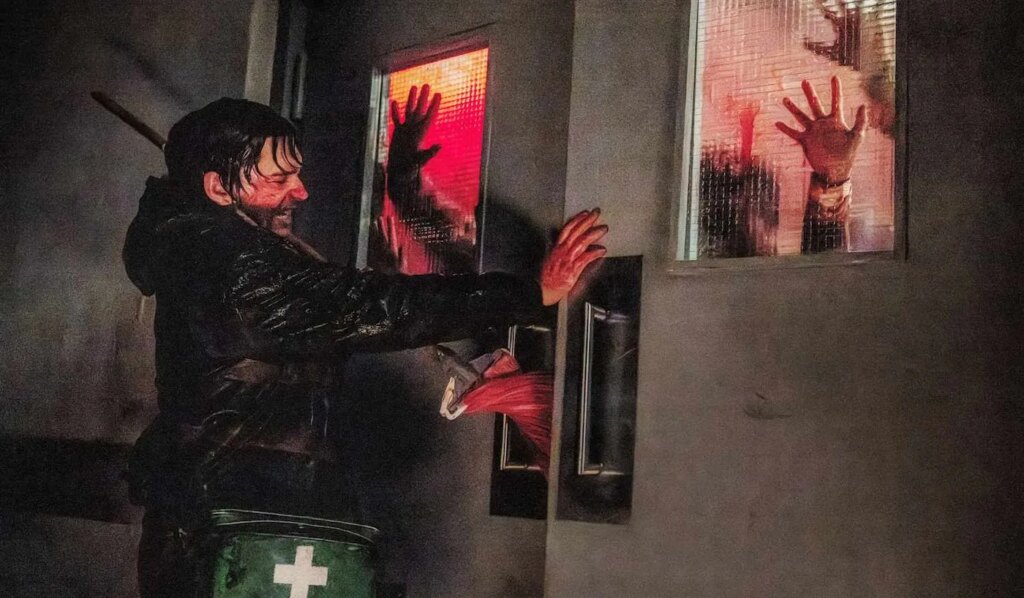

Not that I imagine all gamers will savor the filmmaker’s instincts. The highest compliment I can give the movie is that during this earlier half of the picture, Cregger elicits for the first time in live-action the atmosphere of the video games. It’s a curious thing since not a single character in the film has appeared in the games, and indeed more than a few monsters will do things gamers have never seen before. But the constant sense of helpless doom and giggle-inducing anxiety that comes when Bryan warily aims his flashlight around a dark corner does a better job of adapting the spirit of Resident Evil than a million easter egg callbacks or slices of fan service cosplaying outfits.
The premise certainly feels like it could be one of the background stories Leon S. Kennedy or Jill Valentine found written down in an abandoned police station’s journal (if you know, you know). If they did, they’d see a tale about a chap named Bryan, who is at the end of his shift in a small town Colorado hospital when he is offered double for delivering a mystery, life-saving package to Raccoon City General Hospital. It also fortuitously comes on a night he is dreading going home because his girlfriend Michelle has apparently just told him she’s pregnant. He responded by saying he’d support whatever decision she makes, and then high-tailing it out the door.
That of course turns out to be a mistake, even before the first zombie manifests. Still, those undead sure don’t make things better!
That is pretty much it for this fleet, and to be perfectly honest, slight movie. When, like the game, Cregger and his film go into pure survival mode, Resident Evil 2026 plays like gangbusters, lingering on the creepier emotions that multiplex horror can sometimes paper over—such as what it’s like to find an infected child who hasn’t turned yet and just wants a reassuring hug. But when it tries to use the same incidents to gesture toward some profundity about accepting parenthood, or worse half-baked genre subversion, the movie runs into a tonal disharmony that Barbarian and Weapons were able to avoid despite having far more complex narratives and ideas.
In truth, the movie is modeled after the games, which were in turn modeled after old drive-thru B-movies—less George Romero than his copycats that left the politics out but kept the zombies and gun action. Cregger’s movie has plenty of both, albeit perhaps more of a Resident Evil 4 variety than ‘90s-only gamers might remember. He also structures this around an everyman who must unravel the layers of Umbrella’s Raccoon City shenanigans until he is standing inevitably in a futuristic lab where everything has gone to hell.
Nonetheless, there is a shallowness to the work that might disappoint those wanting more meat on the zombie-gnawed bone after Weapons, and there s also a bold swing of a finale that simultaneously honors the games from a skewed angle while failing to serve its own tone or the thin story that Cregger blazes through like he’s on easy mode. The final twists are definitely amusing, but their implications belie just how empty the whole enterprise is once you get past those stellar graphics.