
For more than 15 years, “The Walking Dead” has been one of the most valuable franchises in AMC’s history. It spawned spinoffs, international licensing deals, streaming agreements, merchandise, video games and an enormous television universe.
It has also produced an astonishing amount of litigation over one deceptively simple question: Who gets the profits?
On September 4, AMC disclosed that it had agreed to pay $120 million to settle a lawsuit brought by “The Walking Dead” creator Robert Kirkman and producers Gale Anne Hurd, Glen Mazzara, David Alpert and Charles Eglee, along with their respective companies.
That’s a gigantic settlement on its own. But it’s even more remarkable when you remember what happened five years ago. In 2021, AMC agreed to pay former “Walking Dead” showrunner Frank Darabont and his agency, CAA, $200 million to settle a separate profit-participation battle.
Add the two settlements together and AMC has now agreed to $320 million in total settlement consideration stemming from two enormous fights over the economics of “The Walking Dead.” And even after those settlements, some of the participants retain rights to future money generated by the franchise.

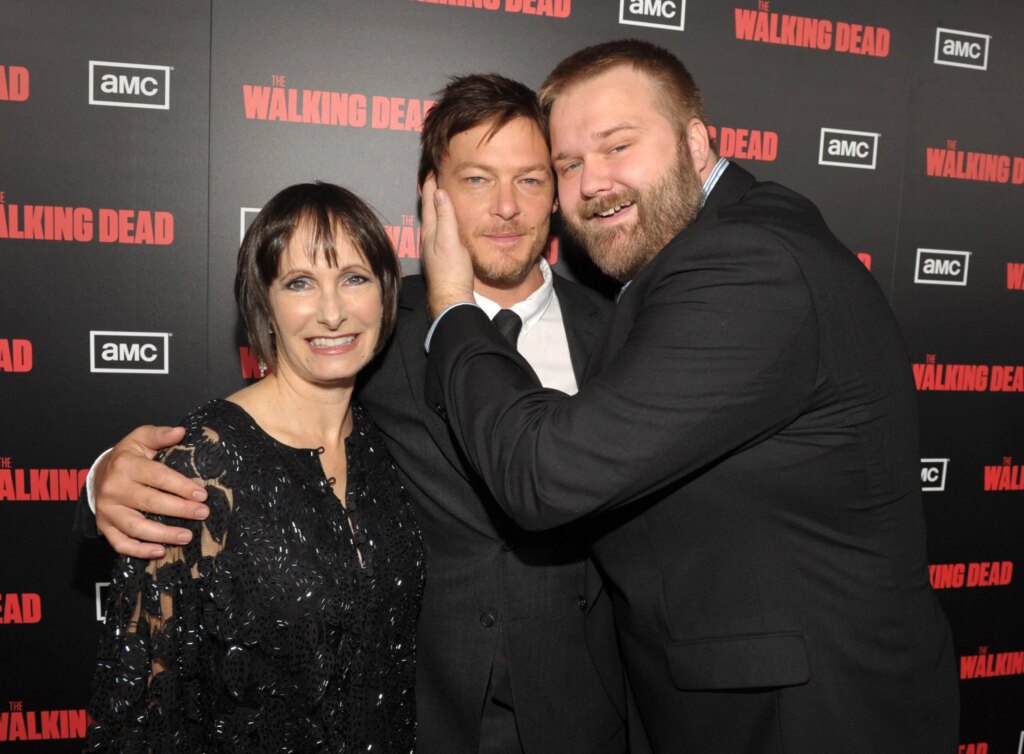
Gale Anne Hurd, Norman Reedus, and Robert Kirkman (via Getty)
The New $120 Million Settlement
According to an SEC filing, the latest settlement covers Kirkman, Hurd, Mazzara, Alpert, Eglee and their affiliated companies. Their case was headed toward an October trial before the parties reached a deal on September 4.
AMC agreed to pay the group $85 million in cash by September 18. Another $35 million is due by January 31, 2027.
That second piece is important. The $35 million is structured as an advance against future Modified Adjusted Gross Receipts, or MAGR, participation owed under the producers’ contracts for “The Walking Dead” and “Fear the Walking Dead.”
In other words, the producers didn’t simply take $120 million in exchange for surrendering all future participation in the franchise. AMC’s filing says they will continue receiving their ordinary contractual MAGR participation going forward, with that $35 million advance credited against future amounts they would otherwise receive.
The settlement is large enough to have an immediate effect on AMC’s finances. Before the agreement, the company expected to generate around $220 million in free cash flow in 2026. After accounting for the $85 million cash payment and the related tax benefit, AMC reduced that forecast to roughly $150 million.
The Fight Goes Back More Than A Decade
To understand how AMC ended up writing another nine-figure check, you have to go back to the early years of “The Walking Dead.”
Darabont developed Robert Kirkman’s comic-book series for television and served as the show’s original showrunner. He directed the pilot and helped turn the zombie comic into one of the biggest television phenomena of the 2010s. AMC fired him in 2011, shortly after the show had become a massive hit.
In 2013, Darabont and CAA sued AMC, accusing the company of depriving them of profit participation they believed they were contractually entitled to receive. A second lawsuit followed in 2018.
Meanwhile, Kirkman and several other producers filed their own lawsuit in 2017. Their fight focused heavily on AMC’s calculation of Modified Adjusted Gross Receipts.
This is where Hollywood accounting gets complicated. A producer may be promised a percentage of a show’s profits or adjusted gross receipts, but the exact definition of that pool can be enormously consequential. Production costs, distribution fees, overhead, licensing arrangements and other deductions can determine whether a participant receives a giant check or is told there isn’t nearly as much money available as expected.
Kirkman and the other producers argued that AMC’s calculations deprived them of substantial contingent compensation. AMC won important rulings in that litigation, including a 2020 decision supporting its contractual definition of MAGR.
But while that case continued, AMC made an extraordinary decision in the separate Darabont fight: It agreed to pay $200 million.
Frank Darabont Gets $200 Million
In July 2021, AMC settled Darabont and CAA’s lawsuits for $200 million.
When we covered the settlement at the time, the size of the payment was astonishing. It ranked among the largest publicly disclosed television profit-participation settlements ever.
There was an important accounting nuance inside that $200 million figure. AMC said approximately $143 million related to extinguishing Darabont and CAA’s claims and certain rights connected to “The Walking Dead” and related programming, while roughly $57 million represented participation payments the company had already accrued in the ordinary course.
Darabont and CAA also retained certain future revenue-sharing rights tied to streaming exhibition of “The Walking Dead” and “Fear the Walking Dead.”
At the time, that appeared to put the most expensive chapter of AMC’s “Walking Dead” litigation behind it. Instead, the $200 million settlement helped create the basis for another enormous claim.
The $200 Million Settlement Sparks Another Fight
In 2022, Kirkman, Hurd, Mazzara, Alpert and Eglee filed another lawsuit against AMC.
This time, the producers pointed to contractual protections known as “most favored nations” provisions. Broadly speaking, those clauses can require one participant to receive treatment comparable to another participant under specified circumstances.
The producers argued that AMC’s enormous settlement with Darabont triggered their own contractual rights and entitled them to additional compensation. And they weren’t claiming they were owed a few million dollars. According to AMC’s disclosures, the plaintiffs were seeking more than $200 million.
The case dragged on for years and was eventually scheduled for trial in October 2026. Then, less than two months before that trial was supposed to begin, AMC and the producers reached the new $120 million agreement.
There is one accounting caveat to the $320 million headline figure. Roughly $57 million of the 2021 Darabont settlement represented participation payments AMC had already accrued, while $35 million of the new $120 million settlement is an advance against future participation. So $320 million is best understood as the combined headline value of the two settlement agreements, not $320 million of pure damages piled on top of every dollar AMC otherwise owed.
Even with that distinction, the scale is extraordinary.
“The Walking Dead” Became A Money Machine
It’s easier to understand why everyone fought so intensely over percentages when you consider what “The Walking Dead” became.
The original series ran for 11 seasons and turned actors including Andrew Lincoln, Norman Reedus, Danai Gurira and Steven Yeun into internationally recognizable stars. At his peak, Reedus was earning around $1 million per episode, while Lincoln earned as much as $650,000 per episode before leaving the original series.
And the money didn’t stop when the flagship show ended in 2022. The franchise continued through “Fear the Walking Dead,” “The Walking Dead: Daryl Dixon,” “The Walking Dead: The Ones Who Live” and “The Walking Dead: Dead City,” the latter starring Jeffrey Dean Morgan and Lauren Cohan.
The library itself remains enormously valuable. AMC has continued monetizing the franchise through streaming licenses around the world, giving “The Walking Dead” an economic life that extends far beyond production of new episodes of the original show.
That’s why the contractual definition of “profits” mattered so much. “The Walking Dead” wasn’t simply a TV show that generated advertising revenue while it aired. It became a durable piece of intellectual property capable of producing revenue from spinoffs, licensing and streaming for years.
When an asset becomes that valuable, even a relatively small percentage can eventually be worth an enormous amount of money.
How Much Could Robert Kirkman Get?
AMC hasn’t disclosed how the $120 million will be divided among Kirkman, Hurd, Mazzara, Alpert, Eglee and their affiliated companies. But thanks to the original litigation, we have enough information to make an educated back-of-the-envelope estimate.
The producers’ contracts disclosed their respective participation interests in “The Walking Dead’s” Modified Adjusted Gross Receipts. Hurd had the largest share at 7.5%. Kirkman had 5%, Alpert had 2.5%, Eglee had 2.375%, and Mazzara had 1.5%.
Those are profit-participation percentages, not ownership percentages in the television series. But together, their interests add up to 18.875 percentage points, and Kirkman’s 5% represents roughly 26.5% of that combined pool.
If — and this is a big if — the $120 million settlement were divided among the producers in proportion to those contractual MAGR percentages, Kirkman’s gross share would come to roughly $31.8 million.
Under the same assumption, Hurd would receive around $47.7 million, Alpert around $15.9 million, Eglee about $15.1 million, and Mazzara roughly $9.5 million.
That almost certainly should not be treated as the actual payout schedule. The settlement covers both the individuals and their affiliated companies, the plaintiffs’ claims were not necessarily identical, attorneys’ fees could come out of the proceeds, and AMC has not said that it allocated the settlement according to MAGR percentages.
But the math gives us a useful ballpark. Under that proportional-participation scenario, roughly $22.5 million of Kirkman’s estimated $31.8 million would correspond to his share of the initial $85 million cash payment, while another $9.3 million would represent his share of the $35 million advance against future participation.
CelebrityNetWorth currently estimates Kirkman’s net worth at $60 million. A gross settlement worth somewhere around $30 million would obviously be significant, even after taxes, legal fees and whatever portion ultimately flows through his production entities.
And Kirkman isn’t necessarily cashing out of “The Walking Dead.” Under the settlement, the producers retain their contractual participation rights going forward. The $35 million portion merely functions as an advance against some of that future money.
“The Walking Dead” has therefore developed an extraordinary financial legacy to go along with its television one. It produced an 11-season flagship series, a sprawling collection of spinoffs, enormous ongoing licensing value and two major settlement agreements with a combined headline value of $320 million.
For a show about people desperately trying not to get eaten by zombies, an astonishing amount of the real-world drama has turned out to be about something much more familiar: getting paid.