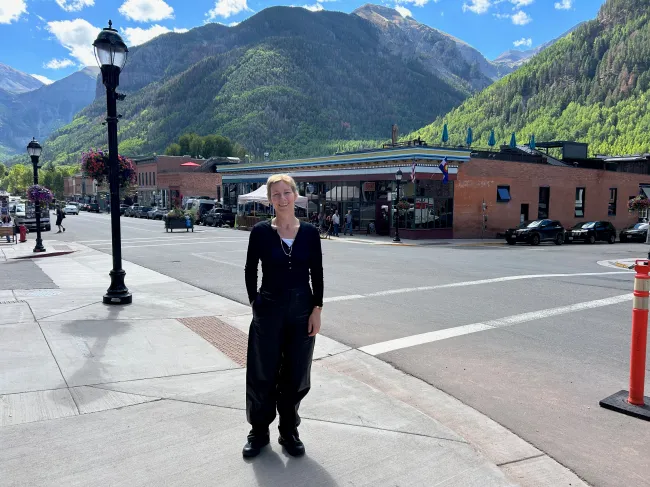

After two Telluride Film Festival tributes, Sandra Hüller left the mountains on Sunday to return to her hometown of Leipzig, Germany, where she is raising a 15-year-old daughter and directing a play. She’s still adjusting to her global rising star status. She’s directing because she has given up on theater acting.
The comedy “Toni Erdmann” put her on the map in 2016, followed by her Oscar-nominated role as a woman accused of killing her husband in Justine Triet’s “Anatomy of a Fall” (2023). She also earned raves as a bovine Nazi wife in “The Zone of Interest” that year. In 2026 she took on four movies, two black-and-white European projects and two big-budget Hollywood blockbusters. She won the Berlinale Silver Bear for her performance as a 17th-century war veteran living as a man in Markus Schleinzer’s “Rose” (MUBI), followed by her first studio gig as Eva Stratt, the scientist assigned to save the world in blockbuster “Project Hail Mary” (Amazon/MGM). And she returned to Cannes in Pawel Pawlikowski’s “Fatherland” (MUBI) as Erika Mann, the car-driver daughter of Nobel Prize-winning novelist Thomas Mann.


“Fatherland” offers a mere slice of the scion Erika Mann, wealthy, privileged, educated, who could warrant a film of her own. The fact that she was married to the gay British poet W.H. Auden is a throwaway in the film, in which she serves as her elderly father’s assistant and representative on a 1949 post-war road trip back to East and West Germany. She’s in charge. “She’s a race car driver, amongst other things,” said Hüller over coffee. “She’s also an author, journalist, an actor. Pawel wanted her to be a part of this journey because, in reality, she wasn’t. It was somebody else in the car. He wanted her to be the person responsible.”
The Buick was a monster. “It’s really heavy,” said Hüller. “It takes some effort to drive it. Because we don’t have help with the steering wheel. It takes some muscle.”
That’s what sets the German actress apart from the field. She’s tall, lithe, intelligent, androgynous, vulnerable, and powerful all at once.
“Fatherland” kicks off with a bravura five-and-a-half minute locked-off single take of Klaus (August Diehl) in Cannes, sitting naked on the floor by a bed with a sleeping young man. He talks on the phone with Erika, who tries to coax her depressed drug-addict intellectual twin to come on a road trip with her back to Germany as his father accepts the Goethe prize. Hüller had long wanted to work with Diehl but had to settle for a phone call from her kitchen. (They will work together on another German film, about the painter Ernst Ludwig Kirchner and his partner Erna Schilling.)
Central to the journey is the dynamic between the father and the daughter, because she’s really angry with him. “When I read their letters to each other,” said Hüller, “they were what we say schonungslos. They didn’t spare each other from criticism. They were open, but they were forgiving each other at the same time. It was a deep, respectful love that they had, and a beautiful relationship. They are in a big conflict with each other at that point of their lives, and it’s painful because they love each other so much. When this loved person is dying, and they don’t agree on how to deal with it, that is devastating.”
According to Hüller, many German films have tried to portray the Manns, “but it’s a complicated family structure,” she said, “and also a complicated moral question around them. They left Germany during the war because it was too dangerous, and as we can see in the film, some people still didn’t forgive them. So it’s a discussion: What would you do if you were privileged? Would you use this privilege, or would you say, ‘I don’t care, I’ll stay here and watch everybody die.’ It’s a big topic.”
Erika Mann’s own homosexual relationships are only slightly referenced. “The person that she meets, this other journalist,” said Hüller, “she’s been in a relationship with her before, and they broke up for I can’t remember the reason. That’s also part of her freedom: not to talk about who she is and what she prefers, and I admire that.”
In one party scene in a night club Mann has a memorable face-off with her ex-husband Gustaf Gründgens, an actor who stayed behind and collaborated with the Nazis. “We always try to imagine ourselves as these superior creatures that do everything right,” said Hüller, “but we actually don’t know what we would do in a situation like this. Joachim Meyerhoff who was playing Gründgens, is an idol for me in German theater. He’s somebody whom we all know, and it was a great choice to let him play this person. I felt honored that I was allowed to slap him in the face, if you know what I mean.”

“Rose” is a less expressive role. No temper tantrums allowed. Blending into a strict rural community required discipline and rigor. When does this woman disguised as a man pee? How does she satisfy her wife? (She acquired dildos during her decade as a soldier in the 30 Years War.) As constrained as the character is, the actress shows us what she is feeling. “This is kind of a defect,” said Hüller. “I can’t hide what I feel. Like never, which is sometimes difficult in life. Even if I wanted to. But in this case, I felt like her whole existence after she chose to live in men’s clothes and to have the identity of a man to the outside, I don’t even know what her inner identity is. She has to be so aware of everything around her that she’s more a spectator of everything than an active subject.”
Survival was key. “She has to have a 360 degrees view of everything all the time,” said Hüller, “because she should never come into a situation where she has to act in a rush or where she would use gestures that are not appropriate for her chosen character. So it had to be contained. She’s coming from a long war. There’s a lot of damage and grief and darkness inside that person. And what I love about her the most is that she’s able to transform it into something soft, in a way. I loved her for not becoming this harsh, hard, cynical person.”

Next up the actress is taking on the portrayal of a man, German artist Wolfgang Herrndorf, in Maria Schrader’s “Work And Structure.” “It’s different because he’s not hiding anything,” said Hüller. “He’s just Wolfgang Herrndorf. I’m playing a man, but not trying to play a man. I look androgynous. I was born this way, and sometimes I can profit from it, not always, but sometimes.”
For her first studio gig, she took on powerful scientist Eva Stratt in “Project Hail Mary.” After she met Phil Lord and Chris Miller in London, she felt she could work with them. “I had no idea how to play her,” she said. “I was thinking about somebody completely different who could inhabit this strength and responsibility and clarity. But there are moments when other people think you can do it. You start to think you can do it yourself. But I would never have thought that somebody would think of me in a character like that.”
While she had to make some adjustments to working on a big-budget Hollywood movie, “I was surprised that there was so much freedom,” she said. “I would have expected it to be much more formal and more delivery oriented, but it wasn’t. And it had a lot to do with the people who were working on this because Chris and Phil are playful and open directors, and they give a lot of space to explore things. And Ryan [Gosling] is somebody who loves that too. So I never felt pressed into something that I don’t belong in. I was lucky.”

While the new idea of Stratt singing karaoke at a party threw her at first, Hüller came around. It happened because Gosling heard her singing on set. She loves to sing. “It’s annoying for people around me,” she said. “My daughter is always rolling her eyes. At first I thought, ‘why would she? it’s not her thing. It’s not her position to do that.’ But then I thought, ‘yeah, maybe that’s interesting that she’s leaving that position for that particular moment.’”
Hüller searched the libraries of goodbye songs. And producer Amy Pascal suggested a few songs that she was sure she could clear. “The next night, I found [Harry Styles’ song “Sign of the Times”] and sent it to her and asked if she could she could make this possible and she did. And the next day we shot it.”

The upcoming “Digger” (Legendary/Warner Bros.) is another big studio project, where Hüller plays the half-sister of Tom Cruise for one of her favorite directors, A.G. Iñárritu. “He’s very energetic,” she said. “He’s leading this whole shooting day in a way that you want to keep up with him. It’s inspiring to see him and his energy and his commitment to what he’s doing, and he’s sharing thoughts about everything. He’s trying things. Sometimes we do things completely different on another day. So he’s looking for the best thing that can happen.”

She enjoyed working with the “focused” Cruise, but did not hang out with him. “I felt like these two chose each other, the director and the actor. They really wanted to do this together. That was great to watch.”
The actress made the transition to directing at her Leipzig theater group last year. “I’m part of a theater collective of people who have known each other also for 20, 30 years,” she said. “Because the reception of my appearance on stage has changed a little bit through this public eye, I didn’t feel safe on stage anymore. The decision to go to the other side was a good decision because there’s so much to learn, and I enjoy it. I might go back. But I took some time to adjust my expectations. I went to the theater to be part of a group, but when you’re in this exhibited position, I didn’t know how to deal with that, and maybe I’ll be ready in the coming years to own that different position that I have. But I was a bit heartbroken that I lost it.”
One aspect of stardom that Hüller has embraced is red carpet fashion. “I have a team with Jordan Johnson Chung, who is choosing the outfits for me,” she said. “And I’m lucky to work with Chanel and people who help me with hair and makeup. But for me, in my life, I like to get up and get out of the house without anything. It’s always a bit of an adjustment to make. But when we do it, it’s fun.”

The promo tour for “Digger” will pull her back in. And the award season beckons. “It’s a challenge to find the balance between your personal life and decisions,” she said. “I don’t have a team around me when I’m at home. I have things to do. But I also want to help the films wherever I can. So I have to try and find the balance between. All of these things come with responsibility. It’s hard for me to to step away from that, like when a studio says, ‘But it’s your responsibility to be at that press day.’ No, it’s not.”
The actress is picky about her projects and has turned many things down, she said: “Not enough, some people think. I roll my eyes when I have to bring emotional value to a project that doesn’t genuinely have it. So if a script isn’t good, but I’m asked to make it good with acting, that’s something that I’m not here for. I don’t like that.”