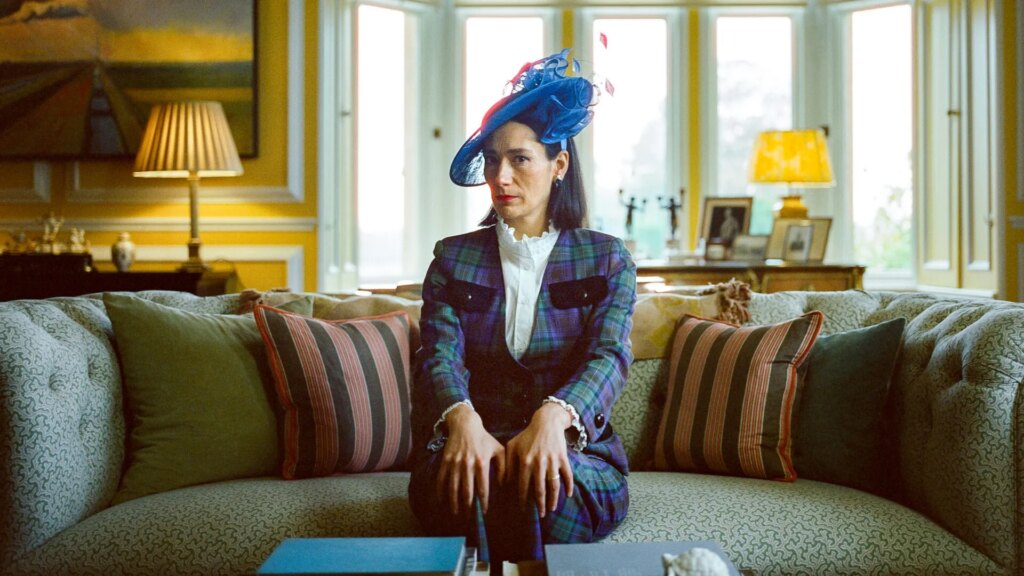

Lady, the first feature film from director-writer Samuel Abrahams, isn’t your typical mockumentary. The tale of the eccentric Lady Isabella (Sian Clifford) being filmed by young egotistical filmmaker Sam (Laurie Kynaston) is equal measures hilarious and heartfelt, but the bizarre otherworldly elements elevate Lady into something truly unique.
Speaking with FILMHOUNDS as the film hit UK cinemas. Abrahams and star Clifford chat about improvisation, the fifteen-day shoot, and creating art for art’s sake in a modern world.
It’s a pleasure chatting to you both. I’ve literally just watched it, and I had such a good time. This must have been such a fun shoot to do, right?
Samuel Abrahams: Go on, Sian.
Sian Clifford: Should I go? Yeah, it was fun. It was also really hard. I don’t know if you know this because I feel like I’m saying it in a billion interviews, but we shot it in fifteen days. And along with our three producers and darling Sam, there were ten crew members. We basically had one HOD (Head of Department) who was across fifteen jobs. We were all across a lot of departments, put it that way. But what’s magical about that is that I can honestly say that that group made that film. I can literally name eighteen people, and they’re the people that made [Lady], that were there.
And of course, there’s post-production and there’s all these wonderful people that have contributed to the film, but it was such an extraordinary experience, is what I’d say more than fun. I can’t believe we’re here now, talking to people who love it. It’s such an amazing journey that we went on. It felt like we were there for a lot longer than fifteen days because it was so intense and we were living together. We were eating every meal together. It was a labour of love, put it that way.
SA: They were the best fifteen days of my life. I just loved it. Yeah, it’s hard, any problem that came my way, it was just like, “I’m getting to do this. I’m getting to make a movie.” Getting to work with Sian, getting to work with Laurie [Kynaston], Juliet [Cowan], and all our crew—just amazing people who came together.
SC: Top of their game. Unbelievable.
SA: I think something for the actors that was quite unique [is that] we would go for insanely long takes. Like we do a take and it’s eight minutes long and at the end of it, I’m going okay, so I’ve got three things to talk to Sian about, three things to talk to Laurie about, Korsshan our DP. You’d quickly review that, and everyone gets their notes, we’d chat about it, and then you go again. For Siian and Laurie, for you guys, that’s a lot.
SC: There’s a couple of moments in the film where we thought you were getting quite candid shots. There’s a moment where the cameras are outside in the courtyard, and we’re rehearsing inside. Everything that we were saying, we were just making up so that we could be moving and doing things in the room. And so much of that is in the film. Me and Laurie, I remember the first time we watched [Lady], we looked at each other and were like, “Oh my God.” We didn’t expect them to use that! Or not use the audio.
It works because we were in character, but I think we did like 25 minutes. That sort of thing is very exhausting. You don’t realise how much, as an actor, you are held by the script. It’s why some actors are terrified of improvisation because there’s such a safety net in that. That’s your guide, that’s your map, your list of instructions in a way. I love improvisation in the right context, in the right project. And obviously this is an absolute gift for it. So as soon as I had a purchase on the character, I was like, “Let me go, let me go.” I want to, but then of course we would do it for 25 minutes, and I’d be like, we have to stop.

I was going to ask about that, because one of the many elements that I really loved with Lady was how the characters and the world feel so lived in. What was that balance between improv and simply having a really damn good script?
SC: I think that’s the word, the operative word there is balance. And that’s the illusion that you have to create as an actor, and that’s why you actually have to allow for improvisation to soften the edges of scripted lines, so it feels completely off the cuff. I have to say the script was so beautifully naturalistic. So that was very easy to use as a platform. Sam encouraged me before we even started shooting to 100% just go for that, and it really helped me find the character. It’s there from the first scene of mine that we shot, but I definitely grew in confidence doing that over the course of the movie. But how would you talk about it, Sam?
SA: A lot of my job was to create the right space for you guys to play. The house is such an amazing playground anyway, so [we had] all of these things helping. And the script, as you say, is there. It was something we followed, the beats in it and the dialogue, but allowing the space so that, as Sian said, you soften the edges or make it feel human. I think that’s the thing; make it feel spontaneous and messy and human. Filming is just kind of an illusion, isn’t it?
SC: One of the sequences that comes to mind when you’re saying that, Sam, is that there’s the sequence when I’m talking about social media. I’m talking about the catalyst for why [Lady Isabella] invited this film crew in, which is seeing an old friend online doing rather well with table scaping. The next obvious step is to hire a film crew and tell them that Netflix have struck a deal with you. I just remember we had to do it so many times because the timing to land at the bottom of the stairs.
SA: Yeah, this line needs to be at this point.
SC: And because Sam knew the location, the script was in certain sections; it was a composition. Some of it was like, we’re going to do this outside in front of the fountain; some of it was, we’re going to start in this bathroom and we’re going to end at the bottom of the stairs. The dialogue had been composed rhythmically to land at certain points.
SA: That stuff was a dance, wasn’t it? Some of it was, as Sian said, crafted in shape to flow through that house and that space. It was really specific to the location in a sense. And it’s a real dance between the two of you as you’re racing around the house. I’m very proud of those scenes; it was really fun to block that out together, and it was a lot of work.
Something that I really took to heart emotionally with the film—being a creative as well—is that there’s so much joy in creative expression. Why do you think that’s really important, especially in today’s world, to find that joy and playfulness again?
SC: I just had a conversation touching on this, about the perception of success. There’s this obsession with certain things needing to hit certain markers, or it was a failure or whatever. I think there is so much to be said for creating for creativity’s sake, and how good that is for your mental health. I was talking about another project that I did called Life After Life. It’s a BBC period drama directed by John Crowley, who directed Brooklyn. It was three of the happiest months of my life. No one watched it. No one watched it. And I am completely at peace because actually—it sounds completely hokey to say this–it was about the journey. It wasn’t about the destination. Of course, I would have loved more people to connect to it. But it was the experience that we all had in that house together making this [that] is the most important thing. I’m so proud of what we’ve made and how it’s come together. In some cases, considering where things had to get dropped or didn’t get shot because of absolute chaos, it’s a magical thing. I’m a huge fan of making art and not being so focused on the outcome.
SA: Process more than result kind of thing.
SC: Yeah, trust the process. Trust the process and what you’re learning on the way, and all of those things. And of course, if it connects with people, that’s magic.
Lady is in cinemas now.


