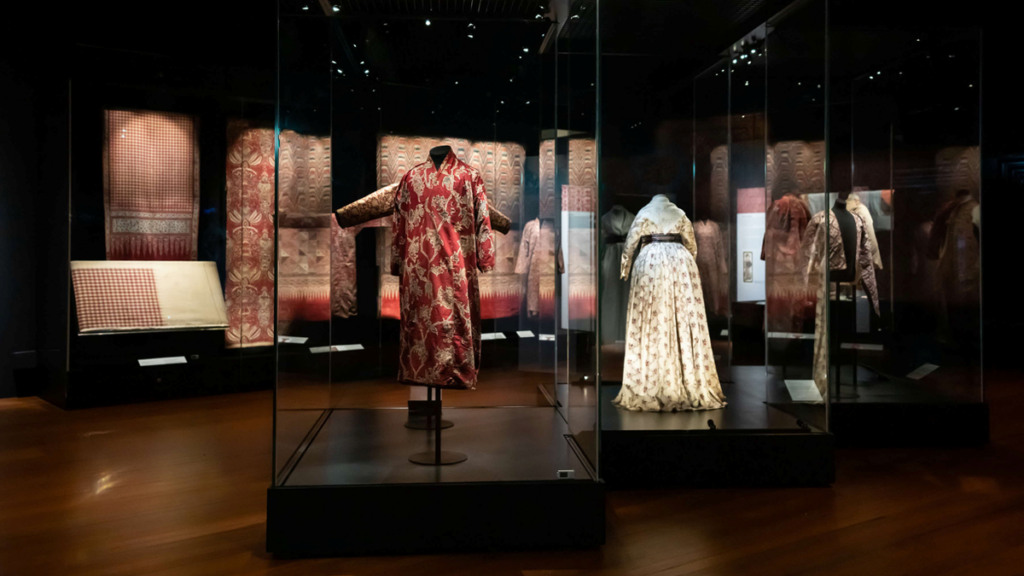

Peter Lee is a man who wears many hats. The Singaporean collector, of Peranakan Chinese ancestry, is an independent scholar, researcher and curator. He is also an Indophile who believes that the “love of checks” unites Peranakan and South Indian textile collectors. “My father and grandfather wore what we call Pulicat sarongs at home [which can be traced to the 17th-century port town of Tamil Nadu]. They are so much a part of my memories of everyday life,” says Lee, who was in Karaikudi a few days ago to participate in the annual Chettinad Heritage and Cultural Festival.
Rapid fire with Peter Lee
The experience, he shares, was inspiring. “Coming from an old community of traders with regional networks, Chettinad heritage really resonated [with me]. Art history is largely still dominated by state narratives and the works of intellectual elites. Chettinad history and material culture, like those of the Peranakan, Parsi and Armenian trading communities, are facets that contour our understanding of the past in diverse ways.”

Peter Lee, Singaporean collector, independent scholar, researcher and curator
Decoding the kebaya
Lee has traced his Peranakan genealogy back nine generations, and learnt much about his community’s culture. The kebaya, an open jacket worn by women, was of particular interest. “I always thought it was quintessentially Peranakan but the deeper I got into it [for his 2014 book Sarong Kebaya], the complexities of the cultural entanglements of its past became more apparent,” he says, explaining how many cultures have influenced its design. “We have imposed a fixed sense of race and identity on dress, and I found that Peranakan fashion can help us rethink that. Because the community resided in multicultural port cities, they did not comply with sumptuary dress codes. It spoke to me about hybridity, and made me question every object and culture and how things are pieced together.”

The Peranakan community is an umbrella description for mixed families in Southeast Asia. “Race, identity and nationality are all modern concepts,” says Lee. “The past was more organic. When these migrant merchants came, they would find local partners/spouses, which led to hybrid rituals, spiritual practices and customs.”
His interest in all things Peranakan led to his role as founding curator of the NUS (National University of Singapore) Baba House, a 19th-century townhouse belonging to a wealthy stevedore family. Lee calls his involvement serendipitous: he’d met the current owner of the house, who wished to preserve his history, at the same time his aunt Agnes Tan wanted to find a project that she could donate to — in memory of her late father Tun Tan Cheng Lock, a Peranakan businessman and political leader. Lee brought them together and now Baba House is a one-of-its-kind museum with objects and interiors intact from 1929, when the house was built.

Facade of NUS Baba House
| Photo Credit:
Getty Images
“Historical house museums can give a multi-sensory understanding of the past,” he explains. “The subliminal effect of seeing, smelling and even feeling things is something not achievable in a standard museum.” The house, which is currently being restored, is set to open next year. “The Tun Tan Cheng Lock Trust has contributed an endowment to NUS that will ensure there will be funds for staffing, programming, repairs and maintenance.”
Family influence
Lee’s collection spans Tamil and Indian textiles, Peranakan treasures, old photographs and objects that tell stories of trade, migration and cultural exchange across Asia. He credits his interest to three mentors: his father, mother and paternal uncle.
He has often talked about his father who used to take him to bookstores as a child and encouraged him to buy one book each visit. But his mother was a connoisseur of all things beautiful. “An instinctive collector”, her different interests became collections, from porcelain and furniture to textiles. She had one of the finest stocks of sarong kebayas sets, ornamented with print, painting and embroidery.

A sarong kebaya from Lee’s parents’ collection
His paternal uncle was an architect and architectural historian, and growing up, Lee had access to his library and its huge cabinets stacked with old maps and 19th-century photographs of cityscapes.
The heart of hybridity
Lee has travelled extensively in India and learnt from scholars, including the late collector Jagdish Mittal from Hyderabad. He admits to being biased towards chintz and kalamkari. “I have been collecting kalamkaris from various world markets, from Japan to Thailand, Indonesia, Nepal, Iran, the Netherlands and even America. It is fascinating how versatile and creative the artisans were to produce patterns in demand in specific markets.”

An example is the production of the two-sided kalamkari (called kain chit dua muka or chintz with two faces) for Southeast Asian islands. “Because the textiles were often draped in a way that revealed both sides, it was necessary to draw and dye the pattern on two sides of the cloth,” says Lee, who has two published essays on chintz.
For him, collecting is not to be “greedy or self-indulgent”, but for a bigger purpose. “I am open to all kinds of people [with an interest in photography and textiles] coming over to my home to see my collection. I encourage them to touch and smell old textiles. They all have different feels and scents; this is something AI can never reproduce.”

Hybridity has always had his heart. Objects without a definitive identity, which historians would use to typify a culture, period or community, and thus left out of their studies. The transient culture of Asian ports was ideal for such objects. “For example, in the Indonesian market kalamkari does not have the same national stature as indigenous textiles like Javanese batiks. But culturally, they are integral to the material culture of the islands,” he says. “The art and culture of these communities that are hybrid celebrate human enterprise at its most unbridled and egalitarian. And the spirit of unabashed experimentation, creative improvisation, and non-conformist expression resonate with contemporary global art and culture.”
Lee is now readying for an exhibition opening at the end of October at the Peranakan Museum in Singapore. “Titled Exceptional/Everyday: New Acquisitions, New Perspectives, it will feature 14 objects, both exceptional and everyday, that reshape what we think of Peranakan heritage,” he concludes.
The writer is cultural activist, philanthropist, and founder of Prakriti Foundation.
Published – September 26, 2026 06:43 am IST