
There are plenty of ghoulish places you can visit in Wales this Halloween

There are plenty of ghoulish places you can visit in Wales this Halloween(Image: Retreats Group Ltd)
Wales is full of spooky places haunted by ghosts and lost spirits, according to local legends and eyewitness accounts.
Many of these creepy destinations attract ghost hunters and paranormal enthusiasts from all over who come to see if they can spot scary spooks and ghastly ghouls.
There are even some spooky places you can stay in overnight in Wales if you’re brave enough, of course.
From haunted castles and manor houses to ancient burial chambers and spooky woodland sites full of local legends, there’s plenty of ghoulish places you can visit in Wales this Halloween.
Here’s our round-up of some of the spooky sites you can visit in Wales to give yourself a fright this Halloween season.
Margam Castle
Visitors to this 19th-century Gothic mansion in Neath Port Talbot have long shared eerie tales of spectral figures, unexplained laughter, and objects that seem to move of their own accord.
From the Bronze Age through to Roman times, and later the founding of the Cistercian Abbey in the 12th century, this site has seen centuries of human life and, perhaps, lost spirits.
Margam Castle is part of Margam Country Park, a gorgeous 1,000-acre South Wales estate in the Neath Port Talbot region and, unlike many other castles in Wales, such as Cardiff and Caerphilly, is free to enter.
The entrance Hallway and Staircase Hall are open to the public, and there are also several ticketed ghost-hunting events during the spooky season.
Built between 1830 and 1840 by architect Thomas Hopper for Christopher Rice Mansel Talbot, the castle is a striking example of Tudor-Gothic architecture. The Talbot family owned the estate until 1942 and it later fell into disrepair after a devastating fire in 1977.
The most infamous spirit of Margam Castle is allegedly Robert Scott, a gamekeeper who was murdered on the estate, some say by a poacher, others by an escaped convict. His presence is said to rage through the castle and the estate to this day.
Scott is frequently spotted making a determined ascent of the Gothic staircase leading to the castle. His presence is a recurring theme among psychic investigators, who all agree that his spirit seethes with fury, unable to rest after his untimely and unjust death.
After nightfall, the castle’s security guards report the unsettling sounds of hurried footsteps and low, chattering voices echoing through the empty halls, though no trace of another soul is ever found.
Psychic investigators have described his presence as one of anger, with inexplicable slamming doors and objects being hurled across rooms attributed to his spirit. Visitors who’ve dared to investigate report an overwhelming sense of dread, as though Scott’s rage still lingers.
Cathedral Close, Llandaff
Cathedral Close in Llandaff has a reputation among paranormal enthusiasts for being a scary spot, with ghost hunters who write about the supernatural holding it in high regard.
And, whether you’re a believer or not, there’s a bit of a story that goes with the street that was once known as The Road of The Dead.
Back when Llandaff was a village in its own right, rather than part of the wider city of Cardiff, the road that runs along the side of the cathedral was given the rather morbid title.
It’s claimed that the location was used for carrying dead bodies along the road, which previously ended at the River Taff.
Once the bodies had been carried down the Road of the Dead, they’d be buried at the now-abandoned and overgrown graveyard near the river.
If you want to find out more about ghost sightings and the spooky history of Llandaff, you can take yourself on a self-guided audio tour.
This tour follows a circular route, taking you along a mysterious, atmospheric wooded lane, the scene of many ghostly experiences, before leading you along the riverbank, where more ghostly encounters and legends are recounted.
The route turns back towards the Cathedral for more tales and culminates in the old, abandoned, and overgrown woodland graveyard, with its intense atmosphere and ghostly tales.
Newton House, Llandeilo
Newton House in Llandeilo is considered one of the country’s most haunted locations. Paranormal investigators and the National Trust often name it their most haunted property in Wales, and visitors regularly report ghostly sightings.
This Grade II* listed beauty is inside the Dinefwr park estate and was once home to Welsh royalty.
Recent excavations near Dinefwr Park uncovered two Roman forts, revealing that Llandeilo’s history stretches back to the first century AD.
But it’s Newton House where most of the ghostly activity occurs. For over 300 years, this opulent manor was home to the descendants of Lord Rhys, Prince of Deheubarth, whose formidable dynasty held firm against the Anglo-Normans until Edward I arrived.
In 1660, Edward Rice constructed the current house and named it after the medieval ‘New Town’ that once accommodated English settlers. However, the mansion’s roots stretch even further back.
The original Jacobean building was erected on land that had been inhabited for nearly 2,000 years. In 1990, the National Trust took over, and they’ve worked tirelessly to preserve its grandeur ever since.
According to the National Trust, there have been numerous spooky reports, as the property is said to be haunted by various entities, including a spectral butler, a lady of the manor, and other eerie apparitions such as a “white lady” or a “ghostly child.”
Visitors have reported paranormal experiences such as unexplained noises, moving objects, cold spots, and even a sensation of being choked on the cantilevered staircase.
Lady Elinor Cavendish’s ghost is one of the most talked-about here. Her tragic tale unfolds in the 18th century when she was coerced into a marriage she desperately didn’t want. Fleeing from her violent husband, she tried to break free, but he tracked her down and, in a fit of rage, strangled her to death.
Today, her spirit is said to roam the grounds of Newton House and the ruins of Dinefwr Castle, eternally chasing the freedom she was denied.
Pembrey Woods, Carmarthenshire
Paranormal enthusiasts love the ethereal Pembrey Woods for its many spooky sightings and stories of strange occurrences.
Over the years, there have been tales of ancient settlements, shipwrecks, explosions and war stories; it’s no wonder that Pembrey Woods is a popular hub for paranormal claims.
As a vital area in World War One and Two, claims have been made by people who are believed to have witnessed soldiers roaming through the woods and dismembered figures, while a number of people have claimed to have fallen over after feeling like someone was grabbing at their ankles.
The claims led the ghost-hunting television show Most Haunted to journey to the woods in 2008, where they held a seance on the nearby Pembrey beach and claimed to witness several spirits, including the ghost of a drowned sailor.
St Catherine’s Island, Tenby
St Catherine’s Island [Ynys Catrin] is a small tidal island, set upon the sloping bay of Tenby Castle Beach that is accessible by foot at low tide.
Legend has it that during a violent storm, there was an unaccounted-for ship in the distance, with strange lights playing across its decks and ghostly shapes clinging to its masts.
Even today, many people have reported spooky sightings and dancing lights near this mysterious island.
The ghost ship isn’t the only local legend in Tenby; there are plenty of other spooky tales and historic buildings to discover in the seaside town.
This family-friendly tour, which includes stories about ghosts, pirates, fairies, witches, and tales and traditions, was named one of the top five ghost walks in Britain by The Sunday Times.
Llanelly House, Llanelli
As one of the most historic buildings in Carmarthenshire and having stood in Llanelli since the early 18th century, the grand house has seen a number of chilling claims made from within its four walls.
The most notable ghost story associated with Llanelly House is that of a 22-year-old housemaid named Mira Turner.
Local legend claims the young maid fell pregnant before taking a dose of laudanum poison and throwing herself down the stairs.
A number of workers, visitors and ghost hunters have all claimed to see Mira roam the upper floors of the Georgian home.
Ghost-hunting thermal detectors have monitored activity, visitors have witnessed unexplained shadows and have felt colder, especially around the stairs and in Mira Turner’s old room.
Tyn Dwr Hall, Llangollen
Tyn Dwr Hall is a Grade II-listed building, built for ironmaster John Dickin in the 1800s, and has been used as a youth hostel and an educational venue.
The historic mansion has since been stored and renovated into a luxury boutique wedding venue after it was bought for around £1m by a local builder in 2015.
The Paranormal Database claims a handful of ghosts haunt the building and surrounding area, including a gamekeeper and a woman in a rustling dress. It has also been named as one of the most haunted hotels in Wales by the Haunted Rooms website.
A mysterious green mist has also been witnessed here, and others have reported hearing children laughing. For ghost hunter brides and grooms, it’s the perfect place to give your wedding guests a spooky thrill.
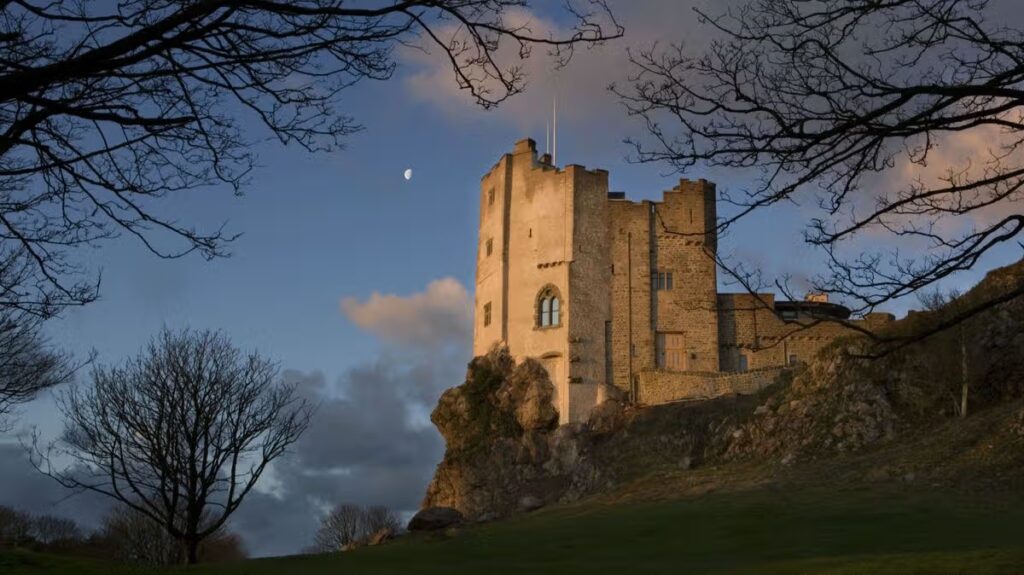
Roch Castle, Haverfordwest
Roch Castle rests high above the landscape on its volcanic, rocky outcrop, providing 360-degree views of Pembrokeshire.
It’s a heritage property that was beautifully restored, with six luxurious en-suite bedrooms and a unique, haunted history.
The Haverfordwest hotel was built in the late twelfth century and was home to Lucy Walter during the 1630s. She was the consort of Charles II and the mother of the Duke of Monmouth.
It is believed Lucy is haunting the castle, and she has been seen floating through locked rooms wearing a white dress.
Noisy running footsteps have also been heard by guests during the night.
Kidwelly Castle, Carmarthenshire
Gwenllian ferch Gruffydd was the Princess of Deheubarth and is known for leading the Welsh to battle against the Normans near Kidwelly Castle.
But despite inspiring a comeback that held off the enemy for years, Gwenllian was ultimately captured by the Normans and beheaded in 1136.
History has branded Gwenllian as a fierce warrior and a free spirit, and because of her spirit and the injustice of her execution, it is said that Gwenllian’s headless body still roams the castle grounds seeking justice.
Various sightings have reported spotting a grey hooded figure stalking the grounds of the castle and the bloody battlefield where she was murdered.
Devils Bridge, Ceredigion
According to legend, the Devil himself visited Ceredigion in the 11th century after hearing about its breathtaking scenery. While there, he struck a bargain with a local woman whose cow was stranded across the river.
In a bid to buy her soul, the devil said he’d build her a bridge in exchange for the soul of the first living thing that crossed it.
When the bridge was built, the woman threw a loaf of bread across it, and her dog chased it. The Devil was never seen in Wales again, too embarrassed at being outwitted by the old lady.
Today, you can visit this mysterious site and walk past the bridge and around the nature trail whilst keeping a keen eye out for Lucifer, to see if he (or the devil dog) has dared return.
Skirrid Inn, Abergavenny
Skirrid Inn is probably best known as Wales’ most famous “haunted” spot.
At least four spirits are said to linger within the walls of the former farmhouse, including the famous Colonel Prichard. Some, they say, have good intentions; others return with a vendetta.
Haunting Happenings is running ghost hunts at Skirrid Inn in Abergavenny, which is said to be the most haunted pub in Wales.
The Inn has been built since Norman times, and with many reports of slamming doors, footsteps, and hushed voices, you will need to be prepared to brave this one.
For more details, click here.
From superstar gigs to cosy pubs, find out What’s On in Wales by signing up to our newsletter here