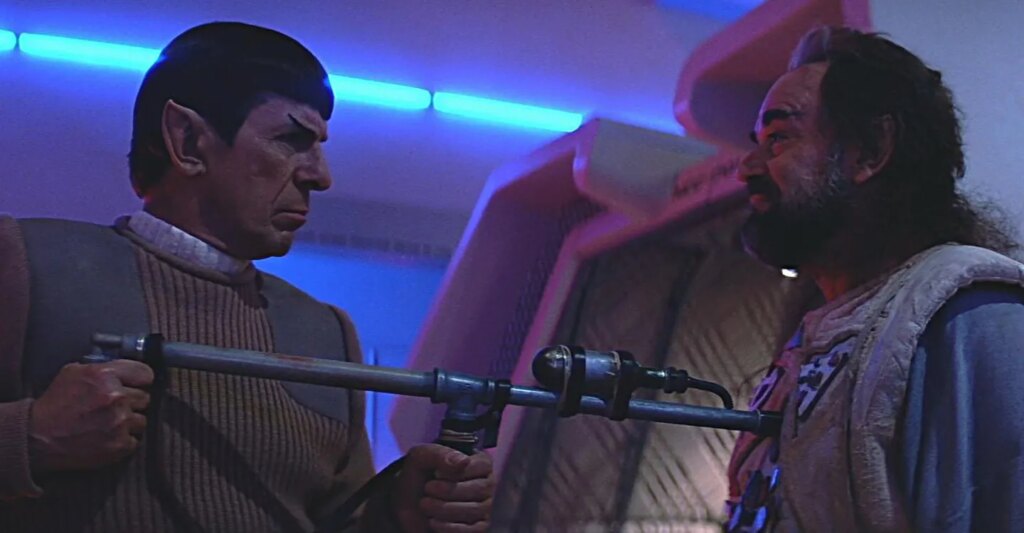

The Final Frontier sees Kirk, Spock, and McCoy forced to end their camping trip when the newly-minted Enterprise-A is called to rescue delegates from the Federation, the Klingon Empire, and the Romulan Star Empire. They’ve been kidnapped by Sybok, who took them in hopes of getting aboard a starship he could capture and fly to Sha Ka Ree. Once aboard, Sybok uses his self-help, mind-healing techniques to make converts of much of the crew, including Uhura, Sulu, and Chekov, and takes command of the Enterprise.
Sybok flies the Enterprise to the Great Barrier, the pathway to Sha Ka Ree, with a Klingon Bird of Prey in pursuit. They are greeted by a being that presents himself as God. But when Kirk reasons, “What does God need with a starship?” the being’s ruse is made plain. It’s just another entity seeking power, and that’s something that Kirk can defeat. Defeat it he does, with some help from some Klingons who have been swayed by Spock’s diplomatic ability. And though Sybok dies in the process in the battle, the Enterprise escapes, allowing Kirk, Spock, and Bones to resume their camping trip.
The film is filled with groaners. The opening, in which Kirk climbs up El Capitan (all while wearing a shirt that says “Go Climb a Rock”) feels like Shatner grandstanding. The sudden romantic relationship between Scotty and Uhura comes out of nowhere. The introduction of Sybok makes Michael Burnham’s addition feel earned, and the movie has nothing to say about faith or televangelists, the film’s thematic subjects.
Sharing Our Pain
Why is The Final Frontier about televangelists? Because they annoyed William Shatner and Shatner got to make the movie. And because he and Leonard Nimoy had a “favored nations” clause that meant that anything offered to one must also be offered to the other. So when Nimoy got to helm Star Trek III: The Search for Spock, one of his conditions for returning to the role, and then again with The Voyage Home, Paramount also had to give Shatner a chance to make a movie.
And so, we got a rambling movie with odd characterizations, half-developed themes, and way too much focus on Kirk. Which is exactly like most episodes of Star Trek.
60 years after Star Trek first went on the air, we tend to only remember the best episodes of The Original Series: “Balance of Terror, ” “Amok Time,” “City on the Edge of Forever.” These are perfect pieces of sci-fi, stories that combine big ideas and star-spanning adventure, making the most of their charismatic cast. These episodes deserve all the praise we heap upon them.