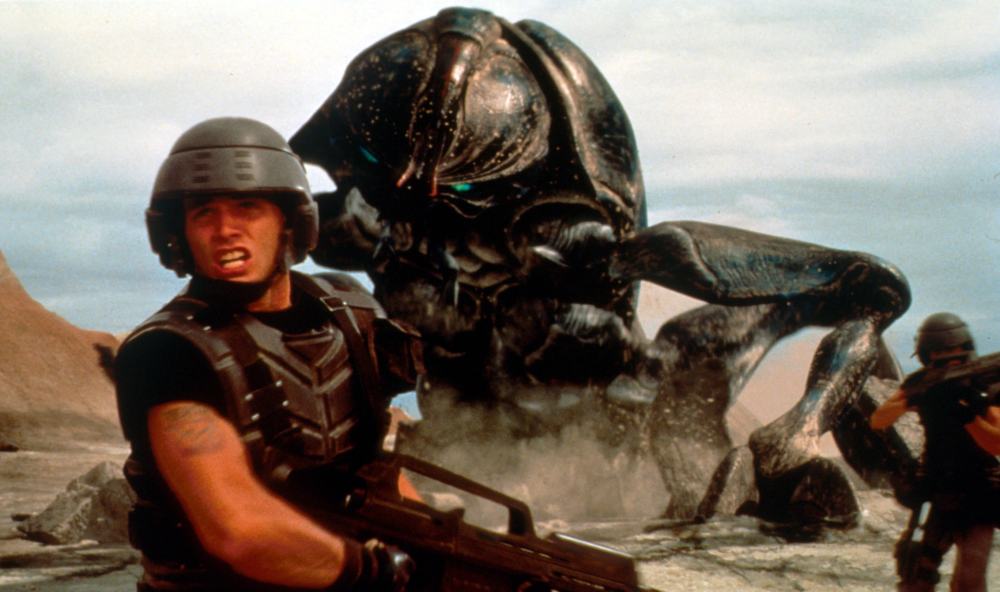

Donald Trump’s AI-generated designs for Space Force uniforms are inspired by Starship Troopers – a film that, 20 years on, is still being misunderstood.
Seldom guilty of putting much effort into anything, the Donald J Trump administration has used generative AI to cough out some uniform designs.
You may have seen these filter out on the social media platform of your choice over the past day or so. First dumped on Trump’s own app, Truth Social, the uniforms are for the United States Space Force – a department established in 2019.
Web dwellers quickly noticed that Trump’s gen-AI uniforms – all black and grey, severe lines, with matching black leather boots – looked a bit Galactic Empire out of Star Wars. Or the similarly fascistic uniforms in Paul Verhoeven’s 1997 masterpiece, Starship Troopers.
Look a bit more closely at Trump’s Space Force graphic, though, and the depth of the inspiration is made as plain as day.
“Design Inspiration,” a bit of copy reads. “Inspired by the discipline and functionality of the Starship Trooper [sic] uniform. Modernised for the guardians of the space domain.”
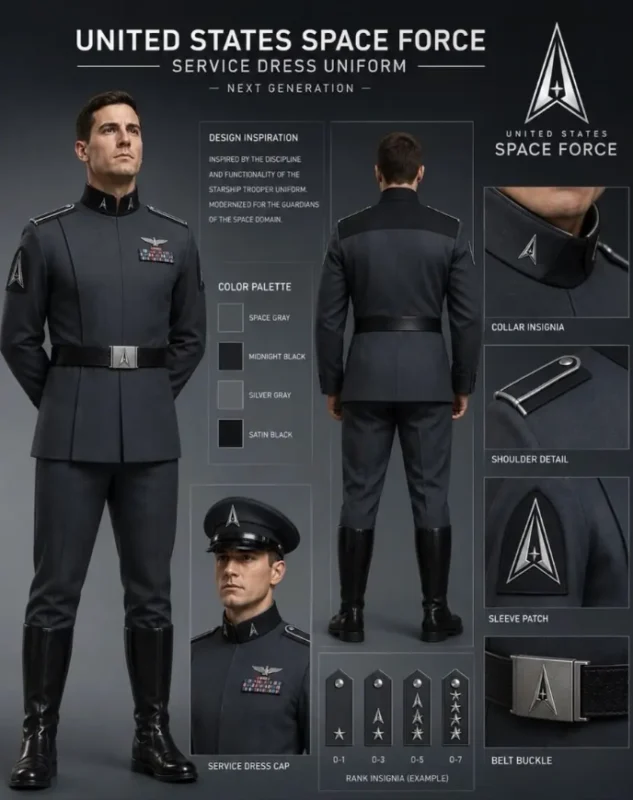
Yes, the Trump administration has drawn on the imagery of a film that was intended as a warning about the United States becoming a militarised fascist state. Verhoeven’s cautionary tale about totalitarianism has been used as a visual reference guide.
In all likelihood, this is probably just more internet trolling on Trump’s part – much like the White House’s site of vibe-coded retro games that add a fascist theme to a handful of arcade classics. Few will play them, but they grab headlines and upset people who possess old-fashioned things like empathy and decency.
Trump’s space Nazi uniforms will probably never get beyond the AI prototyping stage, either – it’s just another means of fomenting yet more outrage and confusion among the president’s opponents.
What’s striking about the whole would-be meme, though, is that it continues a proud tradition of misunderstanding Verhoeven’s (almost) 20 year-old film.
When it emerged in 1997, Starship Troopers horrified critics who took it at face value. The Washington Post wrote that the film was “so inconsistent that it’s impossible to decide whether [Verhoeven’s] sending up the Third Reich or in love with it.”
Mystifyingly, a generation of well-paid writers failed to recognise that, when Verhoeven and his collaborators evoked the imagery of Leni Reifenstahl and the Third Reich, they weren’t endorsing it, but using it as a warning for anyone who might think that the US is immune from falling into the same death spiral of nationalism and militarism.
The misunderstanding, clearly, extends into the present day. Over on Deadline, a piece quotes Roger Ebert’s 1997 review which called the film “quasi-fascist militarism.” Chiming with other notices of the time, Ebert wrote that, “If Star Wars is humanist, Starship Troopers is totalitarian.”
Deadline’s piece also calls Starship Troopers “quasi-satirical” – a weird term that seems to hedge its bets as to whether Verhoeven is sending up fascism or endorsing in it.
Admittedly, author Roger A Heinlein’s source novel was pro-military, and was widely criticised for being so even when it was published. But Verhoeven – who hated the book – and screenwriter Edward Neumeier did was take the politics already present in the source and take them to their natural conclusion.
If you have a future state where a global, military regime fights a forever war against a faceless hive mind far away, and you’re required to sign up before you can become a citizen, then you have fascism. Or, in short, Nazis in space.
Verhoeven himself saw Nazism first-hand in his native Holland. The violence he saw as a child informed much of the imagery he brought to his films as an adult. The filmmaker has said repeatedly in interviews that Starship Troopers is staunchly anti-fascist; as he once told Empire, “All the way through [the film] we were fighting with the fascism, the ultra-militarism. All the way through I wanted the audience to be asking, ‘Are these people crazy?’”
Remarkably – even with 20 years to settle in – this singularly unsubtle film is still too subtle for some.