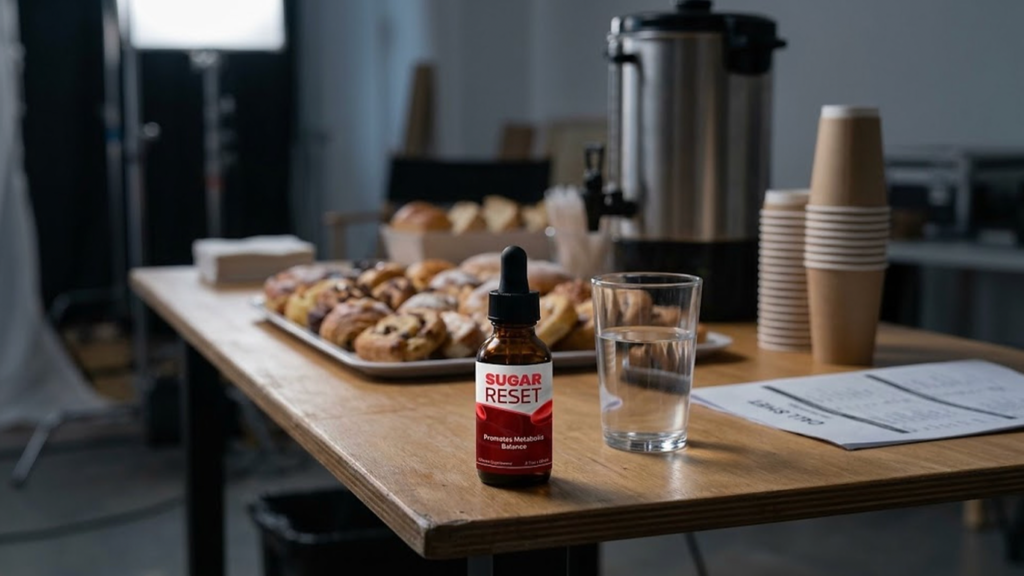


Sugar Reset is a liquid you take by the dropper, sold for metabolic balance and searched for by people worried about sugar. We went through its Supplement Facts panel one line at a time, looked up what each ingredient has been shown to do and at what amount, and set out the two things anyone with a blood-sugar concern should know before trying it.
Sugar Reset at a glance
- What it is: a 60 ml liquid supplement taken as one or two droppers a day, sold for metabolic balance; sugar-free, sweetened with stevia and xylitol; made in the USA in an FDA-registered facility
- What is in it: 0.7 mcg of chromium (2% DV) plus a 200 mg proprietary blend of 22 botanicals and amino acids, including gymnema, green tea, guarana, African mango, ginseng and maca; individual amounts are not disclosed
- Sold: only through Sugar Reset’s own site; marketplace listings and look-alike pages on other domains are not the brand’s
- In the news: USA Today’s report on Sugar Reset’s U.S. availability
- Not: a treatment for diabetes or a replacement for any medication, which the label itself makes clear
Every set has a table, and every table has the same arc: bagels and pastries at call time, candy by mid-morning, and a crash somewhere around the third setup after lunch that no amount of coffee fixes. It is the reason a product named Sugar Reset gets typed into search bars by people who have nothing to do with film, and it is the reason the Sugar Reset reviews they find are worth reading carefully, because most of them are written by people selling it.
This one is not a sales page. Sugar Reset is a red-labelled dropper bottle, two fluid ounces of liquid, with a Supplement Facts panel that lists one mineral and a 22-ingredient proprietary blend. That panel is where the useful information is, and the rest of this Sugar Reset review is built on it: what each ingredient is known to do, at what amounts the research saw it, how a 200 mg blend spread across 22 names compares, and what the product can and cannot be for someone whose blood sugar is a genuine medical concern rather than a craft-services problem.
What is Sugar Reset?
Sugar Reset is a liquid dietary supplement in a 60 ml bottle with a dropper. The label’s claim is three words, “promotes metabolic balance,” followed by the standard note that the statement has not been evaluated by the FDA. Directions are to shake the bottle, take one or two droppers a day, place the liquid in the mouth and swallow; each dropper is a 1 ml serving, so a bottle holds sixty servings, or one to two months. The base is glycerin and water, the flavour comes from organic lemon extract, and the sweetness from stevia and xylitol rather than sugar, which is a sensible choice for a product with this name. It is made in the USA with globally sourced ingredients in an FDA-registered facility and distributed by Instituto Experience of Lakeland, Florida. The company sells it only from its own site, a point USA Today made when it reported on Sugar Reset’s availability, and the full panel and directions are reproduced by Sugar Reset for anyone who wants to compare them with the list below.
The format matters more than usual here. Several of the ingredients, gymnema above all, act on the tongue rather than in the bloodstream, and a liquid held briefly in the mouth is the one delivery method that lets them do that. It is a small point, but it is the most interesting thing about the design of this product, and it comes back in the research section.
Sugar Reset ingredients: what the panel says
Per 1 ml serving, the Supplement Facts panel reads:
- Chromium (as chromium picolinate), 0.7 mcg, 2% DV
- Proprietary Blend, 200 mg: maca root extract, grape seed extract, guarana seed extract, African mango (Irvingia gabonensis) seed extract, Eleutherococcus senticosus root extract, astragalus root extract, green tea leaf extract, gymnema leaf extract, Coleus forskohlii root extract, Capsicum annuum fruit extract, grapefruit fruit extract, Panax ginseng aerial extract, raspberry ketones, L-glutamine, L-tyrosine, L-arginine base, beta-alanine, monoammonium glycyrrhizinate, GABA, L-ornithine HCl, L-tryptophan, L-carnitine base
- Other ingredients: glycerin, water, organic lemon extract, stevia extract 97% (Reb A), xylitol, sodium benzoate, potassium sorbate, citric acid, natural flavors
Two numbers frame everything else. The first is 0.7 mcg of chromium, which is two percent of the Daily Value; the chromium research discussed below used two hundred to one thousand micrograms, so this amount is a gesture towards the mineral rather than a dose of it. The second is 200 mg shared by 22 ingredients. Proprietary blends do not disclose how the total is split, but arithmetic sets a ceiling: even if the blend were nothing but its first-listed ingredient, that ingredient would be at 200 mg, and in practice each of the 22 is a small fraction of that. Nothing here is at an amount that has been studied on its own.
Does Sugar Reset work? What the research shows for the ingredients that matter
With 22 names on the panel, it makes sense to concentrate on the handful that connect to the product’s purpose, and to say plainly which ones do not.
Chromium is the only Sugar Reset ingredient with its own line and a real evidence base. A 2014 systematic review in the Journal of Clinical Pharmacy and Therapeutics pooled twenty-five trials and found that chromium supplementation, mostly as picolinate at 200 to 1,000 mcg a day, produced small improvements in blood-glucose markers in people with type 2 diabetes and no measurable effect in people without it. Sugar Reset provides 0.7 mcg, roughly three hundred times less than the low end of that range. Whatever the product does, it is not doing it through chromium.
Gymnema is the Sugar Reset ingredient that fits the format. Its active compounds temporarily block the sweet-taste receptors on the tongue, and a 2020 crossover study in the journal Nutrients found that people who took a gymnema preparation in the mouth rated sweet foods as less pleasant and ate less of them in the following half hour than after a placebo. That is a mouth effect, not a metabolic one, and it depends on how much gymnema reaches the tongue; a liquid dropper is the right vehicle for it, but the panel does not say how much of the 200 mg is gymnema, so the effect will vary from noticeable to absent. It is the most plausible reason a user might report fewer sweet cravings, and it is worth testing for yourself by paying attention to how sweet things taste in the thirty minutes after a dose.
Green tea and guarana are both sources of caffeine, together with a set of plant compounds studied for thermogenesis, and they are the two ingredients most likely to be felt as a lift. The label does not state a caffeine figure, which is normal for a blend but worth knowing if you are caffeine-sensitive or already several coffees into a shoot day; at these amounts the total is likely small, but it is not zero. African mango seed extract has a couple of small, industry-funded weight studies at 300 mg a day, above the entire blend here. Capsicum contributes capsaicin, grapefruit extract contributes naringin, and grape seed extract contributes polyphenols, all at fractions of the amounts used in research.
Ginseng, eleuthero and astragalus are traditional adaptogens with long histories and modest human evidence at gram-level doses. Maca and Coleus forskohlii sit in the same category. Raspberry ketones have no human trials worth the name. The amino acids that close out the list, glutamine, tyrosine, arginine, beta-alanine, GABA, ornithine, tryptophan and carnitine, are studied at doses measured in grams, so their presence in a 200 mg blend is nominal. Monoammonium glycyrrhizinate is a licorice-derived compound used mainly for taste.
Read together, the Sugar Reset panel describes a low-dose herbal tincture whose most credible effect is on how sweet things taste for a short while after a dose, with a small caffeine lift from the green tea and guarana. That is a fair thing for a product to do, and for someone trying to break a mid-afternoon candy habit it is not nothing. It is a long way from resetting anything metabolic, and the honest expectation is the former, not the latter.
How to take Sugar Reset, and how long to give it
The label says one or two droppers a day, shaken first, placed in the mouth and swallowed. Given what gymnema does, the sensible way to use it is to take a dropper a few minutes before the moment you usually reach for something sweet, and to let it sit on the tongue for a short while before swallowing, so that whatever gymnema is in the blend has a chance to act. On a set, that is the walk to the craft-services table; in an edit suite, it is the 3 p.m. slump. Keep the bottle away from heat and light, as the label asks, and out of reach of pets as well as children, because xylitol is dangerous to dogs. The directions and the storage advice are repeated, together with the label image, by the Sugar Reset site.
How long to give Sugar Reset depends on what you are testing. The taste effect, if you feel it, is immediate and lasts under an hour. Any change in habit, eating less sweet food because it tastes less rewarding, shows over two to four weeks. Anything beyond that is outside what these amounts can be expected to do, and a month is a fair trial.
Sugar Reset side effects and who should be careful
At the amounts on the label, Sugar Reset is unlikely to cause side effects in healthy adults. The points worth knowing are the undeclared caffeine from green tea and guarana, which can add to the day’s total for anyone sensitive to it; the xylitol, which in larger quantities can loosen the stomach and which is hazardous to dogs; and the grapefruit extract, which in the amounts found in juice can interact with certain medications, though the trace here is unlikely to matter. The label rules out use in pregnancy, nursing, under-18s and anyone with a known medical condition without a physician’s agreement.
The second point is more important than the first, and it applies to everyone whose interest in this product comes from a diagnosis rather than a snack table. Sugar Reset is not a treatment for diabetes or prediabetes and does not replace any medication or monitoring; the company’s own communications say as much. Anyone taking glucose-lowering medication should talk to their doctor before adding any supplement marketed for metabolic support, not because this product is likely to interfere at these doses, but because that is the right sequence whenever blood sugar is medically managed. A supplement can be part of a conversation with a doctor; it should not be a substitute for one.
Sugar Reset reviews and complaints: reading them with the label in hand
Because the product is sold only from the brand’s own site, the name attracts imitators: pages posing as an official store on unrelated domains, marketplace listings from unknown sellers, and review pages for storefronts the company has never operated. Many of the complaints filed under Sugar Reset online are about those experiences, wrong products and missing orders from third parties, rather than about the liquid on the label. The panel published by Sugar Reset is the reference: 0.7 mcg of chromium, a 200 mg blend of 22 named ingredients, stevia and xylitol as sweeteners, lemon as flavour. Anything else is something else.
The second kind of Sugar Reset complaint comes from the gap between the advertising language around this category and what a low-dose tincture can do. Ads that promise dramatic metabolic changes set people up for disappointment, and the label’s own claim, metabolic balance, is far more modest than the ads. Users who report satisfaction tend to describe the thing the research would predict: sweet foods losing some of their pull, and a small, steady reduction in how much of them they eat. Judged against that, the product is easier to assess fairly; judged against the ads, nothing at 200 mg would pass.
The company behind Sugar Reset
Sugar Reset is distributed by Instituto Experience of Lakeland, Florida, which also distributes several other supplements in the metabolic and wellness space. The label states that the product is made in the USA with globally sourced ingredients and manufactured in an FDA-registered facility, a registration that covers the plant rather than the product, and customer service runs through the company’s own email and phone line. Its label, like every supplement label in the United States, includes the FDA notice that the claims have not been evaluated by the agency.
Sugar Reset FAQ
Does Sugar Reset really work?
Sugar Reset’s most credible effect is on taste: gymnema can make sweet foods less appealing for a short time after a dose, which may help with cravings. Its chromium is at two percent of the Daily Value, far below studied amounts, and the other 21 blend ingredients are present at fractions of researched doses. Expect a modest habit aid, not a metabolic change.
Does Sugar Reset contain sugar or caffeine?
Sugar Reset contains no sugar: it is sweetened with stevia and xylitol. It does contain some caffeine from green tea and guarana extracts, in an amount the label does not state.
Can Sugar Reset replace diabetes medication?
No. Sugar Reset is a dietary supplement, not a treatment, and anyone on glucose-lowering medication should speak to their doctor before taking it and should not change their medication because of it.
Is Sugar Reset FDA approved?
No dietary supplement is approved by the FDA. Sugar Reset is manufactured in an FDA-registered facility, which is a different thing, and carries the standard disclaimer.
How long does Sugar Reset take to work?
The taste effect is immediate and short-lived. Any change in eating habits shows over two to four weeks; give Sugar Reset a month.
Is the Sugar Reset sold on marketplaces the same product?
Not necessarily. The brand sells only from its own site, so listings elsewhere come from third parties, and the contents on those listings should be checked against the label Sugar Reset publishes before trusting them.
Is Sugar Reset safe?
For healthy adults taking Sugar Reset at one or two droppers a day, yes. Caffeine-sensitive people should note the green tea and guarana, dog owners should keep the xylitol-sweetened bottle away from pets, and anyone pregnant, nursing, under 18 or managing a medical condition should ask a physician first, as the label directs.
Where this leaves Sugar Reset
Sugar Reset is a well-presented, sugar-free herbal tincture whose realistic job is to take some of the shine off sweet food for half an hour at a time, with a little caffeine behind it. For someone who wants a tool against the afternoon candy run and understands that the metabolic language on the front is aspiration rather than description, it is a reasonable one, and the panel is honest enough about its contents to let you decide. For anyone whose blood sugar is a medical matter, the right first step is a doctor, and the label published by Sugar Reset is worth reading in full before anything else, because it is more modest, and more accurate, than the ads.