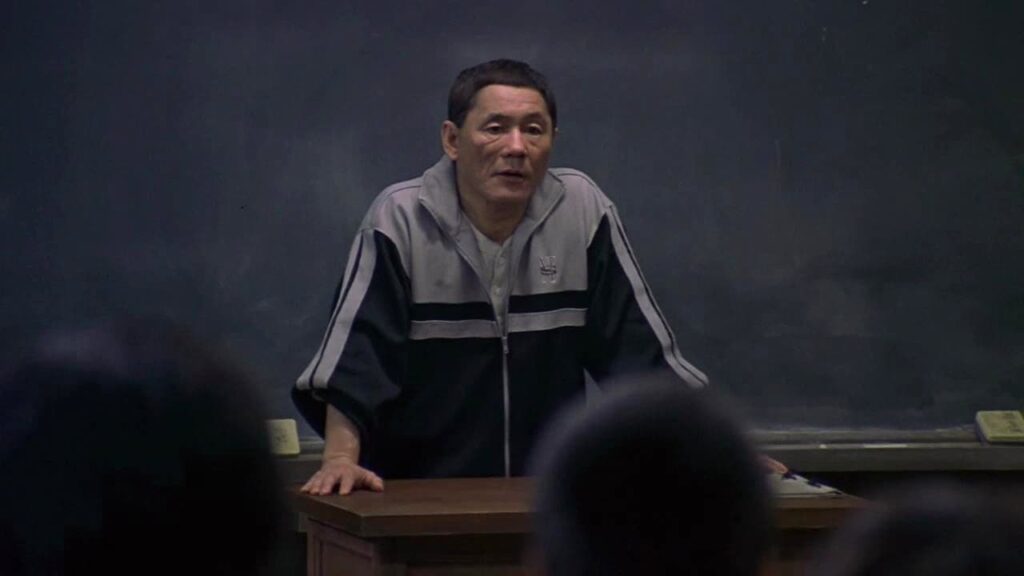

Simon Thompson takes a deep dive into the career of Takeshi ‘Beat’ Kitano…
Takeshi Kitano’s life and artistic career have been spent pushing against convention and his career has been shaped by a series of fortunate events rather than any plan. Kitano started in the entertainment industry, first after a random beginning as a comedian and TV show host, going by the name Beat Takeshi, but accidentally, as I will explain further on, he later found himself becoming a celebrated director. Kitano, as a director, is largely associated with the crime and yakuza genres but has branched out into others, such as historical drama and romance – showcasing his wide range of interests and ideas.
Takeshi Kitano was born in the working class Adachi neighbourhood of Tokyo in January 1947 to a housepainter father and a teacher/factory worker mother. Growing up with his two older brothers and an older sister, the young Kitano saw the war-damaged Tokyo rebuilt into one of the world’s great metropolises, yet in Adachi, (as Kitano stated in an interview with Alex Simon) he and his friends realised they only had two ways out – organised crime or baseball. So, in his first push against expectation, Kitano enrolled in the prestigious Meiji University to study engineering.
Despite his immense intelligence academic study bored him, to the extent that he dropped out at the age of 19. One night, a comedy night was taking place in the bar where he was working and an act dropped out of the bill. Needing a substitute pronto, the bar owner asked Kitano to fill in, and by chance Kitano had found his calling. Subsequently, he moved to the Asakusa district of Tokyo in the early 1970s in pursuit of becoming a comedian. While he was working as a lift operator in a seedy bar, the resident comic Senzaburo Fukami took him under his wing, showing him the ropes until he became the bar’s lead act.
With his friend Kiyoshi Kaneko he formed a comedy duo named The Beats. Blessed with one of the world’s great deadpan expressions, Kitano played the straight man in the pair’s dynamic. Their act was far more risqué and dirtier than the traditional Japanese comedy double act, reaching a level of nationwide popularity due to how much they tested the limits of taste and acceptability.
In the early 80s Kitano decided to pursue a career as a solo comedian, splitting with Kaneko and establishing himself as a key performer in the world of Japanese TV comedy. During his time as a comedian, Kitano met many yakuza through afterparties, who on nights of heavy drinking would tell him stories about their lives. This inspired and provided him with invaluable knowledge for the work that he’d be doing as a director.
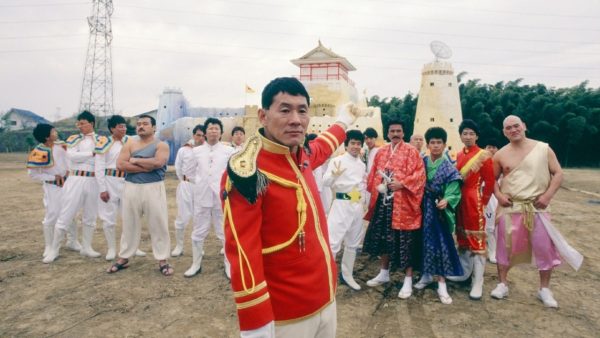
When not hosting the mega-hit game show Takeshi’s Castle or designing his own video game for the Famicom entitled Takeshi’s Challenge (one of the most notoriously difficult and bizarrely executed games in the history of the medium), Kitano was beginning to dip his toes into dramatic acting. His first big break away from comedy came with a starring role in Japanese cinema legend Nagisa Oshima’s World War II drama Merry Christmas, Mr Lawrence (1983) playing a prisoner of war camp sergeant alongside a star studded cast featuring the likes of Tom Conti, David Bowie, and Jack Thompson (the Australian actor not the 2000s anti-video game crank).
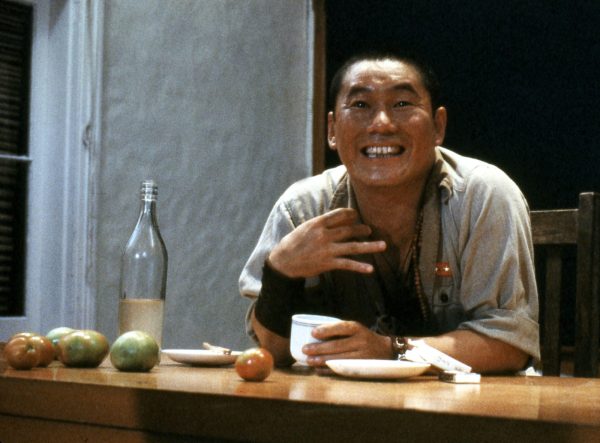
Merry Christmas, Mr Lawrence recast Kitano in entirely new light, and led to some more high profile dramatic roles throughout the rest of the 1980s in films such as Joke With a Sorrowful Heart (1985) – but the rest of his acting work during this time was largely comedic in nature.
In 1989 the great Japanese filmmaker Kinji Fukasaku cast him as the lead in his gangster film Violent Cop, but the production ran into problems because of his star’s assorted tv commitments. Fukasaku, wanting to make sure the movie was seen through to completion, stepped aside, suggested that Kitano direct it himself at his own pace, and allowed him to make extensive rewrites to the script. Little did Fukasaku know just how gifted a director Kitano would turn out to be.
At first the production staff were dismissive towards Kitano, believing that his comedy background would be a hindrance to his doing a good job, but as the tight shooting schedule rolled on they began to trust him and let him get on with directing as he pleased.

Violent Cop is a neo-noir thriller centring around Azuma (Takeshi Kitano), a policeman who takes care of his intellectually disabled sister (Maiko Kawakami) while also suffering from a gambling addiction. When Azuma discovers that a colleague, Iwakai (Sei Hiraizumi), is dealing drugs he goes on a one man mission to disrupt the Yakuza’s drug trade.
Looking back, Violent Cop showcased all of Kitano’s artistic idiosyncrasies early; an anti-hero protagonist who, while far from perfect, is capable of great good; still camera movement; bloody violence and a sense of dry yet dark humour.
What set Violent Cop apart from other Japanese crime cinema before it, was having a hardboiled, morally compromised policeman as the main protagonist, who resorts to the most extreme methods possible. Unlike Death Wish and its various clones, Violent Cop forces you to question the morality of Azuma and what he’s doing, with his extreme violence being presented as the opposite of stylised heroics and demonstrating that in reality it solves nothing.
While Violent Cop doesn’t quite reach the heights that the films Kitano made after it would, it’s still an excellent debut that set Kitano on the path to becoming a director. Despite a chaotic shoot (that would take an article itself to cover), Kitano managed to snatch victory from the jaws of defeat.

Kitano’s first film of the new decade, Boiling Point (1990) was a culmination of everything he’d learnt during the making of Violent Cop but made into a slicker, more focused, and funnier outing, that’s a masterclass in combining dark comedy and crime drama.
Boiling Point follows Masaki (Yurei Yanagi), a local baseball player whose coach Mr Iguchi, an ex yakuza, is beaten up by a current yakuza. Masaki vows revenge for his coach, and along with one of his teammates takes a trip to Okinawa to buy weapons. When they arrive in Okinawa, they come across Uehara (Takeshi Kitano) a borderline psychotic yakuza who takes the pair under his wing and introduces them to the swift violence of organised crime.
Kitano’s editing skills increased tenfold between Violent Cop and Boiling Point, with the latter’s ambiguous storytelling and escalating tonal shifts benefiting from Kitano’s quick cutting. Boiling Point also represented Kitano’s first film as a sole screenwriter, which allowed him to integrate his unique sense of tone into the script more readily than he could have done with his debut.
What works about Boiling Point is that it’s a movie which is making you laugh one minute, and then jarring you the next. Kitano is a director who not only understands the power of violence, but also the bizarre small moments of comedy that punctuate everyday life. Nowhere is this better demonstrated than in a key scene of the movie, where the protagonist finally gets a gun and proceeds to shoot out the windscreen in his girlfriend’s car. Although this is a funny scene on its own, it also functions as a clever tension breaker by Kitano to give the audience a breather from the intense tone and imagery (a technique other directors such as Tarantino and Martin McDonagh have taken up inspired by Kitano).
Boiling Point showed Japanese audiences and critics that Kitano’s success with Violent Cop wasn’t a fluke at all, and that a guy who started out as a slapstick TV comedian was establishing himself as a director of serious promise.
A Scene At The Sea (1991) was Kitano’s first sign that he was more than a gangster movie director. The story of a deaf bin man (Kurodo Maki) who after finding a surfboard on his route becomes completely enamoured by the sport, it showed a softer more contemplative side to Kitano’s artistry. A Scene At The Sea also marked his first collaboration with composer Joe Hisaishi, with the pair forming a Hitchcock- Bernard Hermann or Leone-Morricone style relationship where you can’t imagine one without the other.

Sonatine (1993) marked a significant turning point in Kitano’s career. What makes it such a startling work of art is that Kitano took the stark violence of his first two films and the Bill Forsythe-like sweetness of A Scene At The Sea and married them together, in a way which marked a new frontier for Japanese crime cinema.
Sonatine follows Murakawa (Kitano) a tired, disillusioned, middle-aged yakuza who has become sick of being involved in organised crime. Murakawa is sent to Okinawa to help end a bitter and rapidly escalating turf war, and while laying low with the rest of his family begins to contemplate his place in the world.
The best way I could describe Sonatine is that it’s a crime film that Federico Fellini would have made. While it contains plenty of shocking scenes, and graphic violence, there is a real sense of Felliniesque levity that punctuates it and that, when combined with Joe Hisasahi’s moving score ensures that the memory of the film lingers in your mind long after it’s finished.

Sonatine was the first of Kitano’s movies to garner him an audience overseas, and although it was a commercial failure at the Japanese box office (largely because Japanese audiences still saw Kitano as simply being a comedian and found it hard to take him seriously as a dramatic artist) it took the worldwide film festival circuit by storm. Screened in the Un Certain Regard section of Cannes, praised by Roger Ebert who hailed it as an example of gangster movies not needing “gratuitous gore, non-stop action, and stupid dialogue” and comparing it to Melville’s Le Samourai, it was picked up for wide European distribution by French publishing magnate Jean-Pierre Dionnet (most famous for being one of the founders of Metal Hurlant).
In four short years Kitano had gone from a jobbing director to one of the most heralded voices in international filmmaking, and in the years since its release in 1993 the reputation of Sonatine as one of the finest Japanese films of that decade has only grown.
Getting Any? (1994) marked a return to comedy for Kitano. The movie can largely be described as a twin hybrid Zucker & Abramsesque parody of Japanese pop culture (for example Ultraman, Godzilla, Lone Wolf and Cub, Zatoichi) and a raucous sex comedy about a shy 35 year old virgin (Takeshi Kitano) who is completely inept at talking to women. Although the movie made little dent in the Japanese box office, it’s a work which takes a special place in Kitano’s heart.
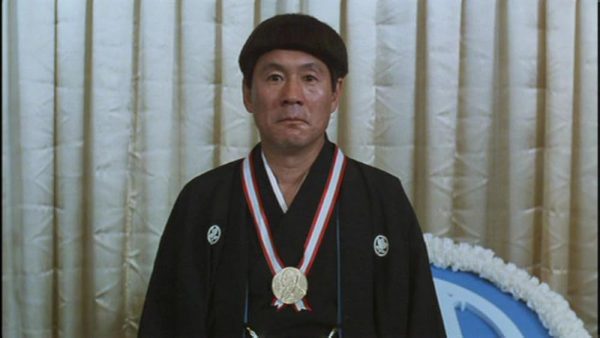
After the filming of Getting Any? Kitano was involved in a serious road accident on his motor scooter. The resulting damage left the right side of his face partially paralysed. While stuck at home recovering, Kitano began to take up painting to alleviate his boredom. Being Takeshi Kitano it wasn’t long before that his work began to be displayed in galleries and published in coffee table books, with their expressionistic nature and bold use of colour perfectly encapsulating their creator’s approach.
Kids Return (1996) was Kitano’s first movie after his recovery from the accident. Kids Return is a slightly underrated entry in Kitano’s illustrious filmography, largely because his fans in the west associate him with his crime films and don’t really give his quieter dramas a chance – which is a shame because they are as fulfilling as the movies for which he’s better known.
Kids Return focuses on two high school students and close friends Masaru (Ken Kaneko) and Shinji (Masanobu Ando), who can pretty much be described as every teacher’s worst nightmare to have in class. Eventually the pair drop out together and take different paths in life with Shinji attempting to becoming a professional boxer and Masaru falling into the lure of organised crime.
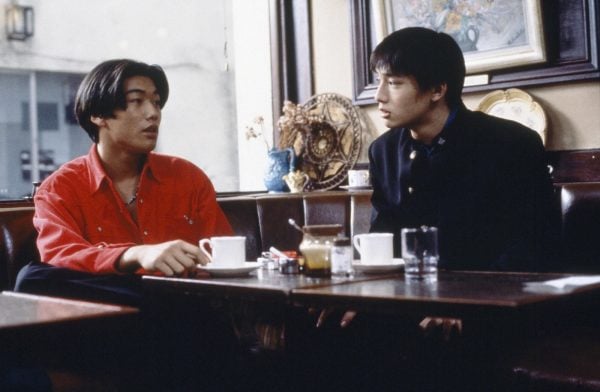
Kids Return manages to be both a hilarious comedy and a heartfelt coming of age film at the same time, Kaneko and Ando’s performances come across as being completely genuine with the two actors playing off each other effortlessly. Kitano’s direction is quiet and understated, with his still camera and washed colour palette being very Ozu like.
What is so resonant about this film is that it captures the stupid antics of being a teenage boy that transcend any cultural differences- with a key scene where the pair pretend to be adults to try and sneak into a porn theatre being a comedic gem.
Kids Return represented Kitano’s first success at the Japanese box office, where it resonated with audiences and critics enough to be nominated for three Japanese Academy Awards, and a best film prize for Kitano at the Yokohama Film Festival that year.
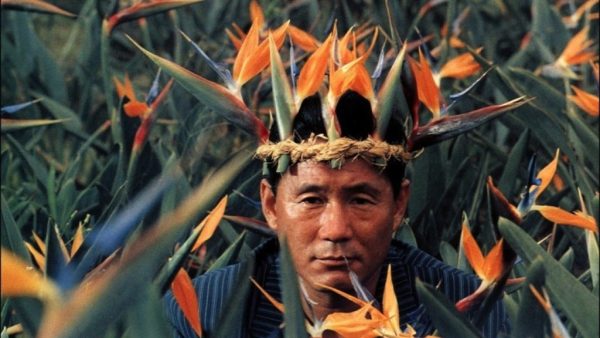
Kitano’s follow up to Kids Return (1996), Hana-bi (1997) or Fireworks, to use its literal English translation, is widely considered to be his masterpiece. Hana-bi is both an emotionally devastating drama and a tense thrill ride at the same time.
The plot focuses on Yoshitaka Nishi (Takeshi Kitano) an ex police officer who quit after a botched arrest led to his partner being severely injured and another detective being murdered. With his sick wife Miyuki (Kayoko Kishimoto) to take care of, Nishi borrows more money than he could possibly ever hope to pay back from the yakuza, to cover her medical costs. Desperate for money, Nishi plans a daring bank robbery to get himself and Miyuki out of their situation.
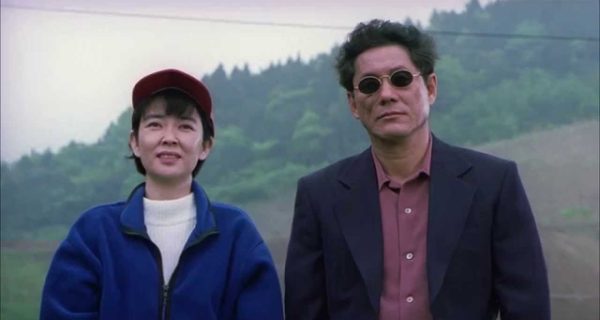
Hana-bi is a film of iridescent and indescribably serene beauty. There are shots in Hana-bi which could be straight out of a Van Gogh painting in the way Kitano uses bright colours to express a sense of melancholy, that never becomes mawkishly sentimental. Joe Hisashi’s melodic piano score, above anything else, really drives home the power of what you see, and out of his musical collaborations with Kitano is my own personal favourite and so impressive you can listen to it on its own without even seeing Hana-bi itself.
Furthermore Kitano gives one of his best performances in front of the camera in his career as Nishi. Nishi is not a likeable character by any means, he has an irascible hair-trigger temper and he’s committed numerous violent crimes, but his motivation for doing so, the genuine love he has for his wife, and the peace and atonement he is trying to find for the actions which got him struck off from being a policeman in the first place are incredibly admirable. Like Clint Eastwood in Unforgiven, the tragedy of Nishi’s life is that no matter what he does the redemption that he seeks is just that bit beyond him.
Hana-bi was the first time Japanese audiences treated Kitano’s film career as something to be taken seriously rather than the hobby of a TV comedian – this was in large part due to the movie being awarded the Venice Film Festival Golden Lion and the Grand Prix at The Belgian Syndicate of Critics ceremony. Hana-bi is now rightfully recognised as not just one of the best Japanese films of the 1990s, but one of the best from any country during that decade, and work that someone with even only a passing interest in Japanese cinema should see.
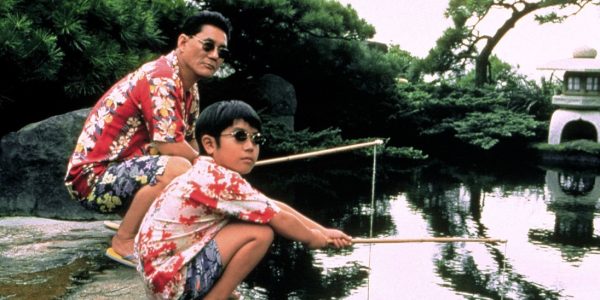
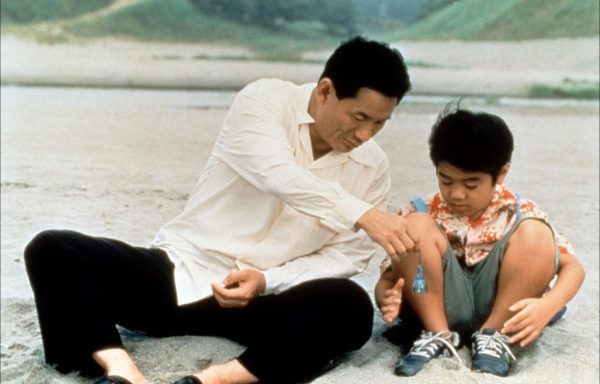
Kitano’s subsequent film Kikujiro (1999) capped off the impressive decade long run he had experienced in the director’s chair. Kikujiro is a charming, yet tragic road comedy about the eponymous protagonist (Takeshi Kitano) who through various circumstances agrees to help a child named Masao (Yusuke Sekiguchi) on a road trip to find his estranged mother during a summer vacation.
What is great about Kikujiro is that Kitano takes a simple plot, and gets the maximum amount of drama, comedy, and tragedy from it. Although they are decades apart in age both Kikujiro and Masao are bonded by both being misfits, and by the strange people they encounter on their trip. If you look at Japanese pop culture, be it movies, books, or manga, a common theme that you will find is the idea that even a short encounter can enrich someone’s life forever (One Piece being one of the most prominent examples of this) and this is a thematic thread that defines Kikujiro as a story.
As crushingly sad as this movie becomes at times, there is a strong undercurrent of light-hearted optimism that life is worth living and that the world is worth exploring – no matter what obstacles or heartbreaks are handed to you – that is absolutely infectious. Joe Hisashi’s score, a mixture of jaunty melody and a sadder more wistful nostalgia forms the perfect sonic backdrop for Kitano’s imagery. Although not as well received as some of Kitano’s other work, this movie is a misunderstood gem on a par with David Lynch’s The Straight Story in how it explores similar thematic ground.
At the start of the new millennium, Kitano had practically achieved everything that he could have strived for as a director. With a Golden Lion on his mantlepiece and basking in his worldwide acclaim, he felt that there was one challenge left for him, which was to conquer Hollywood. Kitano had made small steps into this, with a supporting role in the science fiction action blockbuster Johnny Mnemonic (1995) alongside Keanu Reeves, but he badly wanted an international hit to his name.
Brother (2000) was intended by Kitano to be a global hit, and the first film he shot outside his native Japan. Brother tells the story of Yamamoto (Takeshi Kitano) a tough Yakuza heavy, who is forced to flee to America after the murder of his boss and the destruction of his family in a violent turf war. Yamamoto decides to lie low in Los Angeles and reconnect with his estranged half-brother Ken (Claude Maki). He discovers that his brother runs a small time outfit of drug dealers alongside his lieutenant Denny (Omar Epps), and decides to use his know how to help them expand their business.
Brother is a strange but alluring mixture of a fish out of water comedy and a violent crime film. Kitano’s outsider perspective of Los Angeles and America is something akin to Sydney Pollack’s The Yakuza in reverse, with Kitano in the Robert Mitchum role. Although it’s nowhere near as strong as some of the other films he’s made, there is a lot that Brother has going for it, particularly Kitano’s character’s bizarre yet heartwarming friendship with Omar Epps’s character.
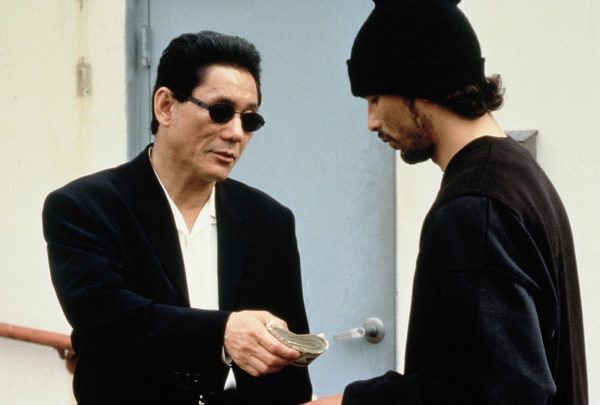
In contrast to Hana-bi, Brother received a much more mixed critical reception in Europe and Asia and much less fanfare from the American critics than he had previously been accustomed to. In the years since, Kitano has seen Brother as a failure on his part, due to the film not attracting the mass global audience that he had hoped. Sadly, because of this feeling of disappointment Kitano hasn’t shot a film outside of Japan since, looking back on the movie with a strong sense of regret.
For Dolls (2002), Kitano decided to move away from the style of crime filmmaking that made him so popular, retreating to the thematic ground that he had explored with A Scene At The Sea, Kikujiro, and Kids Return instead. In contrast to the three act character studies he’s largely known for, Dolls functions as an anthology movie consisting of three stories revolving around love and death. Story one focuses on a young man who rejects his fiancé to social climb, story two on a self-destructive pop idol obsessive, and story three on an aging gangster trying to reconnect with an old girlfriend from his youth.
Shot in luminous colour and taking its cues from Bunraku theatre (a traditional style of Japanese puppet theatre dating back to the 17th century) Dolls has a Jacques Demy and Vincente Minelli like opulence that stands in stark contrast to the usual understatement of Kitano’s previous works. While tonally the movie is nothing less than pure Kitano, it’s garnered a bit of a black sheep stigma in the context of his wider filmography because of this dramatic change in look and the fact that he doesn’t act in it either.
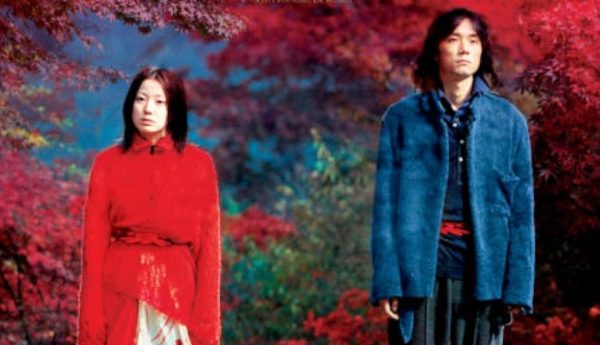
To Kitano himself the film is a critical examination of how both modern Japanese and various western societies handle the idea of death, however he has also acknowledged that the perception of the film by audiences and critics might be widely different from this.
Dolls debuted to little fanfare both in Asia and in Europe, leaving Kitano at the first crossroads of his decade long directing career. Although he was still prominent as an actor around the early 2000s, with his supporting role in Kinji Fukasaku’s Battle Royale (2000) often being cited as one of his finest performances as an actor, his directing career was in need of a film to quieten down his doubters.
For the first time in his career Kitano wouldn’t use an original idea as the basis for one of his movies, instead he decided to put his spin on a beloved staple of Japanese pop culture – Zatoichi. To put Zatoichi into context briefly, the character is the creation of 19th century author Kan Shimozawa and is a blind swordsman/masseur. Shimozawa subverted the discrimination that the blind struggled within the Edo era (being seen as equivalent to or lower than beggars) and created a new kind of adventure hero. Shimozawa’s novels follow Zatoichi and his various exploits across Late Edo Period Japan (1830s-1840s). To Japanese audiences he is akin to Sherlock Holmes in Britain or Fantomas in France in terms of his longstanding popularity.
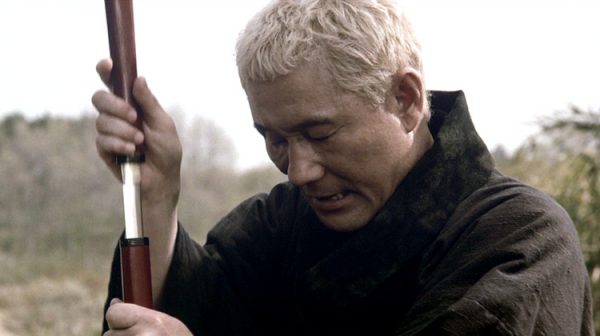
Although he started as a literary creation, he has been further immortalised by a 26 part film series starring Shintaro Katsu in the title role, occupying the same kind of space as Godzilla, James Bond or Star Wars when it comes to decade-spanning popularity.
Zatoichi (2003) sees the eponymous protagonist (Kitano), arrive in a village torn apart by a violent turf war between rival gangs and takes it upon himself to protect the locals. In the midst of this, he comes across a pair of sibling geisha, Okinu and Osei (Yuko Daike and Daigoro Tachibana) whom he decides to help avenge the murder of their parents. Zatoichi quickly comes to realise that the individuals responsible for the murders of Okinu and Osei’s parents are the same as the ones that are terrorising the village.
For the action in Zatoichi, Kitano intelligently combines old school fight choreography with digital effects to increase the gore of the assorted sword fights. The result is a brilliant mixture between the craft of the original Zatoichi movies from the 1960s-70s and the works of Akira Kurosawa and Hideo Gosha with state of the art digital effects that leave an indelible impression on the audience. Kitano bring his usual understatement to the part of Zatoichi, portraying him with a quiet stillness until something or someone provokes him into fighting.
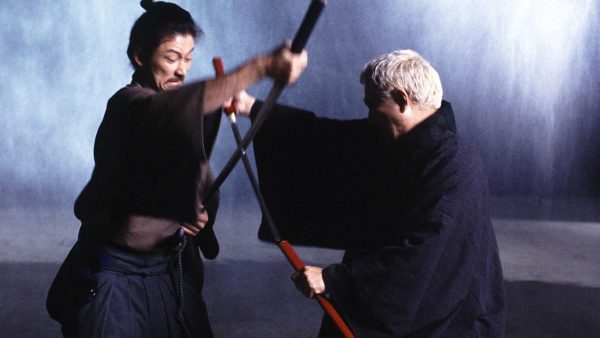
Zatoichi was Kitano’s first unabashed critical success since the late 1990s, with Washington Post critic Stephen Hunter putting it on a pedestal with other samurai classics such as Yojimbo or Lone Wolf and Cub. Zatoichi proved to be the director’s biggest festival success since Hana-Bi six years earlier, with Kitano winning the Silver Lion for best director at the Venice Film Festival and a Japan Academy Prize for best cinematography – leaving any of the critics who had written him off eating vast quantities of humble pie.
The mid-late 2000s were not a particularly distinguished time in Kitano’s career. This era is largely defined by experimental flops which, although commendable in the sense that they represented him trying something new, Takeshis’ (2005), To Each His Own (2007), Glory To The Filmmaker (2007), and Achilles And the Tortoise (2008), all sadly failed to hit the heights of previous work.
In 2010 Kitano intelligently pivoted back to the genre where he made his name with his first film of the new decade, Outrage. To contextualise Outrage within Kitano’s wider career, you could call it his Goodfellas in the sense that, like Scorsese before him, he was returning to the genre where he made his name as a young director, but with a newfound level of experience and craftmanship which can only come with age.
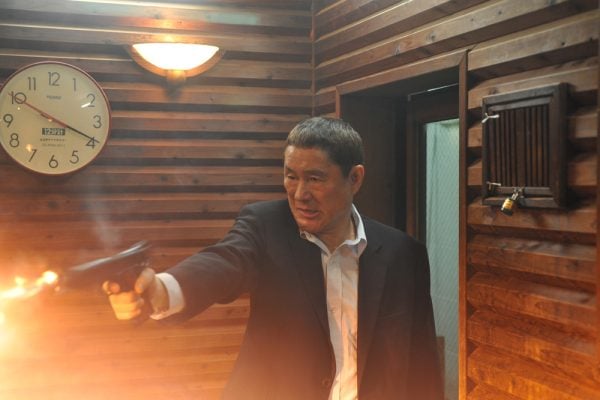
Outrage is the story of Sekiuchi (Soichiro Kitamura) a Yakuza boss trying to bring a group of rogue drug dealers to heel. Not wanting to get his own hands dirty, he decides to send his scariest enforcer Otomo (Takeshi Kitano) to teach them the error of their ways. What follows is a tense 1 hour and 49 minute thrill ride, in which the audience is thrown into the psychological deep end of Otomo’s profession.
Outrage was deliberately conceived by Kitano to be a crowd pleaser, to the extent that when he was drafting the script, he wrote the death scenes of the key characters and the action sequences first, and then plotted a three act structure from there. Outrage is Kitano’s most starkly bloody film since his debut with Violent Cop twenty years before, Otomo is the most coldly irredeemable character that Kitano has ever portrayed, and, unlike in his previous crime films Sonatine, Hana-bi, and Brother, there isn’t a core of Nicolas Ray-like sweet wistfulness to undercut the violence.
As the visuals were being shot on cinemascope, they carry a panoramic quality, that give the dimly lit meeting rooms, hotels, and cars where these characters spend most of their time a stately quality. Kitano’s trademark still camera work really adds to the tension and when combined with the use of cinemascope gives Outrage a look comparable to 1960s-70s political thrillers such as Z, Army of Shadows, The Conformist, and The Conversation, in contrast to the more Nouvelle Vague style of Kitano’s other crime films.
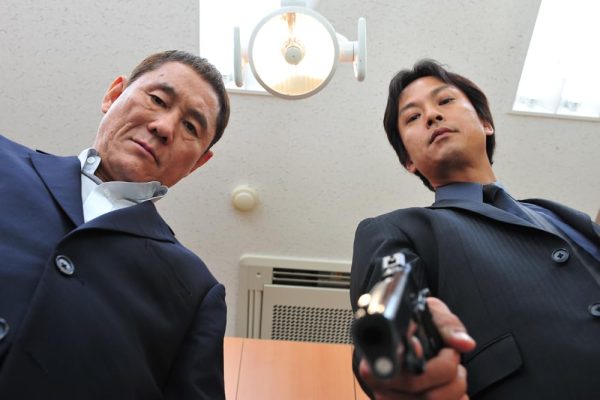
Outrage was Kitano’s first big critical and commercial hit since Zatoichi seven years previously, being nominated for the Palme D’Or at Cannes and making 634 million Yen at the Japanese box office. Outrage represents Kitano managing to pull off the rare feat of designing a movie to be commercially viable yet still having it display a strong sense of artistic integrity.
Since 2010, Kitano has made two sequels to Outrage and has shown absolutely no signs of slowing down in the slightest. Although he hasn’t recaptured his 1990s peak, Kitano has re-shaped how we see crime cinema and the yakuza singlehandedly. To see his influence across Japanese pop culture you only need to look at the crime comedy manga series The Fable, and the video game series Yakuza, to understand just how much Kitano has re-shaped Japanese crime media.
Kitano’s career shows why it is so important for a director to push against convention, and never to find themselves pigeonholed, even if they are strongly associated with a particular genre and style. In a world that is so obsessed with image and perception, films like Hana-bi, Kikujiro and Sonatine are needed more than ever, in the sense that they show you just how multi-faceted human beings can be.
Simon Thompson