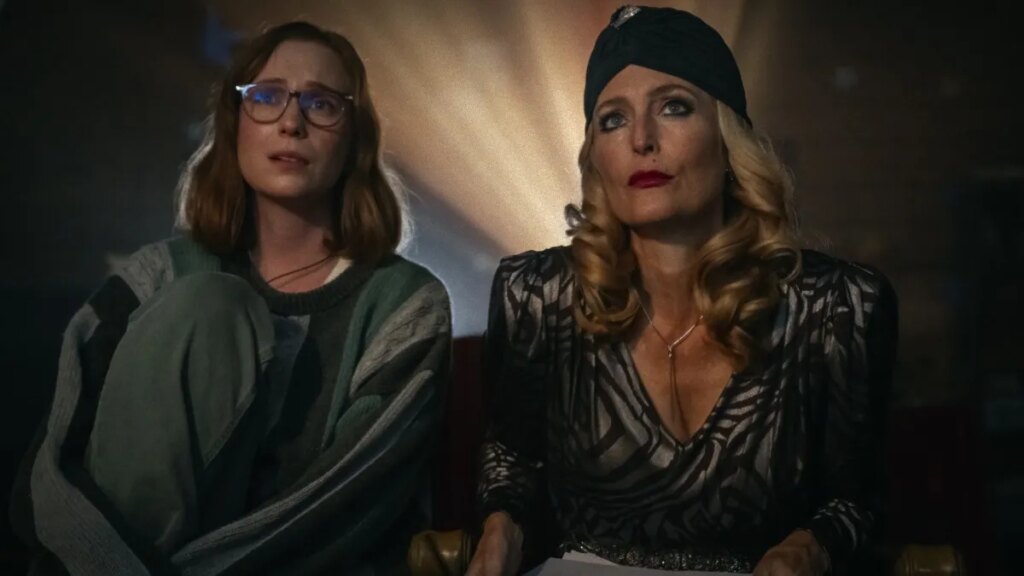

In a particularly telling scene, Kris and Billy watch the first movie together, which more or less follows the plot of 1980’s Friday the 13th: a group of partying counselors visit a summer camp that closed down years ago, when a camper drown and a killer called Little Death (Jack Haven) later attacked. Before the first night of partying can truly commence, one of the counselors (Zack Cherry) gathers his colleagues around a campfire to tell the story of the legend of Little Death. According to the counselor, Little Death was once a camper whose parents dressed them as a different gender every other day, which confused his fellow campers so badly that they drowned him in the lake.
“They had to do it,” insists the counselor, which his fellows all agree with and the fictional movie Camp Miasma seems to accept. But when Kris leans over to Billy and whispers, “This part is transphobic,” the actress hisses back, “Hush.”
Notice that Billy doesn’t tell Kris that she’s wrong. The counselors’ description of the non-binary camper, the actions of the other campers, are all transphobic. And that’s a completely acceptable read of not just the fictional movie Camp Miasma, but also the films that inspired it. In particular, Camp Miasma also echoes Sleepaway Camp, in which gender confusion drives the killer, and the reveal that the killer Angela (Felicia Rose) has a penis is treated as something more horrifying than the fact that she’s cradling a boy’s severed head.
Obviously, it’s wrong for any movie to suggest that anyone should be killed or feared because of their gender identity. But when Billy shushes Kris, she isn’t thinking about morality. She’s drawing attention to something deeper.
Our Killers, Our Selves
As Teenage Sex and Death at Camp Miasma unfolds, we learn that Kris is not just interested in recruiting Billy to reprise her role. Rather, she wants to know more about a key scene from the original movie, in which Billy (played by Amanda Fix in the 1980s scenes) sexually climaxes while being stabbed by Little Death. In particular, Kris focuses on a shot from the film, an extreme close-up of Little Death reflected in Billy’s widening eye.
Through the surrealism that follows, Kris learns from Billy how to sexually release by identifying with both Little Death the killer and with Billy the victim, something that Billy herself did when playing the role years ago. That lesson comes through reality-bending scenes in which fiction and reality merge, to the point that Little Death may in fact be a mad god who watches humanity suffer for entertainment, and emerges through a hole in the lake to stave off boredom by killing innocents.