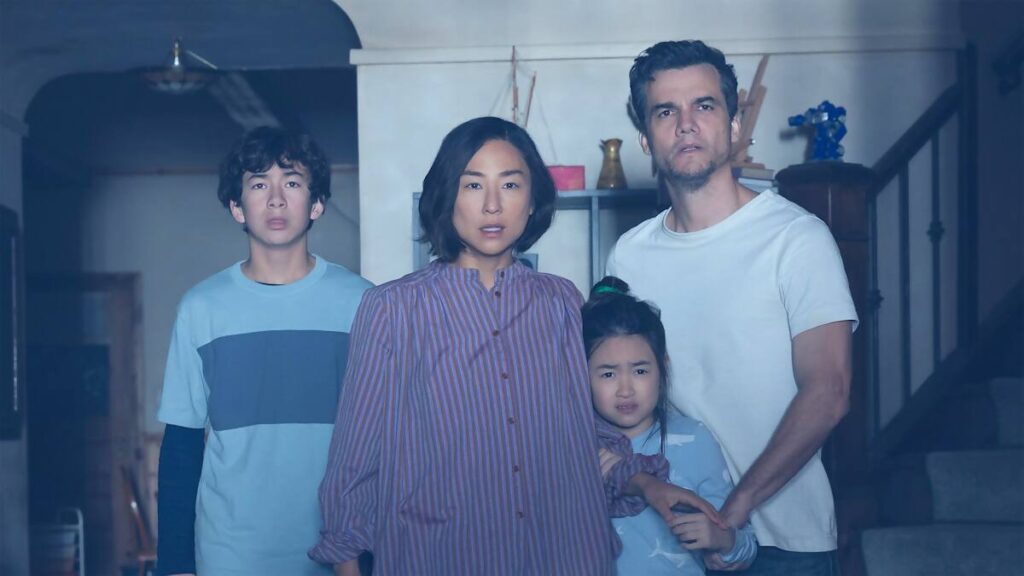

Now on Netflix, The Last House is an okay monster movie, but fascinatingly fuses the anxiety of the lockdown era with Lovecraftian horror.
Much as John Wick left a lasting impression on action movies, 2018’s A Quiet Place appears to have ushered in a particular type of monster-survival film. You’ll probably recognise the formula when you see it: a small group, usually a family, ekes out an austere existence in a hostile, post-apocalyptic world. They face an aggressive, deadly threat that has some particular sensory ability or genetic quirk: in A Quiet Place or The Silence, it was pin-sharp hearing. In Arcadian (2024), it was a breed of critters who were sensitive to light. In Elevation (also 2024), the monsters could only climb a certain height above sea level, leaving humans huddled in mountaintop communities.
The early 21st century ancestor of all these may have been David Twohy’s Pitch Black (2000), in which the batlike monsters (designed by Patrick Tatopoulos) pick off the cast one by one. The difference with these more recent films is that they have a tendency to dwell on the challenges of parenthood: the lengths mothers and fathers will go to in order to protect their kids, that sort of thing.
The Last House, directed by Louis Leterrier and currently dominating Netflix’s streaming charts, is a monster movie in the A Quiet Place mode, but it also comes with a surprising side order of post-lockdown angst and nods to HP Lovecraft.
Given that the global pandemic is now half a decade ago, it seems as though filmmakers are now just beginning to take stock of what it meant and how it affected us. There were, of course, all those movies that were actually made during the time of Covid – some great, some less so. Rob Savage’s short, sharp The Host positively heaved with 2020-tuned fear and loathing, and the reception to it transformed the British filmmaker’s career.
The likes of Abel Ferrara’s Zeros And Ones or Doug Liman’s Locked Down, on the other hand, will probably be best remembered as curios from a distinctly weird time in recent history rather than great films in their own right
More recently, Ari Aster dared to dive back into the era of test kits and N95 masks with his one-of-a-kind Eddington, a film that was so roundly ignored by audiences that some critics wondered whether it was a bit too soon to revisit 2020’s events – especially in a paranoid western told with Aster’s particularly dry sense of irony.
The Last House, meanwhile, deals with the bizarreness of lockdown in a way that will be unmissable to all but the most distracted of Netflix viewers. It begins with the veneer of the fantastical, like a repurposed Twilight Zone episode.
Torrential rain begins to fall on Seattle (a not unusual occurrence), and an ordinary working class family goes about its day as the drops tap against the windows. The Delgados are about to head out to buy a Christmas tree when they discover that the doors are all jammed shut. They rush to the windows and find that they can’t be opened. More ominously, attempting to break the glass doesn’t work, either – some barely-perceptible force plugs up the holes, Terminator 2-style.
Trapped in the house, the family – comprising father Jason (Wagner Moura), mother Ann (Greta Lee) and kids Ruth and Graham (various) – go through some familiar-looking experiences. They keep themselves amused by playing games, listening to music and watching the measly pair of DVDs the dad keeps in the closet (for the record, Annie and Air Force One). Realising that their neighbours, and perhaps everyone in the world, are also stuck inside, they communicate with the people across the street with messages scrawled on whiteboards.
Privately, Jason and Ann ask each other whether the days then weeks of being trapped indoors are traumatising their kids – much as parents did in the real world roughly five years ago. There’s a poignant air to these moments, with some solid acting from Moura and Lee, plus Riley Chung and Noah Alexander Sosnowski as the younger versions of their kids.
What’s unusual about The Last House is just how long Leterrier and screenwriter Matthew Robinson keep the monsters at bay. Their presence is teased from the opening act, with shadowy figures loitering in the rain outside the house recalling Guillermo del Toro’s compromised-yet-wonderful Mimic (1997). But rather than rush to establish them as an immediate threat, they’re left as a background note as the Delgado family adapt to the new normal.
Years elapse in a single cut, by which time the house has begun to resemble something out of Swiss Family Robinson. Jason has set up elaborate, improvised traps to capture water and wild animals; Ann has turned great swathes of the building into an indoor allotment. There are some decidedly implausible moments here (few 21st century parents would shove a kid up a chimney quite so casually as Jason and Ann do, I’d argue), but the central appeal of watching how they thrive where other families on the block have perished still holds.
Eventually, almost begrudgingly, the filmmakers go about the business of properly bringing in the monsters, and it’s here that The Last House becomes a whole other, more predictable film. The allusions to Lovecraft’s Cthulhu mythos offer some intrigue that the film itself seems uninterested in meaningfully paying off – after an action and chase set-piece or two, the story shudders to an abrupt, head-scratching climax.
The Last House emerges on Netflix mere days before The End Of Oak Street, which is another Twilight Zone-esque film about a suburban family whose home is turned from a refuge into a place of terror. (In the latter, the monsters are dinosaurs.)
If A Quiet Place and its immediate imitators were about a parent’s unconditional love and willingness to sacrifice themselves to protect their children, these newer monster movies tap more directly into collective memories of lockdown: trying to maintain a sense of normalcy in uncertain times, the ambivalence as to whether it’s better to survive for its own sake, or better to accept risk and face a threat head-on.
The Last House seems strangely undecided as to whether the years of avoiding the monsters’ attention was sensible parenting or a waste of time that has robbed the kids of their formative years. Maybe that’s the point. As the 2020 pandemic recedes into history, we’ll likely see more films deal with the turmoil of that event: the isolation, the anxiety, the uncertainty of how long it would last and what the world would look like when it did.
The Last House is on Netflix now.


