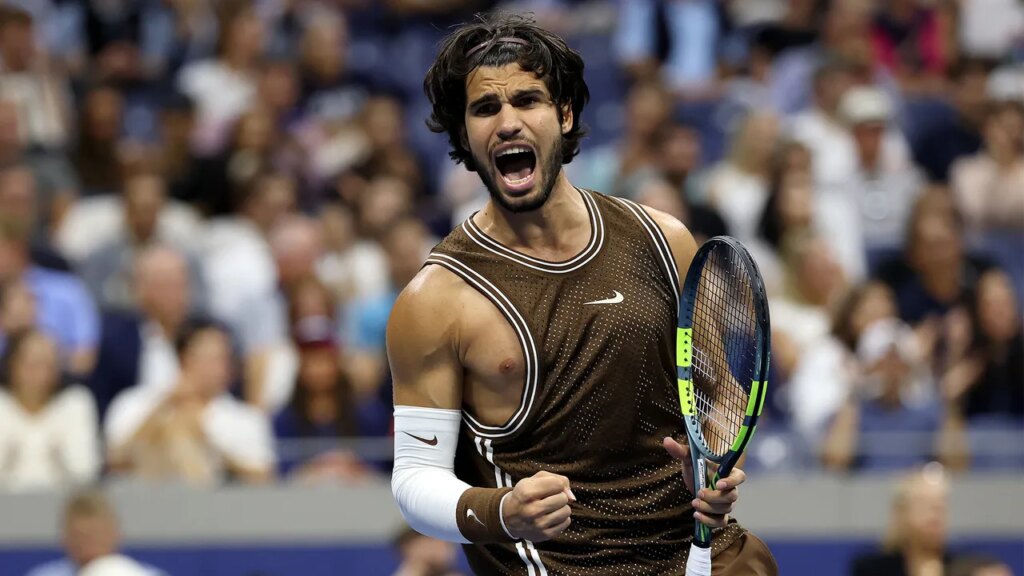

“Listen, I try for it not to be a disaster, but if there’s something I want to do, I do it,” Carlos Alcaraz said when I spoke to him back in March before we shot his very, very viral Vanity Fair cover story. We were talking about his personal style, which, as his fans well know, is in a constant state of flux. On Tuesday at the US Open, which saw him lose to Ben Shelton in a thrilling late-night match, Alcaraz’s blackout outfit and long hair held back by a Nike headband were part of the online conversation. He had gone viral once again at the beginning of the tournament, this time because his basketball-inspired kit—the wardrobe and uniform that Nike created for his long-awaited return to the court—had his tank tops cut with the armholes wide enough to expose his chest. “If I were to listen to everyone’s opinion, I’d go crazy, right?” he said then with his signature wide-open smile.
“Nipplegate” is what some fans dubbed the kerfuffle. Clips circulated online of the tennis champ checking his chest to make sure his top was in the right place, and reporters asked him about his decision to start wearing more modest undershirts. Alcaraz is a tennis anomaly—in both talent and the way his fervent fan base obsesses over his aesthetic choices almost as much as it analyzes his gameplay. And yet one wonders: Is it actually that serious?
This US Open has contextualized the fashion opportunity in sports and the sports opportunity for fashion.
Sure, other disciplines have gone here before: NBA tunnel-walk ’fits now rival Paris Fashion Week street style, and during the World Cup and beyond, brands like Loewe, Amiri, and Boss have become official outfitters for select soccer teams. In 2024, GQ started hosting fashion shows on Super Bowl weekend, first with Bode and then, last year, with Thom Browne, and stars—say, Travis Kelce—are often written about for their off-duty and tunnel style. And yet the tennis court, despite big stars like Serena Williams and Roger Federer fronting fashion campaigns and serving as brand ambassadors for labels like Nike and On, has felt like the final frontier: Its fashion moments have typically been limited to on-court kits and athleticwear. But not anymore.
At last year’s US Open, Venus Williams made it a point to reach past traditional tennis outfitters for her on-court looks: She wore a host of independent American labels, including Willy Chavarria, Khaite, Luar, and ERL, which all made custom ensembles for her. In January at the Australian Open, Naomi Osaka upped the ante, walking onto the court in a dramatic look by couturier Robert Wun. “When I look back at the players who came before me, I think about how those moments—those looks—have become memories that live forever,” Osaka told Vogue. “So much of the time, other people get to write our stories for us. This felt like a moment where I could write a little bit of my own.” She doubled down on that sentiment at this year’s US Open, where she worked with superstar stylist Law Roach, who dressed her in avant-garde ensembles by New York labels Who Decides War, Thom Browne, Monse, and KidSuper.
It’s worth questioning the effectiveness of Osaka’s courtside fashions: They at times landed a little heavily—her frame drowned by excessive amounts of fabric, ranging from tulle to jersey. She was looking to make a fashion statement, but the execution could have used a little finesse. Perhaps the looks themselves were beside the point, though—her choice to work with Roach was most indicative of her ambition. Before Zendaya was the movie star that she is today, Roach made her into one of the best-dressed starlets in Hollywood. Fashion, after all, has the power to augment the public’s perception of a public figure.