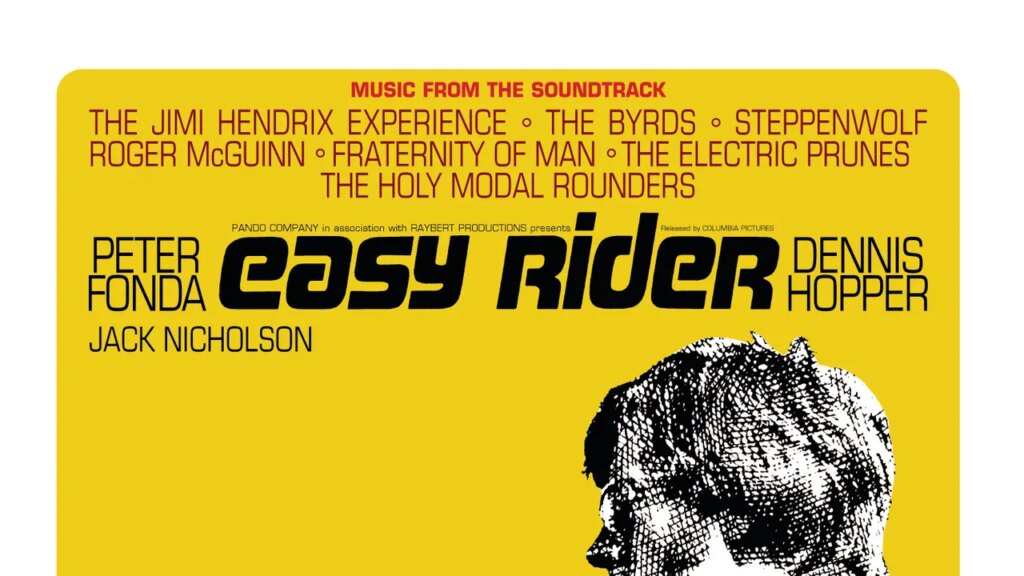

The story could scarcely be more simple: two committed patriots off to find America. The iconic, oft-referenced sequence in 1969’s psychedelic biker opera Easy Rider features the film’s twinned anti-heroes, Billy and Wyatt, tearing down a sprawling U.S. highway astride two choppers at some impossible speed, soundtracked by one of the greatest badass statements of purpose rock’n’roll ever yielded: Steppenwolf’s “Born to Be Wild.” It’s a song that perfectly bisects the dueling hippie impulses between the communitarian and utopian, and the hedonistically self-fascinated, a painful cleavage which was coming to the fore just as Easy Rider hit screens in July 1969.
Can you picture it? Set against the monster rock riffs of lead guitarist Michael Monarch, singer John Kay’s edict to “take the world in a love embrace” sits nervously alongside the tune’s insinuating thirst for danger: “I like smoke and lightning/Heavy metal thunder.” This is the dichotomy that would define both the film and the soundtrack, the pastoral, pacific drop-out resistance of the Summer of Love running directly into the fraught entropy of an ersatz movement losing steam and beginning to cannibalize itself. It’s an image of such pure lawless liberation, from blue-to-red-state America, I’m not sure we’ve ever fully recovered. It’s way more “don’t tread on me” than “come on people now, smile on your brother.” In my mind—and I’ve seen the movie many, many times—I always think this is how Easy Rider starts.
No score yet, be the first to add.
The actual first scene in Easy Rider is intensely uneasy, a tenuous south-of-the-border drug deal that has all the hallmarks of a classic Treasure of the Sierra Madre-style misunderstanding. But no. Peter Fonda and Dennis Hopper—the film’s titular motorcycle muses—manage to fence what looks like a bumper crop of coke to a louche-looking drug connect played by Phil Spector, who sends them off with generational cash in exchange. So, the first song you hear in the movie is not Steppenwolf’s epochal nature-call, but rather their cover version of Hoyt Axton’s sad and cynical “The Pusher.” Soon enough, our heroes are unleashed, furious and stoned, on the now-decommissioned highways of 1969. But they’d never outrun the slow creeping blues of the first Steppenwolf song, even as Hopper’s Billy and Fonda’s Wyatt lit out to what was ostensibly their last deal gone down. Some sage once opined, “To live outside the law you must be honest.” Wyatt and Billy are never honest with themselves until it’s too late. The drugs got harder, the compromises more equivocal. The equation changed. After the wild success of Easy Rider, Hopper bragged that it was the single biggest factor in getting cocaine into the everyday vernacular of American drug abuse. He boasted, “The cocaine problem in America is really because of me. There was no cocaine before Easy Rider on the street. After Easy Rider, it was everywhere.”
The extent to which Easy Rider was a borderline impossible film to make necessitates a wild litany of New Hollywood lore involving everyone from the producers Bob Rafelson and Bert Schneider to the principals given a shoestring budget and charged with delivering a motorcycle picture, originally, and unpromisingly, called The Loners. The script, to the extent it existed, was a largely improvised collaboration between Hopper, Fonda, and the great Terry Southern, recently of Dr. Strangelove or: How I Learned to Stop Worrying and Love the Bomb. Filming was challenging. Hopper, directing for the first time, was a paranoid and psychotic bully with a resolute vision, constantly undermined by chemically induced megalomania. The cast and crew were so convinced of his capability for violence that few dared to intervene on his impulses. Test-filming in New Orleans with an inexperienced skeleton team yielded more questions than answers. Hopper’s first edit was four and a half hours. The studio proposed sending him on vacation, which for some reason he agreed to. When he got back from Taos, the movie was 94 minutes and obviously improved. Hopper rioted, threatening everyone, before giving up and admitting the new cut was superior. Nobody was murdered in the making of the film, except perhaps the enduring vestiges of the old studio system. In the ensuing months, Easy Rider earned a shocking $41.7 million domestic gross against a $360,000 budget, transforming the cinema forever.