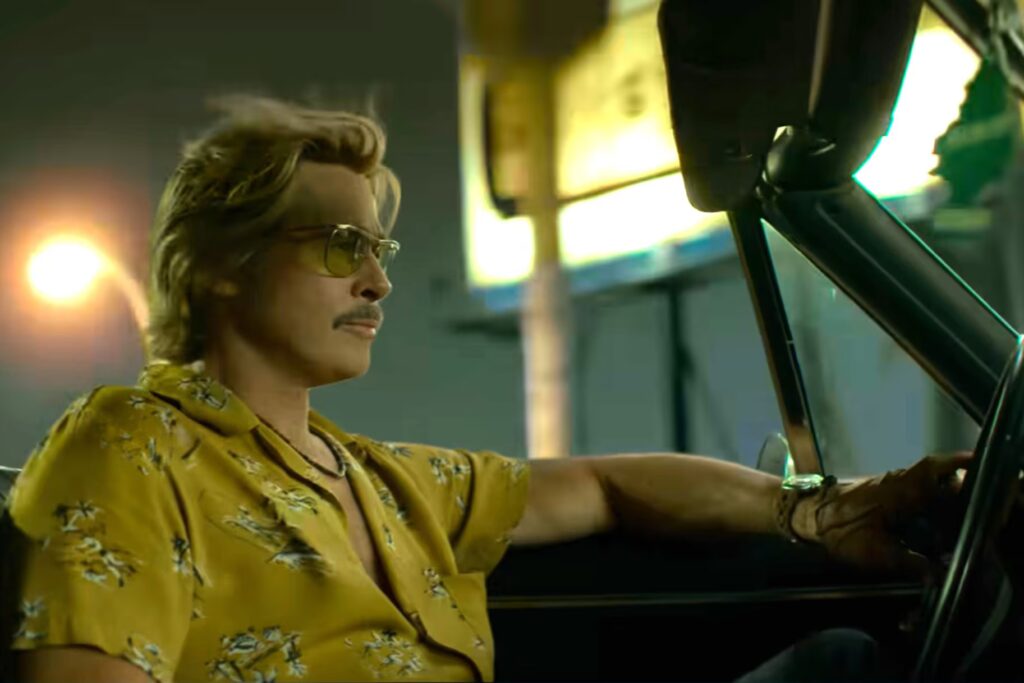

The alternate timeline established by Quentin Tarantino at the end of Once Upon a Time in Hollywood will officially continue next month in Netflix‘s The Further Mis-Adventures of Cliff Booth.
Brad Pitt returns to the role that won his him first acting Oscar, following up with the titular stuntman eight years after the events of the first movie. “It’s 1977,” reads the official synopsis, “and it’s a very different Hollywood.”
Emphasis on different.
After all, history took a wild left turn when Cliff and his actor buddy Rick Dalton (Leonardo DiCaprio) prevented the infamous Manson murders from taking place on Cielo Drive in early August 1969, saving Sharon Tate’s life.
“From the perspective of Manson studies, I’d say the ending was a pretty significant historiographical intervention,” author of Love and Terror: The Helter-Skelter History of the Manson Murders Claudia Verhoeven told SYFY Wire. “Because Tarantino subverts the expectation of yet another—and there have been many—reenactment of the Tate murders and thereby blocks the ‘thrill’ of these killings. Because Tarantino subverts the expectation of yet another—and there have been many—reenactment of the Tate murders and thereby blocks the ‘thrill’ of these killings.”
Instead, added Verhoeven, the director substitutes “a different kind of thrill kill,” with the murderers being the ones to suffer gruesome deaths.
This proved to be a step too far for Jeffrey Melnick, a professor of American Studies at the University of Massachusetts Boston and author of Charles Manson’s Creepy Crawl: The Many Lives of America’s Most Infamous Family.
“I hate just about everything about the Tarantino movie,” he wrote in a blunt statement over email. “But above all, I hate the gleefulness with which it has the Hollywood guy slaughter the freaks. The crimes of the Manson family were horrid, of course, but the perpetrators were, for the most part, very marginal people. Young women who had been runaways, abused at home, etc. I hate how Tarantino turns them into a punchline.”
Still, one has to wonder what kind of reality Cliff and Rick created by saving the lives of Tate, Jay Sebring, Wojciech Frykowski, Abigail Folger and Steven Parent. For author of CHAOS: Charles Manson, the CIA, and the Secret History of the Sixties Tom O’Neill, something had to give in that laissez faire culture.
What If The Manson Murders Never Happened?
“I think Hollywood would have gone on as it was maybe a few more years before something like that happened to someone else,” mused O’Neill, whose nonfiction book actually helped inform Tarantino’s prose adaptation of Once Upon a Time in Hollywood. “Something horrific, some other catastrophe. There were the Wonderland murders a couple years later. I mean, you can’t have that many drugs and that much of an open-door policy with seedy people.”
“It was a much loosey-goosey climate,” he emphasized, “and that was how Manson was able to penetrate that world and get into places he probably wouldn’t have been able to get into five years before or a year after.”
In our own reality, the murders became the symbolic moment of death for late-1960s counterculture naïveté, though this assertion originated by Joan Didion is often refuted by modern-day scholars.
“I don’t think there was much counterculture naïveté left by 1969, if ever there was much,” reflected Verhoeven. “It was a brutal decade. But who knows? Maybe without the murders, non-state political violence in the early 1970s would have been more extreme. Perhaps you could argue that the shock of murders committed by a ‘hippie’ cult caused left wing activists to hesitate before committing to political violence—unlike their European counterparts, who radicalized at this moment.”
Before the guilty Manson family members were arrested two months after the Tate–LaBianca murders, the Hollywood community was extremely paranoid and didn’t know who to trust. “Friends and colleagues and peers of the victims locked themselves in their houses,” said O’Neill. “Everybody suspected each other. It was like a classic Agatha Christie novel.”
“Right after the murders, gun sales went up, people were buying guard dogs, putting up walls, putting up electronic gates and fortifying their homes,” he continued. “Because they didn’t know if there was going to be another attack and where it was going to come from. The Beverly Hills of today, where homes have impenetrable 12-foot walls and armed guards didn’t exist back then.”
Along with the killing of Meredith Hunter several months later, the Manson murders “really brought down the hammer and made people realize that this wasn’t a safe place for everyone,” explained O’Neill. “Amphetamines had spread like wildfire starting in ’67 during the Summer of Love. The amphetamines, combined with LSD and whatever other drugs they were all taking, made people much more irrational and impulsive and acting out on stuff that they might not have otherwise acted out on. It was all kind of headed in that direction as soon as the drugs became so accessible in ’67, so it was a culmination of a lot of things.”
While O’Neill believes some sort of tragedy was inevitable, it might not have been as sensational as the Manson case: “I think things were going to get bad no matter what, just not in this big a way.”
The ensuing media circus is why the actions of the Manson family stand out so clearly in popular culture.
“The response to these crimes was immediately filtered through the media and the entertainment industry,” Verhoeven said. “Aside from the fact that the murders were very violent and visceral, they were quasi-staged for popular consumption—including by news media and the culture industry.”
What is The Further Mis-Adventures of Cliff Booth About?
Having retired from the stunt world, Cliff now works as a bartender, theater projectionist and part-time Hollywood fixer.
The plot kicks into overdrive when he’s hired by Karen Crosby (Elizabeth Debicki), talent agent for television A-lister Charlie Peters (Scott Caan). From there, he crosses paths with Charlie’s wife Toni (Carla Gugino), professional-football-player-turned-actor Roderick “Hot Rod” Harrison (Yahya Abdul-Mateen II) and the mayhem-causing Verdusco brothers (Matt Groove and JB Tadena).
Tarantino wrote the screenplay, but decided to hand directorial duties off to David Fincher, who has worked extensively with both Pitt and Netflix over the years via Se7en, Fight Club, The Curious Case of Benjamin Button, Mindhunter, Love Death + Robots, Mank, and The Killer.
When Does The Cliff Booth Movie Come Out?
The Further Mis-Adventures of Cliff Booth will enjoy a theatrical run in IMAX starting Nov. 25 ahead of its Netflix debut Dec. 23.