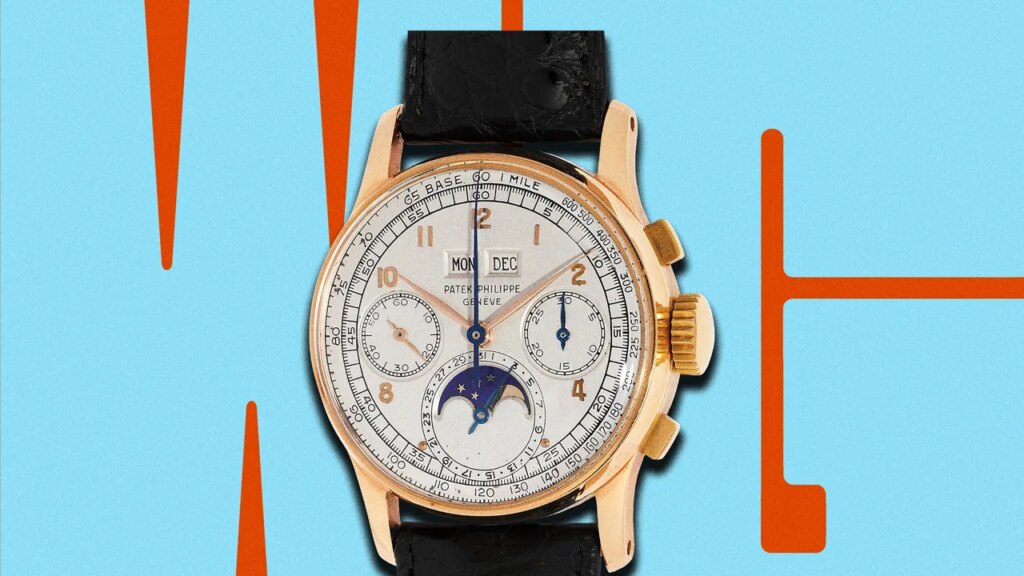

Welcome to GQ’s 201-level Watch Glossary, breaking down the advanced terms and specific references that are essential knowledge for every serious collector.
In 1941, in a show of Katie Ledecky-style dominance, Patek Philippe became the first to release a serially produced watch that combined two of the trickiest functions in watchmaking: the perpetual calendar and a chronograph. In the 85 years since, the brand has perfected this alchemy, and examining the many iterations of this watch is a crash course in how the watch industry has functioned and what collectors have sought out over the decades.
Ref. 1518: The breakthrough (1941)
The ref. 1518 was only produced in roughly 281 examples, but it started a long lineage of signature pieces at Patek Philippe and laid the foundation for a series of timepieces that remains an important component of the maison’s Grand Complications to this day.
Constructing a perpetual calendar is difficult enough: the gearing necessary for a mechanical object to track months (let alone years) of different lengths is difficult to synchronize and miniaturize, and thus QP (“quantième perpétuel” or, in anglais, perpetual calendar) watches prior to the 1518 were generally one-off commissions for ultra-wealthy clients. But to combine one with a chronograph complication—in the midst of the Second World War, no less—was to push the horological envelope in a direction that few other large watchmakers could follow. And that’s not florid language—it would literally take some decades before others were able to serially produce QP wristwatches, let alone QP chronograph wristwatches.
Diving into the production of such a complex movement provides great insight into the traditional way watches were developed in those days. The 1940s were the days of établissage. Rather than hyping up in-house movements, this system—for centuries the norm in Switzerland—divvied up the production of a watch’s components, from the movement to the dial, among different manufacturers and individual, specialized makers in a literal cottage industry.
Even the best firms in the world—Patek, Vacheron Constantin, Cartier, etc.—would purchase movements from dedicated movement specialists and decorate or modify these to their specifications. Indeed, this is the genesis of the ref. 1518, in which Patek took an ébauche (movement base) from Valjoux and modified it into the cal. 13”’130 Q. You could argue that this system only makes Patek’s accomplishment that much more impressive. The other brands in Switzerland had access to the same ébauche, but none managed to convert it into a serially produced perpetual calendar-chronograph.
Measuring about 35mm in diameter and produced from roughly 1941 through 1954, the ref. 1518 represents the genesis of the brand’s perpetual calendar-chronograph production, and has become one of the most sought-after and expensive watches in the world. A version in stainless steel nearly set the record for the most expensive vintage wristwatch ever sold at auction in 2025.
Ref. 2499: Perfection achieved (1950)
.jpg)