
Careers have turning points. Steven Spielberg’s was the film Duel. It was very nearly a bawdy comedy involving Snow White And The Seven Dwarfs.
Dig far enough back into the back catalogues of ‘respectable’ film directors, and there tends to be the occasional bout of fruitiness to be found. Martin Campbell, he of Casino Royale and The Mask Of Zorro made a few naughtier films in the 1970s. Men In Black’s Barry Sonnenfeld has openly talked about his early cinematography work watching mattresses being, er, ‘rearranged.’
Yet Steven Spielberg? He burst onto the scene as a fresh-faced twentysomething, dropping out of college when offered a long-term contract by Universal, off the back of his extremely well received – and shot on 35mm – short film Amblin’ (that, of course, he’d name his company after.)
This was the last vestiges of the contract system, and in the late 1960s, a young Spielberg was told that if you direct a few episodes of television and make enough of an impression, you’ll get a feature film project to do.
He quickly got to work, his first screen credit being an episode of Night Gallery in 1969, before going on to helm shows such as The Name Of The Game, Marcus Welby M.D. and The Psychiatrist. He was in his early 20s, and already being paid to direct TV. But he always had his eye on directing a feature film.
A project came to mind.
The catalyst was two members of the Berg family. Jeff would go on to became head of powerful agency ICM many years later. Yet at this stage, he was more known as the son of Dick Berg, but was on the ladder, working as an agent for a company called Creative Management Associates.
Dick Berg meanwhile was much higher up that ladder. In the 1970s, he was instrumental in launching the careers of filmmakers such as Sydney Pollack and Mark Rydell, and he was pioneering the idea of the made-for-TV movie, that got upcoming directors at the helm of feature films earlier than they otherwise would.
Spielberg saw an opening to pitch an idea for his debut feature film, and what he got his hands on something that that stands well, well apart from everything he’s done since.
The underlying idea was a twist on Snow White And The Seven Dwarfs, just retooled as a bawdy sex comedy. Think American Pie or Porky’s, just a little bit earlier. And with less apple pie.
In 1967, a man called Donald Barthelme, renowned for his short story work, penned the original tale and had it published in The New Yorker Magazine. It followed a young woman who is sharing her apartment with seven young men, as she waits for her prince to arrive. The seven men run, I’m quoting, ‘a Chinese food factory’ for a living. The woman and young men get up to ‘interactions’. A ‘swinging Sixties Snow White’ wrote the New York Times.
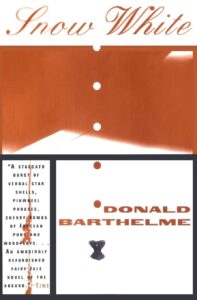
Dick Berg brought the project to Spielberg, whose name was quickly attached to it. Spielberg was 22 years old at this point, and the writer that Berg hired was only 24. He was Larry Grusin, someone who’d broken through with TV credits, and that’s where his career would stay.
For Spielberg, he had – at least he thought – the protection to a degree of his seven-year contract, but the Snow White film idea didn’t go down well with the studio. At all.
Already, there were some within Universal’s corridors who felt that Spielberg wouldn’t quite make it, or if he did he’d be a jobbing director at best, and this did little to settle their concerns.
In Bathelme’s story, the dwarfs are called Kevin, Edward, Hubert, Henry, Clem & Dan. “They have all come from national parks to the city, where they occupy themselves tending the vats where they make Chinese baby food, and washing the buildings”, goes the description.
Among the potential suitors for Snow White who visit the apartment? Paul is an artist, who is quickly rejected. Bill sounds like a bit of a manly man, and he doesn’t wash either (metaphorically.) Then there’s an evil stepmother-esque figure by the name of Jane, who replaced the poisoned apple of the fairy tale for a Gibson cocktail that kills Paul.
I’m not making this up.
Bill gets hung in the end too, if I’m reading this right, for not properly looking after the aforementioned vats.
I know what you’re thinking: it screams Spielberg.
As Paul Fischer’s book The Last King Of Hollywood describes, this was also the era where Francis Ford Coppola and George Lucas decamped to San Francisco, leaving Hollywood behind in the hope of independent filmmaking nirvana. Lucas at this stage was looking at Spielberg enviously, given that he was already directing and being paid to do so.
Spielberg, who loosely knew Lucas and Coppola at this stage, was left in Los Angeles, with Universal. A studio unbeknownst to him at the time beset by behind the scenes struggles. One year into a seven-year contract, it dawned on him that he was basically in a queue behind many others to direct a feature, and after the studio briskly rejected the Snow White project, he wouldn’t direct again for a year.
He was stuck.
It didn’t stop him having another try at getting Snow White off the ground a little while later, as he continued to develop ideas to try and get him off the starting blocks. This time, he pitched a collection of ideas to Universal, but again, no dice. The head of the studio, Sid Sheinberg, had been convinced enough by Amblin’ to award him the initial contract, but the people working in the corridors of Universal were less enamoured. He was not top choice for the TV movies that were coming through, and this would be one of the bumpiest periods of Spielberg’s life.
What eventually got Steven Spielberg to the movies was an article in a different magazine: Playboy.
That’s where Richard Matheson had managed to get one of his short stories published, about a trucker threatening an everyday driver. It’d become, of course, Duel, itself conceived as a television film, but ending up so good it made it to some cinemas around the world.
Duel soon led to The Sugarland Express, and then to the film that poured money into Universal: Jaws. The Snow White film remained, mysteriously, unmade, but Spielberg’s career was off and running nonetheless.
Moving forward to now, with Disclosure Day safely under his belt this year, maybe Spielberg might think it’s about time to go back to where he nearly started. Imagine that.