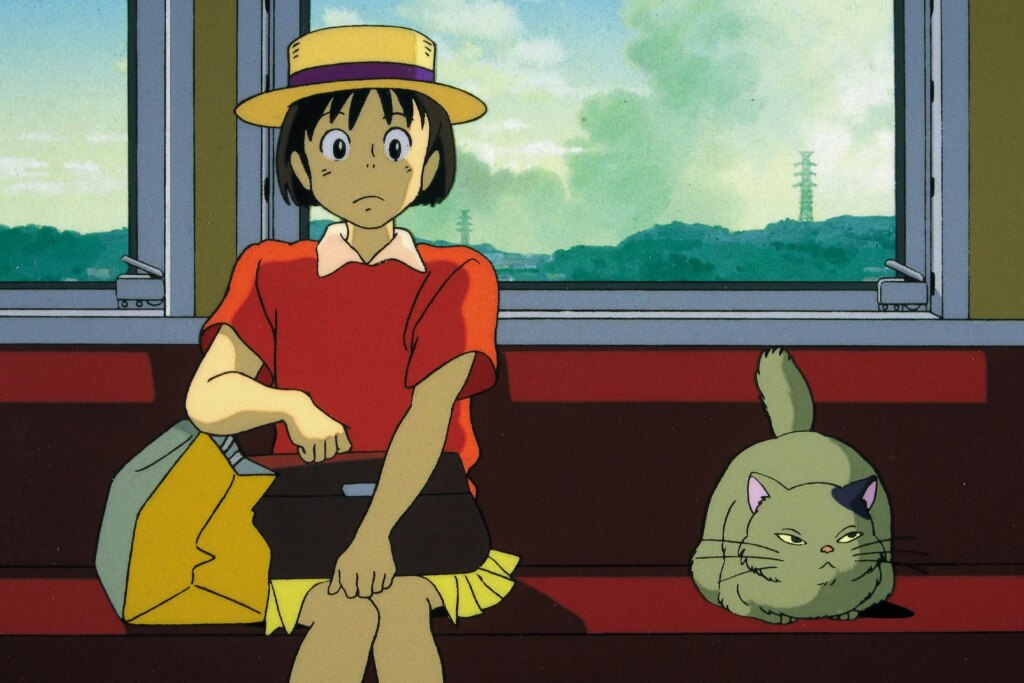

The latest Studio Ghibli film to receive an IMAX upscaled restoration and re-release is this gentle, empowering coming-of-age story from 1995. Thirty years may as well have floated past since Whisper of the Heart was released; it’s a joyous, meticulous and beautiful study of young adulthood and the power of imagination.
Behind the scenes, it’s more bittersweet. Hayao Miyazaki adapted the story from the Manga ‘Mimi o Sumaseba’, with Yoshifumi Kondō directing. It would be Kondō’s only film, as the mooted successor to Miyazaki and his studio co-founders died just a few years after its release. Now, it floats as a beautiful island in Studio Ghibli’s incredible filmography; an unmissable ornament gleaming in an emporium of curiosities.
It’s easy to spend 110 minutes with Shizuku Tsukishima, a girl on the cusp of womanhood. Well-read, impetuous, creative, she builds a story around her life in a Tokyo flat with her parents and sister. The name of a boy, Seiji Amasawa, that constantly appears ahead of her in every library book she takes out, the cat catching the train to visit a magical trinket shop— it’s all food for her imagination as she works on the perfect translation for Bill Danoff, Taffy Nivert, and John Denver’s ‘Country Roads’.
As Shizuku sees the shop—particularly the striking stature of a cat known as the Baron—as where stories begin, life gets in the way. The struggles her friend Yuko is going through with boys seem a world away until Shizuku meets the boy who’s been reading the same books as her, and their teasing turns to friendship. When the talented craftsman Seiji leaves for two months in Italy to study with a master violin maker, Shizuku sets herself the impossible trial of writing a story inspired by the Baron before he returns, at the cost of everything else.
First and foremost a coming-of-age story, Whisper of the Heart becomes something else in the hands of Miyazaki, Kondō and the studio talents. The quality of animation and staggering attention to detail is endlessly breathtaking, particularly in its representation of the mundanities of life, like clearing the breakfast table or putting the washing out on the balcony, that weigh down Shizuki’s life.
The gentle layering is never more evident than in the repeating refrains of shifting versions of ‘Country Roads’. Olivia Newton-John performs the song in the film’s opening sequence, and it subsequently reappears with shifting lyrics, performed by the cast, with translation and humorous lyrics from producer Toshio Suzuki’s daughter and Miyazaki. The song couldn’t be more perfect: an undulating, uplifting call to belong that works instrumentally or a cappella—its structure meets the film’s rhythm and themes beautifully, in the classroom or under the shop of curiosities in an impromptu concert. It’s particularly enthralling in the subtitled Japanese version reviewed here, although the English dub is also being rereleased.
The originally Denver-sung classic at the centre of Yuji Nomi’s score, and despite its wide appeal and cultural ubiquity outside the film, is likely always to remind you of Whisper of the Heart once you’ve heard ‘Concrete Roads’.
It’s heartwarming that Whisper of the Heart was the highest-grossing film in its domestic market on release, and hasn’t lost any of its appeal as it emerges brighter and bigger than ever in IMAX.
A heart-warming blend of the magical and relatable, the funny and, when you’re at school, insurmountable, Whisper of the Heart is a beautiful slice of life. It’s well worth seeing in theatres for long-standing Ghibli enthusiasts and anyone who walks in as a soon-to-be Ghibli fan.
Whisper of the Heart is in cinemas now.