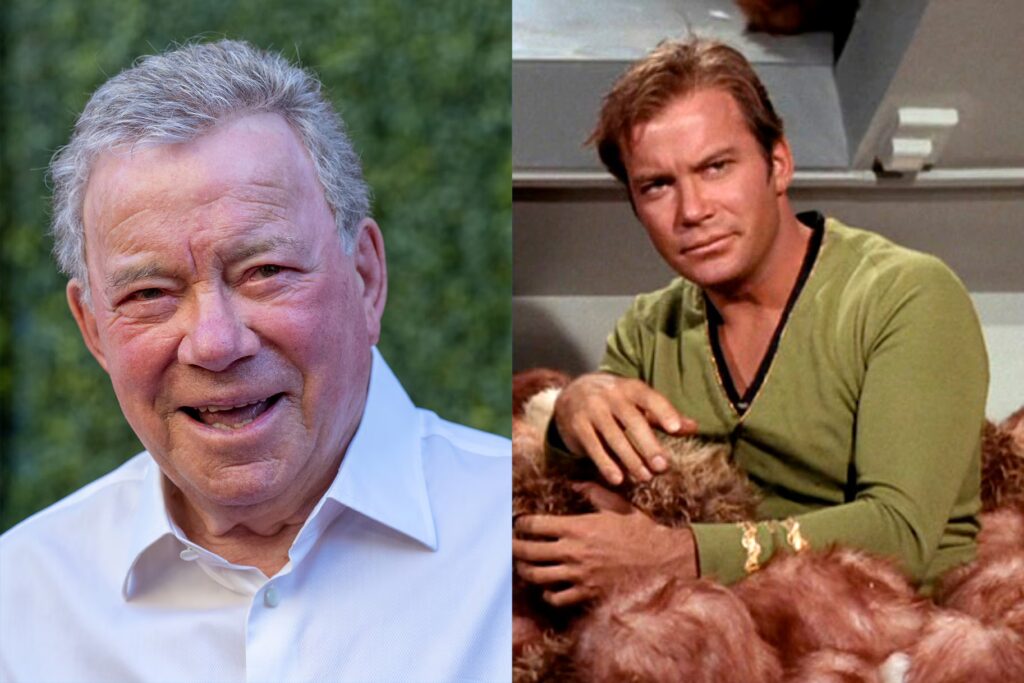

It’s been 32 years since William Shatner played James T. Kirk in a Star Trek project. Will he ever return to Starfleet?
There’s certainly precedent: Leonard Nimoy coming back as Spock in J.J. Abrams’s rebooted film universe.
“I don’t know,” Shatner told SYFY Wire at the Sep. 25 premiere of The Sixty Year Mission: How Star Trek Changed Television and the World in Los Angeles. “If the part is written well and they pay me enough money…”
While a reprisal of Captain Kirk may be in question, Shatner’s admiration for the franchise is not.
William Shatner Looks Back On 60 Years of Star Trek
“It’s extraordinary that this show has lasted as long it has,” he said, “and the reasons why are many and varied.”
His favorite memories of shooting the original TV series and feature films all include his late co-stars DeForest Kelley (Bones) and Nimoy.
“Leonard particularly was the brother I never had,” Shatner, 95, confessed. “I miss him and think he would have enjoyed this…But he and I had a great time together, and I miss him.”
He briefly reflected on his own mortality, bluntly adding, “I hope to be alive” for the next six decades of Star Trek. “That’s pretty much in question 60 years from now, but I’ll try.”
Shatner, George Takei (Sulu) and Walter Koenig (Chekov) are the only surviving members of the original Enterprise crew.
On the subject of memorable fan interactions, Shatner recalled the time he interviewed renowned theoretical physicist Stephen Hawking, who wanted to know the actor’s favorite episode of the OG television show.
“That’s one of the great minds of our time asking me [about] my favorite episode,” Shatner reflected on the surreal conversation. “Well, I don’t know. There were some really beautiful science fiction stories that were told.”
In the end, he went with season three’s commentary on the irrationality behind racism, “Let That Be Your Last Battlefield.”
“There was a story about a character who was Black one side and white on the other, and met another character who was white on one side and Black on the opposite side,” he explained. “They were angry at each other, they were racially divided because of the Black and white thing. It showed the idiocy of racial tension. I loved that story, it was imaginative, well acted, and it had a message, but you didn’t know it. You were entertained.”
The Sixty Year Mission: How Star Trek Changed Television and the World hits theaters Oct. 9. Tickets are on sale here.