
Yezhu Kadal Yezhu Malai has the makings of a fascinating existential fable, but Ram’s surreal experiment gets lost in its own muddled storytelling, discovers Sreeju Sudhakaran.

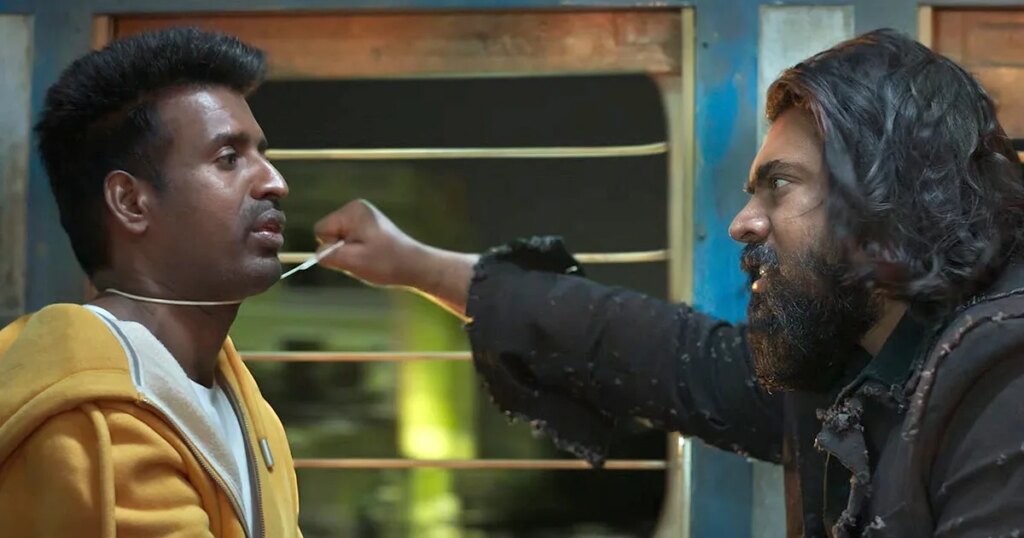
IMAGE: Nivin Pauly and Soori in Yezhu Kadal Yezhu Malai.
Key Points
- Director Ram’s Yezhu Kadal Yezhu Malai has several intriguing ideas but struggles to bring its multiple storylines together into a cohesive narrative.
- Nivin Pauly feels miscast as the immortal protagonist, while Anjali emerges as the film’s most fascinating element.
- Striking Dhanushkodi imagery, tender moments and flashes of Ram’s brilliance hint at the more effective existential drama the film could have been.
Peranbu Director Ram’s Yezhu Kadal Yezhu Malai is a fascinating film that does not quite manage to fascinate you. Confused? Well, even I was at times while watching his surreal experiment on existential themes, where the grandest idea is simply that immortality sucks. Big time.
Nivin Pauly plays the immortal being in the movie, someone who has lived for over 8,000 years. His last movie was in Malayalam, Bethlehem Kudumba Unit, which recently became the industry’s highest-grossing film of all time. It had to beat Lokah Chapter 1: Chandra to do so, a movie that, funnily enough, also dealt with immortal beings.
Okay, I know you are wondering why I am making such a tenuous connection. Well, it is far easier to make these connections than to decode what Ram was trying to convey through his muddled screenplay. It contains a handful of arresting ideas but completely refuses to let them coalesce, a flaw not helped by the skittish editing and the rampant use of AI.
AI Visuals Of Yezhu Kadal Yezhu Malai
In the kind of world we are living in, we have to slowly accept that AI is going to be heavily used in movies, and Indian cinema clearly does not have any moral dilemmas about it. But AI-generated visuals used in Yezhu Kadal Yezhu Malai frequently to generate animals, humans and landscapes still have not reached the kind of quality that leaves you in awe.
There is a stark artificiality to them that completely takes you out of the visual experience, a lifelessness that instantly pulls the plug. For a director trying to craft a surreal thematic experience using a storyline that spans centuries and crosses continents, suddenly noticing the AI visuals becomes an immediate mood-killer.
The same way how bad VFX ruins a scene.
Thematic Plotlines
It is not just the AI visuals that become a problem here.
Yezhu Kadal Yezhu Malai has three or four interesting plotlines but struggles to weave them together into an enchanting fable about an immortal man seeking his eternal love.
The running storyline follows a Gulf expat (Soori) who returns to India to see the son he has not met in eight years. He meets a mysterious stranger in an empty train compartment, a man who turns violent towards him when he accidentally tries to kill a rat.
This definitely sounds like an interesting hook on paper, certainly enough to catch the attention of Soori and Nivin Pauly, both actors seeking out challenging films with acclaimed directors.
But there is more.
Yezhu Kadal Yezhu Malai also deals with the immortal man struggling with centuries of memories that manifest as hallucinations, blurring his ability to differentiate between past and present.
Then there is a subplot involving a centuries-old guilt over a life he failed to save. And yes, the movie is also about him desperately chasing a woman (Anjali) across five lifetimes of her reincarnations. Along the way, it seeks to be a moral redemption story about how all lives should be treated equally, whether human or animal.
At one point, it even hints that the immortal man could have been Jesus Christ. This made me strongly suspect that Ram had watched Richard Schenkman’s 2007 drama The Man From Earth and thought the ideas presented there could make for a solid visual fairytale.
Yezhu Kadal Yezhu Malai is a movie heavily laden with visual and surreal metaphors that openly invites you to dig deep into it.
Symbolism And Missed Opportunities
For instance, if you want to ponder, you can ask why Soori is dressed in a bright yellow hoodie, while one of his suitcases is red and the other blue. Is it because, much like the colour yellow at a traffic signal, his moral values are in a transitional phase that will change by the end of his journey?
Look, that is just one example. If we really wanted to, we could seek out hidden meanings in almost every single scene, like the immortal man hallucinating people from different tribes, eras, and nationalities right inside the train compartment.
Unfortunately, Yezhu Kadal Yezhu Malai is not a film that invites you to engage in such meaningful observations. On the contrary, its abrasive screenplay and highly jagged narrative style leave you feeling entirely emotionally distant.
The real trouble is that Ram, an otherwise brilliant storyteller with a firm grasp on human drama, just could not mesh his intriguing themes together in a convincing or engaging manner.
This is particularly glaring throughout the train storyline. The immortal keeps endlessly harassing Soori’s character, and his attempts to make comical observations about the latter’s life stories quickly become repetitive and humdrum once the actual chase begins.
When the immortal being reminds Soori’s character (the movie finds both inventive and non-inventive excuses for characters to never reveal their actual names) that he could have simply pulled the emergency chain, it does not land as a funny observation. It just feels like a deliberate character oversight, explicitly written so the film has a lazy excuse to stretch out the train drama.
The Performances
Yezhu Kadal Yezhu Malai cannot seem to settle on the exact mood it wants to strike. There is black humour, heavy melancholy, and even sudden cartoon humour, not to mention plenty of fantasy elements. Yet, it fails to feel evocative in any of the moods it indulges in. Of course, it is challenging for a movie that explores the surreal and bizarre to create a genuine emotional connect with the viewer.
But the fault here is never the genre itself; it is the fractured manner in which the narrative is constructed further spoilt jumping from one arc to another, without properly developing any.
The performances do not help much either. Soori is alright in the role, though some of his humour feels completely unwarranted given the highly precarious situation his character is trapped in. Nivin Pauly feels miscast. This is a role that demands a certain, how to put it delicately, physical flexibility that the actor simply does not bring to the table.
Anjali, as the woman he seeks out across centuries, is easily the most enigmatic aspect of Yezhu Kadal Yezhu Malai, whose appearances keep reminding the movie is not entirely a lost cause.
Glimmers of Brilliance
Yezhu Kadal Yezhu Malai stills holds a few flashes of Ram’s brilliance, much like the thunderclaps that feature throughout the film.
The immortal’s fierce protective bond with the rat on the train carries some genuinely tender moments. The Dhanushkodi portions are beautifully picturised, reminding us that real locations populated by real people are simply no match for anything cooked up on Claude or Gemini.
The sequence where the immortal watches Anjali’s character riding a bicycle, the headlight acting as the sole source of light piercing the darkness, is an incredibly enchanting moment. You just wish Yezhu Kadal Yezhu Malai had far more of those moments. The use of two lovely G V Prakash Kumar songs here also hits the sweet spot.
The movie ends with the messaging that men and women are equal, and how it eventually arrives at that message is definitely an interesting twist.
It is just that the ending serves as yet another piece of evidence that Yezhu Kadal Yezhu Malai would have been a far more effective existential drama had it simply been about two people desperately seeking each other across various lifetimes. Instead what we have is a movie that wants to convey a lot, high and deep, but what is communicated across is a lot of garbling.
Yezhu Kadal Yezhu Malai Review Rediff Rating: