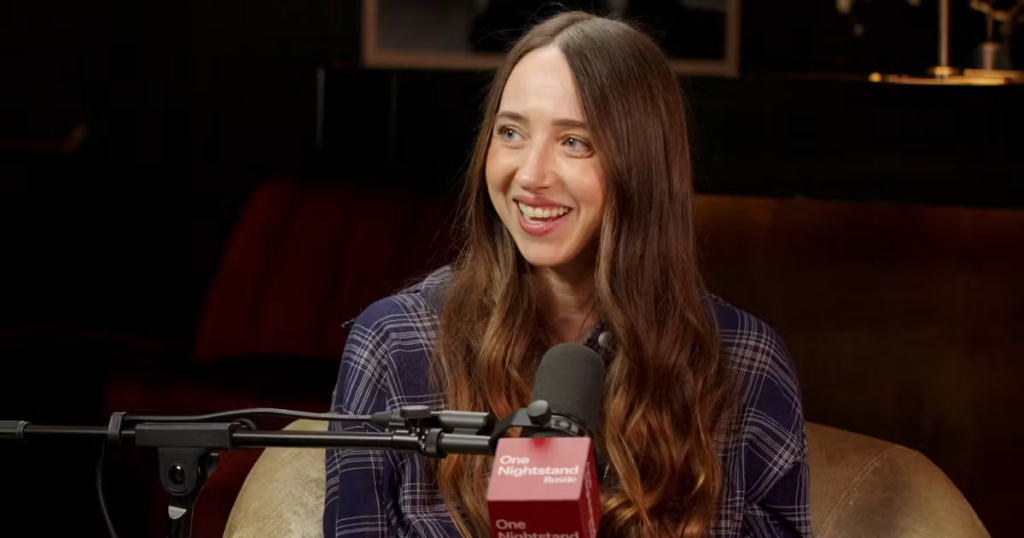

In One Nightstand, celebrity readers and writers join us at the blond in 11 Howard to discuss some of their favorite books, allowing us to learn about their tastes and lives in the process.
Zoe Kazan’s love of reading began under challenging circumstances. “The year I was 10, I had a terrible bout of insomnia and I read the complete works of Shakespeare with a dictionary,” says the 43-year-old actor, writer, and showrunner. “My mother actually had it in volumes, these little slim blue books. They didn’t have a lot of annotations, so I had a dictionary and I had those books and then I would look up words that I didn’t know.”
The power of books to soothe her is something that has persisted into adulthood. “One of the things that I go to books for is to feel like I’m not alone,” she says. “To be in this completely different body, in this completely different time, there’s an X-ray of my soul.” While Kazan is measured in assessing her childhood comprehension of Shakespeare — “I say I got the basic plot of some of them, but did I understand Titus Andronicus? No, I did not.” — it did help her develop confidence in her own point of view.
“I mean, fortunately or unfortunately, I think I’ve always had a lot of faith in my own perspective,” she says. “I think that’s probably why I started writing and why I started acting. I felt like there was something in me that was called so deeply to the text that was almost unbidden. I didn’t feel like I was making a choice. I was just responding.”
Kazan’s creative choices as an actor have resulted in bewitching performances for screen and stage that are both vulnerable and surprising. After breaking out in Revolutionary Road as the lonely secretary having an affair with Leonardo DiCaprio’s character, she had a run of idiosyncratic indie leads — The Exploding Girl, Meek’s Cutoff, Ruby Sparks (which she also wrote), The Big Sick — before transitioning into writing and directing, co-scripting Wildlife with her partner, Paul Dano, in 2018. Shortly after that, she pitched to take on her biggest challenge yet: adapting East of Eden into an upcoming seven-part series for Netflix premiering Oct. 1 and starring Florence Pugh, Christopher Abbott, and Mike Faist.
John Steinbeck’s seminal text — a roughly 600-page multigenerational epic the author considered his own magnum opus — is a mammoth undertaking at the best of times, but Kazan was reckoning with family weight, too. Her grandfather, Elia Kazan, famously adapted the work for a 1955 film starring James Dean and Jo Van Fleet, who picked up an Oscar for her 15 minutes on screen as Kate, Cathy Ames’ alter ego.
That history nearly kept her from pursuing the project herself. “It was one of these things where over the years, this book, the rights would go into different people’s hands and I would read in the trades like, ‘Oh, this person is going to do this with it.’ And I’d get really mad and I’d be like, ‘That’s not how you’re supposed to do it.’ And Paul [Dano], my partner, would be like, ‘What is this emotional reaction you’re having? It doesn’t belong to you.’ And he was right.
“However, at a certain point I called my agents and I did a thing that I never do, which is that I said, ‘If the rights to this come up, can you just please put my name forward? I’d love to adapt this.’ And I think it really pained me to do it because I think I’ve worked really hard to not be always standing in my parents’ shadow or my grandparents’ shadows. And at the same time, I felt like, well, of all the things that he made, first of all, there is a very different adaptation to be made here from the one that he made, because the one he made is so loosely adapted from the book. And then also, this book is all about intergenerational stuff and what gets carried down and inheritance and legacy. I was like, ‘Well, it is correct thematically, this makes sense.’”
The resulting work is a sumptuous TV production which Kazan filmed for five months in 2024 and 2025. Her parents — both Oscar-nominated screenwriters who once collaborated on the 1996 adaptation of Matilda — were with her. “They came to New Zealand because my partner was filming in Latvia, and so they came out and made sure my kids got to school,” she says, noting that their help extends beyond the practical. “They’re my phone-a-friend. I was struggling a lot with one episode, two pages where I kept getting notes of being like, ‘Can you tighten this section?’ Basically this part is boring. And I went to [my dad] and was like, ‘What is happening here?’ And then he diagnosed it for me and it was very simple and I was like, ‘OK, thank you.’ But I try not to do that too often, mostly because they can get quite excited about the problem. Then I’m like, ‘Well, I want to solve this. Don’t come and solve this for me.’”
As a writer, the overarching problem Kazan wanted to solve was getting the full scope of the novel, and its iconic antiheroine, on screen. “You don’t get the full intergenerational scope of the book in the movie,” she says of her grandfather’s version, which focuses on Cal’s relationship with his father, leaving the Hamilton family, Lee, and Cathy’s full arc as a character in the dust. “I saw the movie after I read the book and I was like, ‘Someday someone has to put this person on screen.’ And I had this little quiet voice in my head being like, ‘Maybe I could do it.’”
Reimagining Cathy thus became Kazan’s primary focus. “I think that Cathy is the most extraordinary character,” she continues. “To see a girl and then a woman who has no care but her own autonomy and gain, who is not doing anything for anyone else’s benefit, it was bracing… I felt like re-atomized by it or something.”
In order to prepare for the adaptation, she went deep into Steinbeck’s letters to his editor and friend, Pascal Covici, which he drafted while writing the novel and which she believes “chart the progression of his experience of Cathy.”
“I think this was really a hugely useful tool for me in decoding some of his intention and giving myself permission to do certain things,” she says of Journal of a Novel: The East of Eden Letters. “I feel like Steinbeck sort of loses control of Cathy. I think, in a way, she became much more than he intended her to be. And then I think he kind of punishes her. He writes a lot about her physical decay, the decay of her beauty. And that’s where I find the kind of mid-century misogyny jumping out.”
Casting Florence Pugh in the role of Cathy made this reimagining possible. “Florence was the person that I went into my pitch with,” she says. “When I went in and pitched to write this, I was like, I have one actor in mind. I can’t believe I got so lucky. I sat in front of our monitors every day on set going, ‘How did she do that? She didn’t move her face.’ And I saw all those things just go past. I truly think she’s a genius. I think she has an otherworldly gift and I’m so excited for people to see her in this role. And I think she found the humanity in this part.”
Keep reading to discover five of Kazan’s favorite books.
Her first choice is Sula by Nobel Prize winner Toni Morrison. Set over the course of nearly five decades, the novel follows the complicated and often fraught relationship between two women, Nel Wright and Sula Peace.
Although Kazan read Morrison’s work in high school, she says she truly came to appreciate it later in life. “Having the experience of discovering an author as an adult has been one of the most beautiful things about growing up,“ she says. “I think Toni Morrison falls into a kind of F. Scott Fitzgerald category for me where the book came to me so sanctified by the establishment that I didn’t realize how funny and transgressive and brave and bold these books were.”
As it moves, the book captures both the joys and the losses of the women’s lives. “I think in my own work, I’m always trying to ask the question, ‘What makes life worth living? When life is so hard, why do we keep going?’” she says. “I see that in this book — that the cruelty of life is held in the same breath as the beauty of life.”
Her next pick is Angels in America, Tony Kushner’s two-part play centered around ’80s life in New York City. “The AIDS crisis was a shadow over my childhood. I had two teachers who died of AIDS,” she says. “I remember my mother describing it to me. She was like, ‘It’s like everyone who made the world beautiful and interesting got on a plane and the plane crashed.’”
Kazan performed in two productions of the show, first as the Angel during her time at Yale and later as Harper in the 2010 off-Broadway revival. “When I was in my mid 20s, I knew that there was a production coming up in New York, and I wrote to my agents being like, ‘Please let them see me for Harper.’ They didn’t want to. They thought I was too young,” she says. “I prepared for that audition like I’d been working my whole life for it. It was one of these completely transportative auditions, and I got to play this role. I think I was too young to play it, in retrospect. I’m like, ‘Oh, I would really play that much better now.’”
She continues, “To be in communion with Tony’s brain is the most special thing. There’s so much in this play that speaks to the moment that we’re living in.”
Her third pick is Who Will Run the Frog Hospital? by Lorrie Moore. The novel follows a middle-aged woman named Berie while on vacation in Paris with her husband. Feeling nostalgic, she reflects on the summer she was 15, working at an amusement park with her best friend, Sils.
For Kazan, it’s the language that sticks out. “Sometimes I remember something so vividly that it feels as if I only had a little bit more of some power, I could time travel,” she says. “There’s a kind of sensuality to this book. I mean, it starts with a description of eating animal brains. It’s a very embodied book.”
In the book, Berie and Sils have an all-consuming type of friendship that ultimately ends with the two drifting apart. Kazan can relate. “From the age of five through college, I had a best friend who was everything to me, and we were like a married couple. We were so enmeshed, and we aren’t really in each other’s lives anymore,” she says. “Whether it’s a friend or a sibling or a romantic relationship, the fact that you can have that person no longer in your life and still have the love remain is such a powerful thing.”
Kazan can also see the story play out on screen. “Who Will Run the Frog Hospital? has been my sort of secret, maybe I’ll make a movie of that someday,” she says.
Her fourth choice is My Favorite Thing is Monsters, a graphic novel in the style of a 10-year-old’s diary. “The author, Emil Ferris, had a really rare mosquito-borne illness that paralyzed them,” she says. “This was the book they made while learning how to draw again.”
She discovered it at a comic book store by her therapist’s office when going through a difficult period. “I was in the wake of a second trimester miscarriage, which was really tough. And just being alone with myself was really hard. Reading in general really helped me during that time, but not things that felt too close to home,” she says. “I started watching X-Files during that time, which was a show that I had no history with. I was like, ‘I need things that are so far away from my life that they don’t make me think about myself.’ And this book really did that for me.”
Her final selection is John Steinbeck’s 1952 epic East of Eden. Kazan was on a Steinbeck tear when she first read it. “It stopped me in my tracks. It really arrested me,” she says. “I actually didn’t read any more Steinbeck after that because I felt like this was a kind of apotheosis book. I was like, ‘Everything is in here.’”
Though Steinbeck was 48 when writing the book, Kazan admired how he approached his characters from all walks of life, including children. “There’s a kind of fluidity to this book. The perspective, you just move from person to person, and there’s so much empathy in that movement,” she says. “He can’t help but be writing in the time that he’s writing it. There’s some real racist stuff in this book and there’s some real misogynist stuff in this book, but around that, there’s so much humanity and empathy and deep understanding of what it is to be human.”
Watch the full episode below: