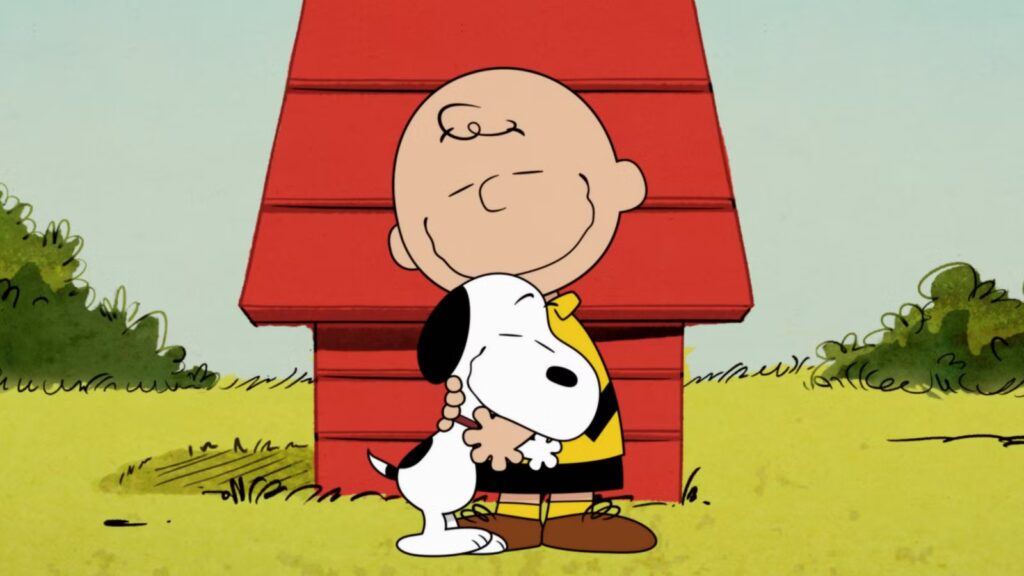

Snoopy is a comic-strip character who somehow became bigger than the strip itself. Part of that comes from how easily Charles M. Schulz could reinvent him without ever making him feel inconsistent. The cartoonist used the beagle’s wild imagination to give him hilarious personalities and storylines that continue to define Peanuts.
That range gave Schulz decades of material, but it also makes choosing the character’s most memorable moments surprisingly difficult. That is not to take credit away from the strip’s other incredible characters, but there is just something about Snoopy that makes him impossible to outshine. To prove that, here are the five best Snoopy comics ever, ranked.
5
Snoopy vs. the Red Baron

What better way to understand Snoopy’s wild imagination than his never-ending battle with the Red Baron? In the October 10, 1965, strip, Snoopy climbed onto his doghouse, imagined it was a British Sopwith Camel fighter plane, and became the World War I Flying Ace for the first time. His mission was to find the Red Baron and shoot him down. Of course, nothing went according to plan. Now, the Red Baron was based on real German fighter pilot Manfred von Richthofen, but Schulz never actually drew Snoopy’s enemy into the strip, which made the rivalry even funnier.
Readers only experience these enormous aerial battles through Snoopy, who sits on top of an ordinary doghouse while imagining gunfire, enemy planes, emergency landings, and heroic missions across Europe. The joke works because Snoopy never treats any of it like make-believe. To him, the danger is very real, and the Red Baron absolutely must be defeated. The whole concept started as one gag but became one of Snoopy’s defining alter egos, even when the enemy himself never appeared on the page.
4
Happiness Is a Warm Puppy

Some of the best Peanuts comics aren’t the funny ones. The April 25, 1960, strip simply has Lucy walk over to Snoopy, pat him on the head, pull him into a hug, and then leave after saying, “Happiness is a warm puppy.” It is an unusually sweet moment for Lucy, who normally has a far more complicated relationship with Snoopy. In fact, she regularly gets annoyed by Snoopy’s behavior and is especially disgusted whenever he tries to kiss her, while Snoopy seems to enjoy getting under her skin. That makes this rare moment of genuine affection between the two feel even sweeter.
It’s also a testament to Schulz’s brilliant ability to find something surprisingly big in an ordinary childhood moment. Even Snoopy’s reaction sells the idea, as his expression goes from pleased to completely content the second Lucy wraps her arms around him. What makes this strip even more memorable is what happened afterward. The phrase became so popular that Schulz used it as the basis for the 1962 book Happiness Is a Warm Puppy, which offered more little definitions of happiness from the Peanuts world and spent 45 weeks on The New York Times Best Seller list. Just like that, a four-panel interaction between Lucy and Snoopy had somehow become one of the defining moments associated with Peanuts.
3
Joe Cool’s First Appearance

Snoopy has imagined himself as everything, but none of his alter egos are as effortlessly ridiculous as Joe Cool. The character first appeared in the May 27, 1971, Peanuts strip, when Snoopy suddenly decided he was a college student hanging around the student union. Linus even plays along by asking how he did in chemistry class, but Joe Cool has bigger concerns. He thinks chemistry is a drag, and being seen around campus is clearly much more important. That first strip is simple but already contains almost everything that makes Joe Cool work.
All Snoopy needs to turn into him are his sunglasses and an extremely laid-back attitude. Later strips expanded the joke by turning his doghouse into a dorm room and letting Joe spend more time around the student union while he chased the college experience without showing much interest in actually going to class. The official Peanuts description still calls him the “ultimate big beagle on campus,” which is about as accurate as it gets. More than anything, Joe Cool works because he exaggerates a side of Snoopy that was already there. The character has never suffered from a lack of confidence, but Joe Cool turns that into an entire personality.
2
Dark and Stormy Night – World’s Shortest Novel

Snoopy may be a terrible novelist, but nobody can question his commitment to the craft. His writing career officially began in the July 12, 1965, Peanuts strip, when he dragged a typewriter onto the roof of his doghouse and began with the immortal words, “It was a dark and stormy night.” From there, Snoopy’s world-famous author persona became one of Schulz’s funniest recurring ideas, as the beagle spent years trying to write the great American novel from the least original opening imaginable.
The joke was even smarter than it first appeared. Of course, Snoopy did not invent the sentence. It comes from Edward Bulwer-Lytton’s 1830 novel Paul Clifford and had already become a famous example of overwrought writing by the time Schulz borrowed it. That was exactly the point, though, as Snoopy approached the cliché with complete seriousness. Schulz took the gag even further in 1971 with Snoopy and “It Was a Dark and Stormy Night,” a published book built around Snoopy’s adventures as an author. The actual novel may not be much, but as a Peanuts joke about ambition and confidence, the strip is still perfect.
1
Snoopy’s First Appearance

Any list like this would obviously be incomplete without Snoopy’s actual debut. It is almost strange to look back at Snoopy before he became the character he is today. He made his first Peanuts appearance on October 4, 1950, just two days after Schulz launched the strip. The character’s introduction doesn’t feature his iconic doghouse or any mention of his many personas. Instead, the strip shows Snoopy wandering beneath Patty’s window box and ending up soaked when she waters her flowers.
This simple moment turns the future star of Peanuts into the punchline of a hilarious visual gag. What’s fascinating is how early Snoopy actually behaved much more like an ordinary dog, while the huge personality and imagination that would eventually define him came much later. Nobody reading this tiny four-panel joke could have known that the nameless little dog would eventually become a novelist, fighter pilot, college heartthrob, and arguably the most recognizable character any comic strip has ever produced. The first Snoopy strip is not his funniest or most imaginative adventure, but as beginnings go, it feels extremely special in hindsight.

- Release Date
-
2016 – 2017-00-00
- Network
-
Cartoon Network
-

Aiden Lewandowski
Charlie Brown (voice)
-
Emma Yarovinsky
Sally Brown (voice)
-
Bella Stine
Lucy van Pelt (voice) / Crybaby Boobie (voice) / Peggy Jean (voice)
-
Jude Perry
Linus van Pelt (voice)