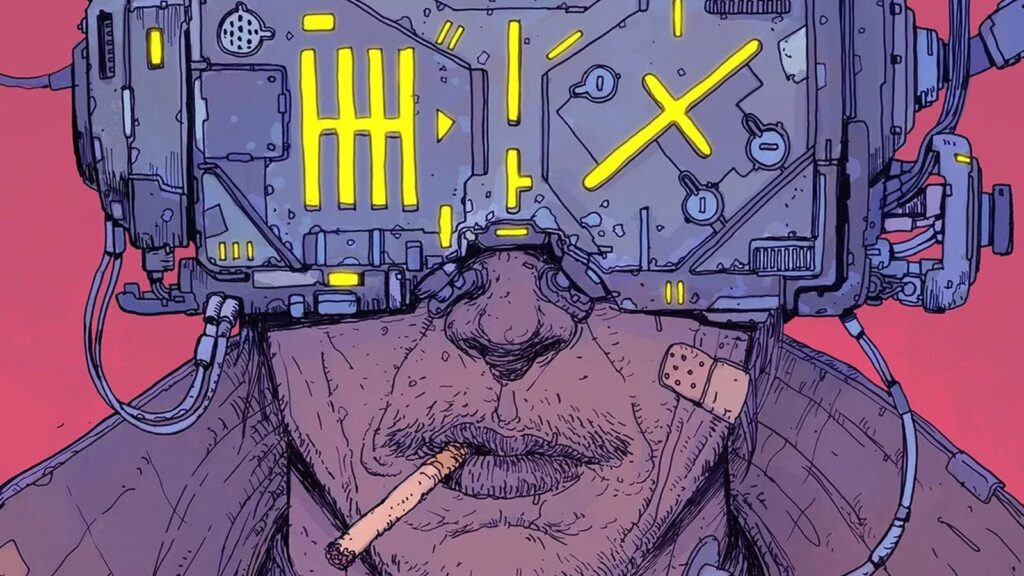

Cyberpunk is not, at its core, a genre about technology. It is a genre about power, and about who controls information, who controls bodies, and who controls the architecture of reality itself. It explores what happens to the people at the bottom of all those hierarchies when the gap between them and the people at the top, usually evil corporations, becomes unbridgeable.
The neon-soaked ambience, the rain, the corporate dystopia, and the neural implants are the furniture of a genre whose real subject is what human beings do when the systems built to serve them start consuming them instead. Getting into cyberpunk might seem intimidating at first, but these five novels are the best place to begin.
Do Androids Dream Of Electric Sheep? Is The Starting Point Of Blade Runner

Philip K. Dick wrote his most influential novel in 1968, a full 16 years before William Gibson named the genre, and it remains the most philosophically rigorous entry point into cyberpunk’s central question: what makes somebody human? Set in a post-nuclear San Francisco where most animal species have gone extinct and humans colonize off-world, Rick Deckard is a bounty hunter tasked with “retiring” six Nexus-6 Replicants who have escaped to Earth.
The Voigt-Kampff test, used to measure empathic response, identifies the Replicants and is the real subject of the novel, but it fails to do so convincingly. Dick is not interested in the thriller mechanics of the manhunt, instead focusing on whether Deckard is any more capable of real empathy than the beings he hunts, and the novel refuses to answer the question cleanly — the very thing that makes it so enduring. There are few movies better than Blade Runner, and this novel was where it all began.
36 Streets Won The Ditmar And Aurealis Awards

Before turning to writing, T.R. Napper spent a decade as a diplomat and aid worker in Southeast Asia, living in Hanoi’s Old Quarter, which became the setting for his debut novel. His lived experience gives 36 Streets a specificity of place that most cyberpunk novels, built on Japanese aesthetics and American noir conventions, simply cannot access.
Set in a near-future Hanoi under Chinese occupation, the novel follows Lin “The Silent One” Vu, a Vietnamese-Australian gangster and martial artist who has carved herself a place in the city’s criminal underground under the tutelage of her mentor Bao. When an Englishman arrives hunting his friend’s murderer, Lin is pulled into a conspiracy involving mega-corporations and an addictive immersive simulation of the Vietnam War called Fat Victory that the city’s population is slowly disappearing into. The novel uses Vietnamese history and culture as the structural foundation of its world rather than decorative backdrop.
Altered Carbon Is Dynamic With Fantastic World Building

Richard K. Morgan’s debut novel won the Philip K. Dick Award in 2003 and was adapted by Netflix in 2018. Altered Carbon remains the most propulsive novel on this list; a hardboiled noir detective story built on a premise so elegant it feels obvious in retrospect. In Altered Carbon’s future, human consciousness is stored on a cortical stack at the base of the skull and can be transferred between bodies (called sleeves), making death a logistical inconvenience rather than a permanent condition — provided one can afford a decent backup.
Takeshi Kovacs, a former UN envoy soldier, is “resleeved” on Earth and hired by Laurens Bancroft, one of the ultra-wealthy Meths who effectively live forever through continuous digital backup, to investigate Bancroft’s own murder that she does not remember. The novel uses its immortality premise to build the most unequal society in cyberpunk fiction, where the rich cycle through bodies indefinitely, and the poor lose everything when their stack is inevitably destroyed.

Neal Stephenson published Snow Crash in 1992, but the book remains uncomfortably relevant even today. Hiro Protagonist (a name that the novel is aware is ridiculous) is a freelance hacker and pizza delivery driver in a near-future America where the federal government has essentially collapsed and been replaced by corporate franchise-states.
Hiro moonlights as one of the world’s greatest sword fighters in the Metaverse, a virtual reality universe that has become economically more significant than the physical world. When a new drug called Snow Crash appears with the ability to fry the brains of hackers through their virtual reality interfaces, Hiro begins investigating a conspiracy that reaches back to ancient Sumerian mythology and the very origins of human language. Stephenson writes at a velocity that is almost aggressive, and Snow Crash is one of the funniest cyberpunk novels, packed with ideas that arrive at breakneck speed towards the reader. It’s the ideal starter novel for someone who wants to get to know the genre and also have a good time.
Neuromancer Defined Cyberpunk, And It Was Written On A Typewriter

William Gibson anticipated the architecture of the internet before most people knew the internet existed in Neuromancer. Case is a washed-up console cowboy, a hacker who jacks directly into cyberspace through neural implants. His nervous system has been deliberately damaged by former employers he cheated, leaving him unable to access the virtual world that gave his life meaning.
A mysterious employer named Armitage offers to repair the damage in exchange for one last job — to pull off a heist that reaches into the orbital platforms of the ultra-rich, but one that turns into something far greater involving artificial intelligence entities. Neuromancer is the only novel in history to win the Hugo Award, the Nebula Award, and the Philip K. Dick Award in the same year in 1985. It is now being made into a cyberpunk show by Apple TV.