
In every Look Back, we examine a comic book issue from 10/25/50 years ago (plus a wild card every month with a fifth week in it). This time around, I’m a bit late as I look at June 1976’s introduction of a very Marvel-coded Batman villain that came out during a weird moment in Gerry Conway’s career.
1976 was an EXTREMELY weird point in the career of the late, great Gerry Conway. Conway had begun his career working for DC on some short stories before he was quickly hired away by Marvel to become one of their major writers, most famously being his stint writing Amazing Spider-Man, one of Marvel’s biggest titles. Over time, he also became the major writer on Marvel’s BIGGEST title, Fantastic Four, as well as Thor, Marvel Team-Up, and a number of other comic books.
However, when Conway was passed over to become Marvel’s Editor-in-Chief, he quit Marvel and returned to DC. That changed, though, when the Marvel Editor-in-Chief job opened up for Conway in 1976, so he went to Marvel and became Editor-in-Chief. A job he promptly held for…a few months, and then left it to go back to DC again.
The funny thing, though, is that that the way comic books work is that Conway’s DC work was still coming out when he was at Marvel, but since he left Marvel so quickly, there were DC books coming out still from BEFORE he left Marvel that were being released AFTER he left Marvel, which is the case for this June 1976 issue of Detective Comics (#464, drawn by Ernie Chan and Frank McLaughlin) that sure seems to be a bit of an homage to Conway’s time at Marvel.
What Surprisingly Major Character Made Their Debut in This Issue?
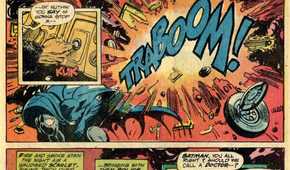
The issue opens with Batman taking on a group of drug dealers who are doing a deal after hours at a boxing arena, but after the leader of the gang seemingly escapes from Batman, he gets into a car that has been rigged to explode.
-
 Image via DC
 -
 Image via DC
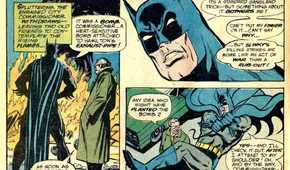
Conway then introduced a City Commissioner named Arthur Reeves (I love how vague comic books always were about the jobs of politicians. “He’s a…city….commissioner, yeah, that’s the ticket!”). Later, when Conway returned to the Batman titles for an extended run on both Batman and Detective Comics, he brought back Reeves as a major thorn in Batman’s side.
It is interesting that this was Conway’s last issue before he left for Marvel, so I would IMAGINE that he knew he was leaving, and yet he was also setting up future plots. I suppose he didn’t know that he WAS leaving when he wrote this issue, but either way, it’s interesting.
The idea of someone in the city government being ANTI-Batman was a relatively novel concept at the time (perhaps even TRULY novel, but I doubt it), and so Conway clearly felt he had a good hook here for a later story, since he returned to it down the line.
How Was the Black Spider a Mixture of Punisher and Spider-Man?
-
 Image via DC
 -
 Image via DC
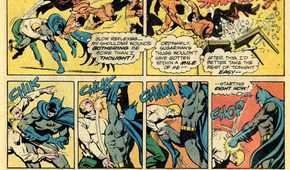
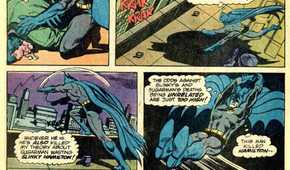
Later, Batman is looking into another drug dealer when he has to defend himself from the crimelord’s goons, but then, suddenly, the drug dealer is killed by a sniper, and the Dark Knight hunted him down, and that’s when we met the Black Spider for the first time!
-
 Image via DC
 -
 Image via DC

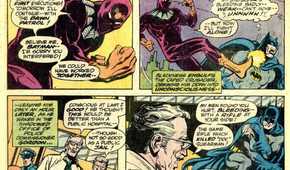
Clearly, as you can see, the Black Spider’s setup is the same as the Punisher, a character that Conway had created a few years earlier during his run on Amazing Spider-Man. However, in an extra twist, Black Spider also had a full face mask and, you know, the whole spider motif, and thus was obviously a bit of a reference to the famous Spider-Man character…

Check out the cover for the issue, and you’ll even see Black Spider’s swinging into the scene sure seems to be reminiscent of Spider-Man. This was particularly amusing because Conway had just previously ruffled some feathers the previous year by introducing a new character called Power Girl, who debuted soon after Marvel had named Luke Cage Power Man.
The weird thing about THAT is that Jim Shooter, irked at Conway for introducing Power Girl, then decided to bring Wonder Man back (as there had been this whole thing about DC perhaps being irked at Marvel over introducing a Wonder Man, which is why Marvel killed him off. I doubt that’s actually what went down, but obviously it was enough of a story that Shooter thought it WAS the truth). The weird thing about that is that Conway was technically the Editor-in-Chief of Marvel when Shooter introduced a character in response to something Conway had done at DC, but Conway, of course, was on the way out so quickly that I don’t even know if he was still listed as the Editor-in-Chief on Wonder Man’s return.
Black Spider was seemingly killed during his first storyline (which extended to the next issue), but Conway brought Black Spider back in a story a few years later after he had returned to DC. Had Conway remained on the series back in 1976, I’m sure he would have done more with Black Spider then.
It’s interesting how Conway had Black Spider handle Batman relatively well. Conway was big on letting his main heroes be vulnerable like that (see how well the Tarantula did against Spider-Man back in the day).
If you folks have any suggestions for October (or any other later months) 2016, 2001, 1976 and 1951 comic books for me to spotlight, drop me a line at brianc@cbr.com! Here is the guide, though, for the cover dates of books so that you can make suggestions for books that actually came out in the correct month. Generally speaking, the traditional amount of time between the cover date and the release date of a comic book throughout most of comic history has been two months (it was three months at times, but not during the times we’re discussing here). So the comic books will have a cover date that is two months ahead of the actual release date (so October for a book that came out in August). Obviously, it is easier to tell when a book from 10 years ago was released, since there was internet coverage of books back then.