
If an OTT series can make a young person curious about the armed forces, make a family understand the sacrifices made by those in uniform, or simply make someone walk up to a veteran and say, “Thank you for your service,” then it has achieved something far more important than merely getting its history right, notes Air Commodore Nitin Sathe (retd).

Key Points
- Operation Safed Sagar has renewed public interest in the Indian Air Force’s role during the 1999 Kargil War.
- The Netflix series focuses on No. 17 Squadron and its commanding officer B S Dhanoa during the conflict.
- It carries authentic military details, human stories, camaraderie and convincing aerial combat sequences.
- Several major Safed Sagar stories, including Nachiketa’s capture, remain largely outside the six-part series narrative.
- The series succeeds by making a younger generation remember the sacrifices and humanity behind India’s armed forces.
I always proudly wear my Air Force cap when I travel. It has often helped me find friends, make new ones and strike up conversations with complete strangers.
A little while ago, while travelling in the US, I was pleasantly surprised when people walked up to me and said, “Thank you for your service” — something one does not hear very often in our country.
But something has changed in India too.
I was in Chandigarh recently, and my cap seemed to attract more attention than usual. The moment people spotted the insignia and the words embroidered on it — Proudly Served the IAF — they would come up to me and tell me how proud they were of the Indian Air Force and the role it played in the 1999 Kargil War.
I couldn’t help but wonder what had changed.
The answer was obvious.
Operation Safed Sagar.
The serial being aired on Netflix seems to have struck a chord. It has brought the story of the Indian Air Force’s role in Kargil into people’s homes. More importantly, it has made many realise what it takes for the men and women of the armed forces to keep the nation safe.
For someone like me, however, watching the serial was a little more complicated.
I had been close to the project even before it became an OTT series. I also had the privilege of serving in the IAF during the time of Kargil operations.
It was sometime in 2022 when I met air force veteran-turned-film director Kushal Srivastava in Mumbai. He told me he had plans to direct a film on the Kargil War.
I was immediately excited.
I had just finished writing a book on some of the untold stories of Kargil in my book 1971-1999: War Stories. Having interviewed several veterans, gathered stories that had never appeared in print and, also have had the opportunity of serving in the Kargil and Siachen sectors myself, I had some understanding of the environment in which these events had unfolded.
I offered to help him in whatever way I could.
After all, this was not just another film project. It was about the Indian Air Force — an organisation that had given me a life.

IMAGE: Jimmy Shergill and Siddharth in Operation Safed Sagar.
Veterans Take Makers Back To 1999
In September 2023, Kushal and his creative team of eight or ten people drove down from Mumbai to meet me and some other veterans in Pune. They were firming up the storyline and wanted to gather as much information as possible from those who had actually lived through the period.
Over cups of coffee and a fair amount of nostalgia, we tried to take this wide-eyed team back into 1999.
Amongst us was Air Vice Marshal Manmohan Bahadur, a veteran and my senior, who had landed the first helicopter in Siachen way back in 1978. There were stories, recollections, operational details and, inevitably, a fair number of fun times that we narrated to the team.
For me, there was something satisfying about seeing a younger creative team genuinely curious about a part of our history that many of them had known only through books and newspaper reports.
Over the next year, Kushal remained in touch with me sporadically, sharing bits and pieces of how his dream project was progressing.
And then came the first glimpse.
A few weeks before the release, Kushal sent me a small teaser. It was impressive.
But there was also disappointment.
I was told that the story being depicted in the six-part Netflix series would not cover the entire contribution of the Indian Air Force during Operation Safed Sagar — a subject that I had studied in detail to write my book.
I had hoped that the enormous canvas of the Indian Air Force’s role in Kargil would finally be brought alive for a mass audience.
It wasn’t going to be that story.
Instead, some of the most extraordinary chapters of the air war were going to be left untouched.
There would be no story of the Canberra on a photo-reconnaissance mission, hit by a missile, yet managing to limp back to Srinagar on a single engine.
No account of the MiG-25 — the IAF’s high-speed, high-altitude reconnaissance aircraft — being flown at low levels, doing exactly the opposite of what it was designed to do.
Why A Narrower Kargil Story Worked
We would not see the remarkable jugaad that transformed ordinary bombs into GPS-guided weapons, giving them the accuracy the IAF desperately needed in the mountains. Nor would we see how the Mirage 2000 was employed for missions and tactics that had scarcely been imagined before the war.
These were not merely technical details or footnotes to Kargil. They were stories of courage, ingenuity and improvisation under fire.
And there were many more such stories.
Sadly, this was the canvas that was going to be missed.
Instead, Kushal and his team had chosen to concentrate largely on one fighter squadron — No. 17 Squadron commanded by then wing commander B S Dhanoa, and their exploits.
Later, after I finished watching the serial, I realised that choosing to just concentrate on one part of history became the strength of the serial.
If they had chosen to tell the entire story of Safed Sagar in six episodes, it would have turned out to be a hurried catalogue of aircraft, missions and personalities. By narrowing the lens, the makers had the opportunity to tell the story through just a few people operating from the Srinagar airbase.
Post the release of Safed Sagar, Kargil seemed to have again become the centre of public attention. News channels were discussing the war, social media was full of stories from 1999, and friends were sending me messages about the serial.
I finally found the time to watch it from beginning to end in two sittings.
I approached it with some trepidation. I thought I knew what I was in for; as if I had already read the book and I knew what was coming.
My earlier experiences of watching films based on the armed forces had not always been happy ones. Having served in uniform for more than three decades, one develops a rather unforgiving eye for badly worn uniforms, incorrect terminology, implausible cockpit sequences and soldiers who behave more like Bollywood characters than military professionals.
I wondered how Operation Safed Sagar would fare. And fare well, it did.
I was hooked late into the night.
What unfolded in the entire serial was a gripping combat drama centered on No. 17 Squadron- ‘The Golden Arrows’, stationed at Bhatinda, commanded by then wing commander B S Dhanoa, who later on became the chief of air staff.
And this is where the serial became particularly interesting for me.
Because I knew the man called Tony — Tony Dhanoa.
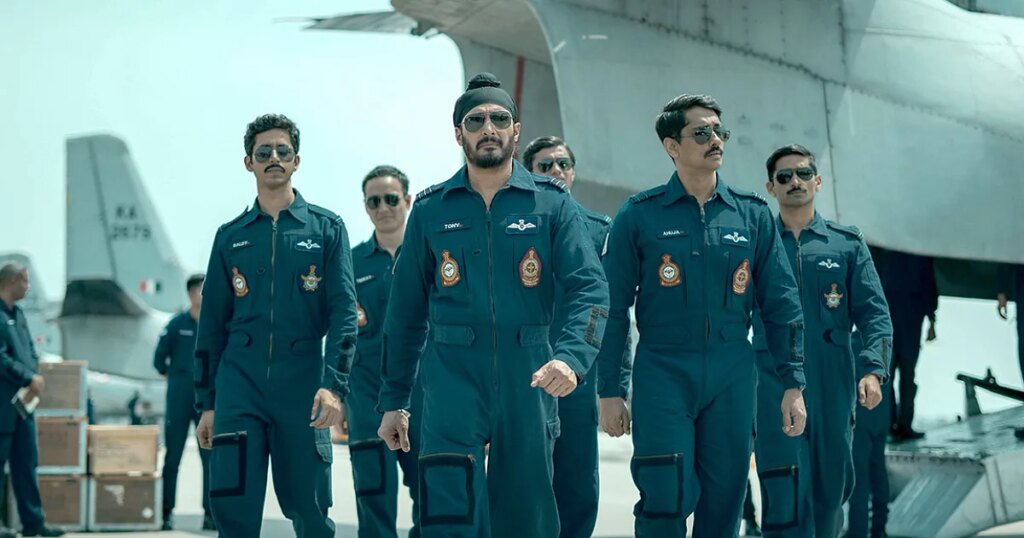
Jimmy Shergill plays Tony Dhanoa beautifully. He looks like a fauji. More importantly, he behaves like one.

IMAGE: Then IAF chief Air Chief Marshal Birender Singh ‘Tony’ Dhanoa with then Wing Commander Abhinandan Varthaman on board a MiG-21. Photograph: PTI Photo/Rediff Archives
The Man Behind Dhanoa’s Leadership
I knew Dhanoa from my time in Shillong. He often spoke about his ‘boys’ in 17 Squadron and would recount his experiences of the Kargil conflict when we briefed him during the morning conferences over coffee in his office.
Dhanoa was known in the IAF as a thorough professional who was willing to experiment with new tactics and strategies aimed at surprising the enemy. He was particularly fond of devising new stratagems to counter the Chinese on our northern borders. Often, he would order us to plan exercises and validate these, making times very interesting at Shillong.
There were many instances of incidents or failures, but we never saw Dhanoa losing his cool. He went to the root cause of the problem and wanted us to always try harder for success.
The leadership qualities and mannerisms of men like Dhanoa are difficult to explain to someone who hasn’t served the military.
A commanding officer doesn’t have to shout to command a room. Sometimes it is the way he listens, the way he asks a question, the way he speaks with his men and the way he unhesitatingly argues with his seniors that makes him a hero.
Shergill manages to capture much of that.
And then there is Squadron Leader Ajay Ahuja, the able flight commander to Dhanoa played by Siddharth equally well.
I knew Ajay from our days at the National Defence Academy.
The Ajay I knew was soft-spoken, shy and somewhat introverted. But when the discussion turned to flying, operations or war, he came into his own.
He was serious and calm on the outside, but underneath that quiet exterior was a caring human being, a gentleman and a thorough professional.
Siddharth has managed to bring much of that personality to the screen.
For me, therefore, the scenes involving Ahuja carried a poignancy that perhaps they wouldn’t have had for a viewer who had never known him.
I was watching someone I had known, not only a character in a film.
The serial depicts a squadron going to war with older aircraft, limited equipment and a demanding operational task. Its initial role is largely reconnaissance and battle damage assessment (BDA) using cameras fitted in the belly of the aircraft.
Half way through the episodes, the narrative changes.

Photograph: Kind courtesy Netflix
Beyond The Cockpit: The Human Side Of War
Ahuja ejects from his crippled aircraft, lands in enemy territory and is captured, tortured and killed. The boys in the squadron are distraught and low on morale. Dhanoa volunteers his squadron for an additional bombing role, using GPS-aided bombing to take revenge against the enemy who does not follow the Geneva Convention.
The serial captures the uncertainty and pressure of those early operations reasonably well — the feeling of men being asked to accomplish an almost impossible mission; with many of the tools that would make that task easier simply not available.
This is one of the aspects of Kargil that is often lost in the larger narrative.
We remember spectacular victories. But we sometimes forget the improvisation, uncertainty and sheer hard work that went into achieving them; and this has come out splendidly well in Safed Sagar.
One of the things I particularly liked about Operation Safed Sagar is that it doesn’t remain permanently in the cockpit.
It takes the viewer into the personal lives of the pilots — their friendships, relationships, social occasions and moments of ordinary life.
That is important. A fighter squadron is not simply a collection of aircraft and pilots. It is a family.
The camaraderie, the banter, the concern for one another and the quiet support that air warriors and their families provide each other become particularly important when the squadron is at war.
The series brings some of this out without turning every scene into a patriotic speech. And that restraint is welcome.

Photograph: Kind courtesy Netflix
For the most part, I thought that the directors did a remarkably good job at depicting the military scenes. Having an ex-veteran like Kushal behind the camera clearly made a difference.
The uniforms are generally convincing. Even the ribbons on the chest have been selected with attention to detail. The operational environment feels right. The cockpit sequences are particularly good, with the use of the throttle and various instruments giving the flying scenes a degree of authenticity that is often missing in Indian cinema.
These may appear to be small things to the average viewer. For someone who has spent thousands of hours in aircraft, such details can either pull you into the story or throw you straight out of it — if not depicted properly.
Here, more often than not, they pulled me in.
The aerial combat sequences also benefit enormously from the advances in visual effects and computer-generated imagery available to filmmakers today. It is just not noise and jets zooming across the screens like I have seen the films that I had a chance of reviewing earlier.
Indian cinema has come a long way in depicting air warfare.
And that is good news, because there are many more stories waiting to be told. Especially, the larger story of Operation Safed Sagar that yet remains untold.
The Kargil air campaign was far more than the story of one squadron.
Like I said earlier, many more aircraft, crews, helicopters, support elements, and the intense liaison between the two services (that was lacking during the initial part of the war) yet remains in reports and books. These can surely make great narratives if someone chooses to take them on.
And then there is a whole part of what the Indian Army was doing on the ground. Battling weather, altitude and tactical disadvantage, our men fought with their blood and toil to achieve what the Pakistanis felt was unachievable.
Speaking of Pakistan, there are sequences in the narrative that takes the viewer across the border — to then prime minister Nawaz Sharif and his cabinet and General Pervez Musharraf who headed the Pakistani army then. Maybe it was meant to make the viewer understand the Pakistani military and political viewpoints that were depicted to be poles apart.
These depictions felt a little out of place, farfetched and over fictionalised. Personally, I felt that these could have been given a miss.

Photograph: Kind courtesy Netflix
But what should have been included in the episodes is the story of Squadron Leader Nachiketa. He had to eject out of his aircraft due to an engine malfunction during firing at the enemy post and was captured by the Pakistani Rangers. What followed was a military, diplomatic and political imbroglio with repercussions for both sides.
Nachi’s episode finds just a little mention in the story line for some inexplicable reason. After all, Ahuja’s crash occurred whilst he was searching the area for Nachiketa, exposing himself to an enemy missile attack. This was relevant to the plot.
Overall, having watched the series, I am less disappointed about omission of the whole story of Kargil. The makers understood what the OTT drama needed to convey: Our armed forces were the true heroes who need to be remembered. The series’ job was to make people care; and that was achieved.
Operation Safed Sagar has, no doubt, managed to make a generation that wasn’t born when Kargil happened feel something about the people who fight wars. That is no small achievement.

Photograph: Kind courtesy Netflix
How Safed Sagar Keeps War Human
Military stories inevitably require cinematic liberties. Liberties must be taken to make the general public ‘feel’ what is being shown but these should not distort the truth.
Operation Safed Sagar occasionally dramatises events, compresses timelines and presents the story through the conventions of television drama. But importantly, it does so without drowning the story in the kind of jingoism and noise that has become common in some recent military films.
It talks about the ‘human’ and ‘humane’ humans behind the war fighting machines and machinery who are not super heroes. These men and women are frightened, excited, confident, uncertain, professional and occasionally vulnerable — like every other human on earth. This is what makes these characters more believable.
In my generation, it was films like Vijeta that introduced many of us to the world of fighter pilots and the Indian Air Force. Vijeta, I believe was a film that was closest to reality in our times. It was shot whilst we were at the NDA; and I remember being part of the shooting in the cadets’ mess.
Operation Safed Sagar could well be doing something similar for a new generation. A generation that is different and may not understand war and war fighting as well as an older generation did.
Today, the technology is different, the visual effects are vastly better, and the audience wants everything in quick time.

The fundamental story of any war epic is the same. But what Safed Sagar has done is that it has made people look up. Look up in awe and respect at its fellow citizens who don the uniform to guard the border 24/7/365, and who ensure a safe and meaningful life for the citizenry.
And, judging by the reactions I have received, it has made some people look at an Air Force cap a little differently.
I now wear mine with more purpose.
For now, when someone spots the IAF insignia and starts a conversation, I no longer have to explain what the Indian Air Force did in Kargil.
They have seen Operation Safed Sagar.
This is the greatest compliment the series could receive.
I only hope that the feeling lasts long after the six episodes have disappeared from our screens.
Because if an OTT series can make a young person curious about the armed forces, make a family understand the sacrifices made by those in uniform, or simply make someone walk up to a veteran and say, “Thank you for your service,” then it has achieved something far more important than merely getting its history right.
It has made people remember.
And sometimes, that is where inspiration begins.
IAF Veteran Air Commodore Nitin Sathe is a rediffGuru and you can ask him questions about careers in the defence services here.
A helicopter pilot who served the IAF for 35 years, he is a frequent contributor to Rediff and you can read his earlier articles here.
Feature Presentation: Aslam Hunani/Rediff