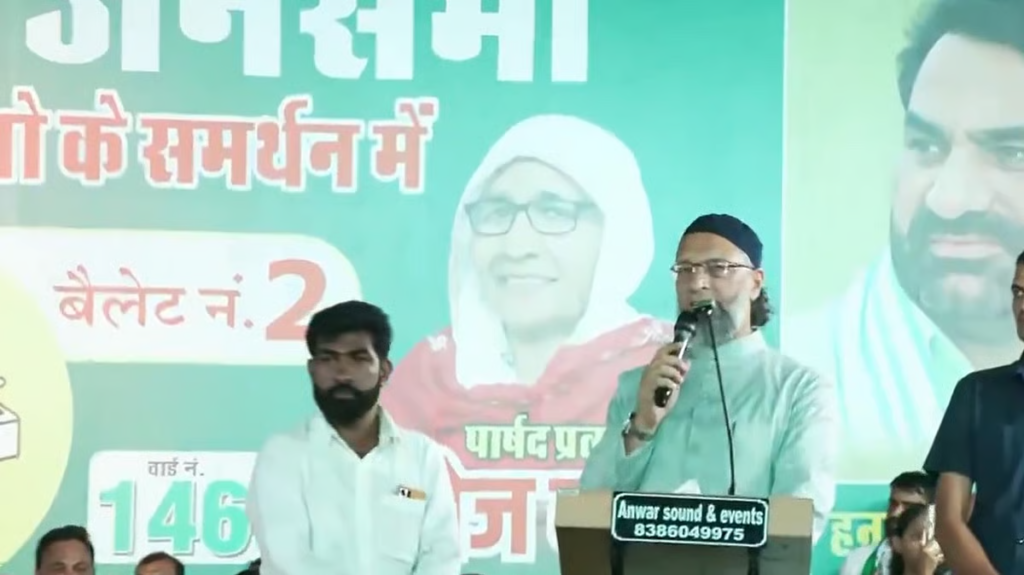

Owaisi & Beniwal Announce Third Political Front In Rajasthan Against BJP & Congress | ANI
Jaipur: Amid the ongoing local body elections in Rajasthan, a new political alignment is taking place with AIMIM chief Asaduddin Owaisi and Rashtriya Loktantrik Party (RLP) leader Hanuman Beniwal announcing plans to build a third political alternative to the BJP and Congress.
The two leaders indicated that their political partnership would not be restricted to the municipal elections and could continue through the next Rajasthan Assembly elections.
AIMIM-RLP alliance takes shape
Owaisi described the move as the beginning of a “third option” in the state’s politics, while Beniwal said a new political chapter was being written from Jaipur.
Addressing a public meeting of an AIMIM candidate in Jaipur on Sunday night, Owaisi said, “Rajasthan’s politics had for decades remained centred on the BJP and Congress, and voters now need an alternative.”
He appealed to voters to support RLP candidates in areas where the party has fielded them in the ongoing local body elections.
Leaders pitch social partnership
While Hanuman Beniwal, the MP from Nagaur, described the alliance with Owaisi as a new beginning for Rajasthan politics.
“The Jat and Muslim communities have shared political space in the past, and this social and political partnership can continue in the future as well,” said Beniwal in the public meeting.
He said the proposed alliance was not merely an electoral arrangement but would also work to raise public issues and launch political movements.
Also Watch:
Third front in Rajasthan politics
Rajasthan has traditionally witnessed a bipolar political contest between the BJP and Congress. The emerging alliance between the AIMIM and RLP is being taken as an attempt to create a third political front in the state.
Muslims account for an estimated 9-10% of Rajasthan’s population and have significant electoral influence in several constituencies, particularly in parts of Jaipur, Jodhpur, Nagaur, Alwar, Bharatpur, and Jaisalmer.
While Jats are estimated to constitute around 12-14% of the state’s population and have a considerable electoral influence, particularly across the Shekhawati, Marwar and Bikaner regions.
The two parties could potentially seek to combine the political influence of different social groups.