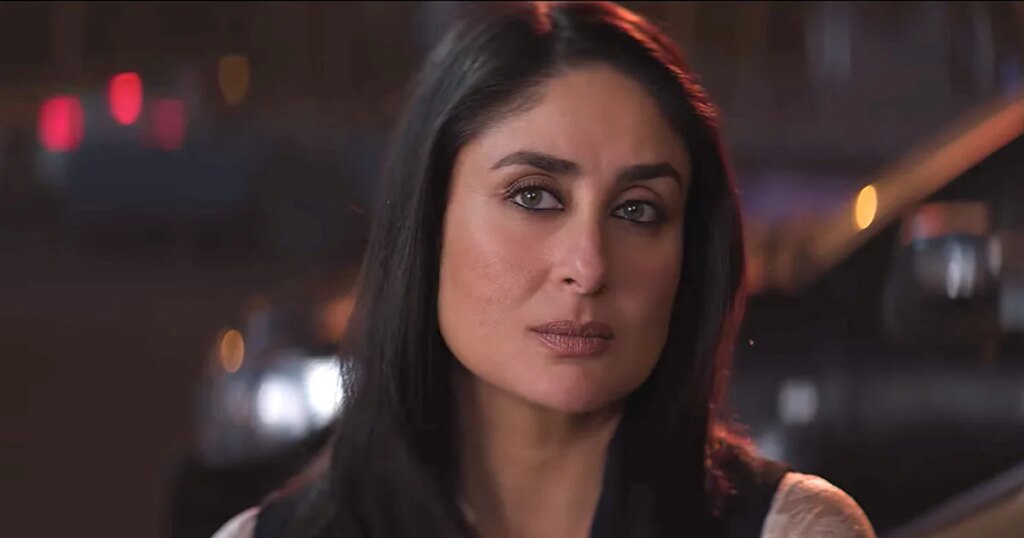

‘Kareena is completely instinctive.’

IMAGE: Kareena Kapoor Khan in Daayra.
Key Points
- ‘Is it the failure of the police that the accused remains unpunished?’
- ‘Is it a lapse in the legal framework or even on the part of the human being sitting in judgement?’
- ‘One is not independent of the other, therefore a myopic view that the police or the judiciary is at fault is wrong.’
“It’s the last push before the baby is out,” jokes Meghna Gulzar, who despite all the time constraints, manages to make time for one more interview in the midst of hectic promotions.
Speaking to Rediff Senior Contributor Roshmila Bhattacharya about Daayra, Meghna shares, “My father loved the film for its neutrality and dignity. My mother sees it only when the first copy comes out; she doesn’t even like watching the film’s promos.”
Daayra talks of encounter killing and a film on the subject that remains in the mind is Shimit Amin’s 2004 crime drama Ab Tak Chhappan with Nana Patekar’s Inspector Sadhu Agashe modelled on Mumbai Sub-inspector Daya Nayak.
What’s your POV on this grey area of police procedure and the resultant moral dilemmas that arise from it?
I have not seen Ab Tak Chappan, but from what I understand, any systematic institution, anywhere in the world, gets stifled at some point by certain restrictions.
In the case of the police, even if they do a cracking job of the investigation and file what seems like a foolproof chargesheet, certain clauses in the law to prevent an innocent from being unfairly implicated can be misinterpreted and misused to benefit an actual criminal.
Is it the failure of the police that the accused remains unpunished?
Is it a lapse in the legal framework or even on the part of the human being sitting in judgement?
One is not independent of the other, therefore a myopic view that the police or the judiciary is at fault is wrong.
What is needed is an overview of the entire chain of systems.
‘Daayra underlines that there is no right or wrong’

IMAGE: Prithviraj Sukumaran in Daayra.
There’s also public sentiment that believes the judicial process is long and tedious and wants instant justice.
Yeah, and this sentiment comes from years of disappointment over justice undone.
But does that make it right?
Again, you cannot see things in isolation, you need to see them in connection with the entire link of systems which are operational.
Daayra underlines that there is no right or wrong. It is all grey, subject to a particular circumstance and its interpretation, an instinctive action and reaction.
We spotlight a series of issues and questions that need to be looked at holistically and in connection with each other.
Writing the film must have been a challenge?
Yes, maintaining objectivity was important, right from paper, otherwise it would never have reached the screen.
Fortunately, I had two astute co-writers in Yash Keswani and Sima Agarwal, who understood the fragility of the script and how easily it could bend in either direction.
Everything was thought through several times to maintain the tenuous balance.
‘I witnessed my sister-in-law and brother-in-law’s challenges in their first pregnancy’

IMAGE: Sanjay Suri, Tabu, Sushmita Sen, and Palash Sen in Filhaal.
The first screenplay you worked on was Hu Tu Tu? Would you have designed it differently today?
My father (Gulzar) wrote the entire screenplay, I only assisted him with drafting, fine-tuning and formatting it with maybe a few inputs of my own.
I don’t think I would have been able to conceive Hu Tu Tu because that world, its characters and the rural politics of the time were not as familiar to me.
Yes, certain themes like political dispensation, corruption and injustice were, but their interpretation as we see it in Hu Tu Tu was not for me to write.
Was Filhaal more familiar territory?
Yes, because I had witnessed my sister-in-law and brother-in-law’s challenges in their first pregnancy and that struck a chord.
Usually, a film’s ‘The End’ comes after the hero and heroine, having overcome family obstacles and misunderstandings, get married to presumably live happily ever after.
We forget that even while living happily, something may cause an upset in a couple’s lives.
That was the starting point of Filhaal.
Would the story change today?
The execution would because that has changed dramatically over the last 23-24 years and I would probably sketch my characters better today.
But thematically and emotionally, I don’t think I would do anything differently.
The complexities which arise from a woman wanting to have a child irrespective of it being harmful to her health or even her life, the dilemma of the husband in allowing her to do so, the helplessness the two men experience when the girls decide on surrogacy, the insecurities of one when she sees the other carrying her child and going through the maternal experience.
All this and the core emotions around them haven’t change with the years.
‘Tabu walks a fine line and never strikes a false note’

IMAGE: Irrfan Khan and Tabu in Talvar.
Having collaborated with her on Hu Tu Tu, Filhaal and Talvar, how would you describe Tabu as an actor?
I would say her performance is fragile and finely nuanced.
Tabu walks a fine line and never strikes a false note.
I can’t talk of Tabu and not talk about Sushmita Sen.
For her, the word is ‘organic’.
When she did Filhaal, Sushmita was known for her item numbers and the glamorous roles she did in commercial blockbusters. But she made the transition effortlessly. She gets under the skin of her character and her performance comes from deep within her.
‘Alia’s pure instinct’

IMAGE: Alia Bhatt in Raazi.
What about Alia Bhatt, Raazi’s lead actress, and Deepika Padukone whom you worked with in Chhapaak?
Alia’s pure instinct, you can’t say she applies a method or sets out to do something consciously.
Deepika is the opposite. I won’t say it’s method, but she is a measured performer, and will give layers to her performance depending on the intensity of the character graph.
What about Kareena Kapoor in Daayra?
Kareena is completely instinctive; she performs from the gut.
The best part of all these actors is that they are not studious and given to rehearsed performances.
All of them are spontaneous which is why they successfully transform from one character to the next in the different kinds of films they have been doing.
‘Prithviraj said our set was one of the most organised sets’

IMAGE: Kareena Kapoor and Prithviraj Sukumaran in Daayra.
Actors down South are known for their professionalism and discipline. Was working with Prithviraj Sukumaran smooth?
I won’t say it’s a South industry thing, it’s more to do with an actor’s personality.
I’ve been fortunate to work with extremely dedicated actors even from Hindi films.
Prithviraj is a producer and director himself, so he manages things a little differently.
(Chuckles) He said our set was one of the most organised sets he has been on in a very long time.
Daayra has just one song, Sach Ka Daayra penned by Gulzarsaab and composed by Amit Trivedi. How did it happen?
The song is a parenthesis, summarising in lyrics and music what the film says in two-and-a-half hours.
My father had read the script, knew it well, but still insisted he had to see the film first to understand what was needed.
Like the last song in Sam Bahadur, which is a tribute to India’s first field marshal Sam Manekshaw, and came into only after the composers, Shankar (Mahadevan), Ehsaan (Noorani) and Loy (Mendonsa), and my father saw the film, the Daayra song too was composed after the film was completed.
‘My father loved the film for its neutrality and dignity’

IMAGE: Meghana Gulzar on the Daayra set.
What was Gulzarsaab‘s reaction to Daayra?
He loved the film for its neutrality and dignity.
And what about Raakheeji?
My mother sees it only when the first copy comes out; she doesn’t even like watching the film’s promos.
Ever thought of directing your mother?
When I was younger, yes.
But then I realised it would be difficult translating our personal relationship onto the studio floor.
Lines would crisscross, I wouldn’t want that and neither would she.
Photographs curated by Satish Bodas/Rediff