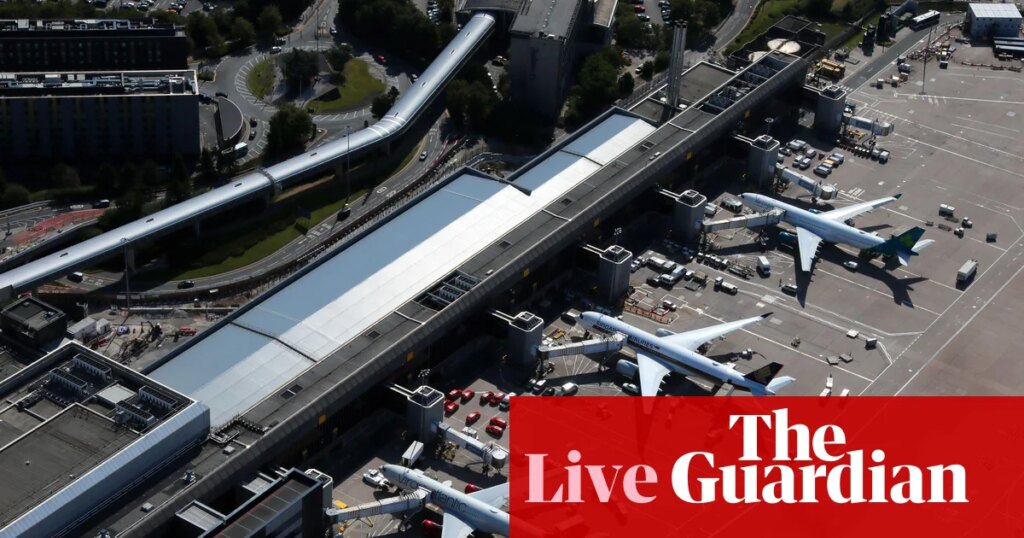

Air traffic control failure disrupts flights in Scotland, Northern Ireland and northern England
An air traffic control failure has disrupted flights in parts of the UK, about two weeks after a software glitch caused widespread flight chaos in the UK.
A number of departing and arriving flights at Scottish airports have been severely delayed, with disruption affecting Scotland, Northern Ireland and northern England.
The technical fault has been reported at National Air Traffic Services (Nats)’ second control centre, at Prestwick in Scotland.
NATS said the issue is unrelated to the problems earlier this month, when more than 2,000 flights were cancelled to and from the UK due to a NATS software glitch, disrupting travel plans for hundreds of thousands of passengers.
Some flights at Manchester Airport are delayed as a result this morning. EasyJet and British Airways issued messages to passengers that they may face delays.
In a statement, a Nats spokesperson said:
We are investigating a technical issue at our Prestwick centre in Scotland. To maintain safety, air traffic regulations have been applied to manage traffic demand.
Engineers are on site investigating and working to resolve the issue. The issue is unrelated to the technical problems experienced earlier this month.
We apologise for the disruption and any delays to passengers’ journeys. Passengers should check with their airline for the latest information on their flight.
Key events
Airbus to hire up to 900 workers in north Wales
Alex Daniel
Airbus is expected to hire as many as 900 more workers in north Wales to build its long-range A321 jet, as the aircraft maker invests £150m to ramp up jet production.
The company has a backlog of more than 5,000 of the planes, and will make an initial 480 new hires at its wing production centre in Broughton to help meet soaring demand.
Airbus is understood to be planning a similar number of hires next year at the group of factories, which have about 6,000 people working there.
The move will include restarting production at its West Factory, which used to make the wings for its double-decker A380 jet, but was converted into a warehouse after the company made 1,700 people redundant across its UK sites during the pandemic.
The West Factory will be retooled to build the new aircraft which can fly 240 passengers from the UK to the east coast of the US.
Jerome Blandin, head of Airbus Wing, said:
Investing in our capacity strengthens our industrial footprint, creates high value jobs that support the wider UK aerospace sector and ensures we remain competitive in the years to come.
The investment comes after Airbus said it would also expand a wing factory in Belfast over the next few years to help it build more of its smaller A220 planes.
UK car industry warns locking UK out of ‘Made in Europe’ would be ‘own goal’

Lisa O’Carroll
Locking the UK out of a new EU scheme to protect industries from Chinese competition would be an “own goal” and risk up to 250,000 jobs in the bloc, the British car industry has warned.
Most of those jobs, 69,000, would be jeopardised in Germany, France and Spain but also in central and Eastern Europe, according to a new study by Oxford Economics commissioned by the Society of Motor Manufacturers and Traders (SMMT).
SMMT’s arguments comes days after the chancellor, John Healy, urged EU finance ministers to include the UK in its definition of Made in Europe legislation.
They fear if UK industry is locked out then EU manufacturers may no longer buy British parts for assembly lines.
The government is also warning that it won’t commit to a second EU-UK summit unless Made in Europe is discussed amid fears over opposition in France to including Britain and other countries such as Japan who are warning that their EU bases should be included.
Mike Hawes, head of SMMT, said:
The EU is rightly focused on strengthening its industrial base, but the UK remains fundamental to Europe’s automotive ecosystem and is therefore essential to that ambition. Excluding the UK from ‘Made in Europe’ would be an own goal, weakening competitiveness, reducing scale and limiting consumer choice.
Ryanair calls on Nats CEO to ‘resign immediately’ or be sacked
Ryanair has stepped up calls on the Nats chief executive Martin Rolfe to resign immediately, or for transport secretary Heidi Alexander to sack him.
This latest Nats failure which is affecting its Prestwick control centre is disrupting flights operating to and from Dublin, Edinburgh, Newcastle, Manchester and a range of airports across Scotland, Northern England, and Ireland.
So far, more than 25,000 Ryanair passengers are expected to be affected, with more than 140 Ryanair flights delayed and delays exceeding three hours.
This latest system failure comes just days after Nats published its preliminary report into the 8 September failure.
Ryanair said:
Today’s disruption raises serious questions about Nats’ operational resilience and why, after repeated system failures, there is still no effective back-up system capable of preventing widespread passenger disruption.
The report confirmed that the permanent software fix identified following the 8 September failure had not yet been implemented and remained under testing.
Ryanair’s chief operations officer, Neal McMahon, said:
Just three days after NATS assured airlines and passengers that it had introduced a robust ‘mitigation plans’, its flight data processing system has failed again. More than 25,000 Ryanair passengers have already suffered disruption, with over 140 Ryanair flights delayed, yet NATS still cannot tell passengers when this disruption will end.
Martin Rolfe’s report claimed that another failure was ‘unlikely’ and that NATS could recover more quickly if one occurred. Those claims have been exposed as completely worthless. Just three days later, passengers are once again suffering lengthy delays because Nats has failed to deliver either a reliable system or an effective back-up.
After the August 2023 collapse, Martin Rolfe assured parliament that it was a ‘once-in-a-lifetime event’. Then Nats collapsed again on 8 September, disrupting more than 2,000 flights. Now, just 13 days later, the same flight data processing system has failed once more. How many times must UK passengers suffer disruption before Martin Rolfe is replaced by somebody competent?
Another review, another report and another round of empty promises will not fix NATS. Martin Rolfe has presided over repeated system failures, repeated passenger disruption and repeated failures to deliver an effective back-up system. Enough is enough.
Martin Rolfe should resign today. If he will not, then Transport Secretary Heidi Alexander should fire him and appoint somebody capable of delivering the resilient ATC service that UK passengers and airlines deserve.
Here’s our full story on the flight cancellations and delays in parts of the UK, caused by a technical issue at National Air Traffic Services (Nats)’ second control centre, at Prestwick in Scotland.
It’s the second time within a fortnight that a technical problem in air traffic control has disrupted flights, although this time the impact on passengers appears to be more limited. The issue has been fixed, according to the UK’s transport secretary, Heidi Alexander.
Bitcoin soars through $80,000 to seven-month high
Bitcoin has jumped through $80,000 today, hitting the highest levels since May.
The world’s best-known cryptocurrency hit $84,721 this morning.
Chris Beauchamp, chief market analyst at investing and trading platform IG, said:
It has been months since bitcoin has seen the world above $80,000, but it has finally managed to breach the May highs in early trading today. Financial markets have rediscovered a risk-on frame of mind after being consumed with worry about government bond yields, debt piles and the prospect of a return to tighter policy at the world’s most powerful central bank.
Cryptocurrencies are advancing in a group this morning, a move given strength by recent inflows and one likely to attract even more of those vital funds. Perhaps investors are realising that they can live in a world of higher US [interest] rates, though falling oil prices certainly help too.
UK transport secretary: Technical issue at Nats has been fixed
The UK transport secretary, Heidi Alexander, has just said that the technical issue at Prestwick Centre has been fixed – but warned there could be “some delays as things reset”.
She said on X:
There has been a further IT issue affecting @NATS.
Engineers have fixed the problem and systems are resuming.
I know this will be deeply frustrating for passengers after the previous issue.
There may be some delays as things reset. Please check with your airline for updates.
Aviation News UK posted on X:
A Flight Data Processing System (FDPS) failure at Prestwick Centre continues to disrupt Scottish-controlled airspace.
🔴 60% below normal capacity
⚠️ High delays
🚫 No critical flights accepted
⏰ Restrictions currently extended until 14:00 UTC
The disruption is affecting the wider Scottish control area — not just Prestwick Airport — with delays reported at Glasgow, Edinburgh and Prestwick.
Manchester airport posted the Nats statement on Twitter, with passengers due to travel today advised to keep an eye out for updates from their airlines.
Airlines including British Airways and easyJet have reported immediate cancellations.
A total of 24 flights have so far been cancelled across UK airports, according to the analysts Cirium. However, many flights continue to operate.
An easyJet spokesperson said:
A Nats air traffic control system failure in its Prestwick centre is causing delays to flights with some unable to operate. This, once again, calls into question the resilience of Nats’s systems and demonstrates the need for firm actions to prevent these repeated failures.
A BA spokesperson said:
Yet another technical fault with Nats means some of our customers are likely to experience disruption to their travel plans today. This is disappointing, and while it is an issue that is entirely out of our control, we’re doing everything we can to limit the impact on customers and are keeping them updated.
Air traffic control failure disrupts flights in Scotland, Northern Ireland and northern England
An air traffic control failure has disrupted flights in parts of the UK, about two weeks after a software glitch caused widespread flight chaos in the UK.
A number of departing and arriving flights at Scottish airports have been severely delayed, with disruption affecting Scotland, Northern Ireland and northern England.
The technical fault has been reported at National Air Traffic Services (Nats)’ second control centre, at Prestwick in Scotland.
NATS said the issue is unrelated to the problems earlier this month, when more than 2,000 flights were cancelled to and from the UK due to a NATS software glitch, disrupting travel plans for hundreds of thousands of passengers.
Some flights at Manchester Airport are delayed as a result this morning. EasyJet and British Airways issued messages to passengers that they may face delays.
In a statement, a Nats spokesperson said:
We are investigating a technical issue at our Prestwick centre in Scotland. To maintain safety, air traffic regulations have been applied to manage traffic demand.
Engineers are on site investigating and working to resolve the issue. The issue is unrelated to the technical problems experienced earlier this month.
We apologise for the disruption and any delays to passengers’ journeys. Passengers should check with their airline for the latest information on their flight.
Fixed-rate UK mortgage costs jump to multi-year highs
Fixed-rate mortgage costs have jumped to multi-year highs in the UK.
The average two-year fixed residential mortgage rate rose to 5.88%, its highest since 16 April and up from 5.84% last Friday, while the average five-year is at its highest since October 2023, at 5.92%, up from 5.88%.
Rachel Springall, Finance Expert at Moneyfacts, said:
Borrowers will be frustrated to see fixed mortgage rates soar, with around £150 added to monthly mortgage payments, based on a typical mortgage [of £250,000 over 25 years], since the start of March 2026. There were notable rate hikes last week from the major brands, some increasing for the second time this month to catch up with rising swap rates.
The average two-year fixed rate is approaching its highest point seen this year, rising by over 1% since the start of March, and the average five-year fixed is now back to highs not seen since October 2023, the month after the infamous mini-budget.
In the months ahead, remortgage business is expected to boom, so any borrower coming off a cheap fixed rate must seek advice. It could be a good opportunity for lenders to consider extending their product transfer windows while rates remain volatile, giving existing customers more time to secure a new deal while also helping lenders protect their mortgage books.
The interest rate on a typical two-year mortgage fixed deal of £250,000 over 25 years has risen from 4.84% in March to 5.88%.
There are now 7,419 residential mortgage products available, down slightly from 7,435 at the end of last week.
Bund yields drop, shrugging off German vote but Merz under scrutiny
German markets have largely shrugged off the results of two regional elections.
The yield, or interest rate, on the 10-year government bond, known as Bund and the eurozone benchmark, retreated 5 basis points to 3.48% this morning, mirroring moves in other countries.
The main stock exchange, the Dax in Frankfurt, rose 0.8%.
Germany’s embattled chancellor, Friedrich Merz, has vowed to stay in office and fight for future-proofing economic changes despite heavy losses for his conservative party in two state elections, one to the far right in Mecklenburg-Western Pomerania, and the other to a leftwing party, in Berlin.
Preliminary results indicated Merz’s Christian Democratic Union (CDU) tallied just 4.9% in Mecklenburg-Western Pomerania, below the 5% threshold needed to enter the state parliament and indicating the party may be excluded altogether. It would be the CDU’s worst-ever state score, which Merz called a “disaster”.
Holger Schmieding, chief economist at Berenberg Bank, said he expects Merz’s coalition government of CDU and Social Democrats to carry on with its pro-growth reforms.
After a potentially contentious debate, the [federal] coalition will likely soften some of the envisaged entitlement cuts for instance with a long transition period for the end of early retirement.
Nonetheless, I still expect the coalition to implement the bulk of its planned pro-growth reforms.
European stock markets bounce higher; bond yields tumble as oil slides
European stock markets have also bounced higher, while government borrowing costs retreated, as oil prices slid on reports that more supplies are passing through the Gulf than though.
The UK’s FTSE 100 index rose 0.36% to 10,697, up nearly 40 points. Germany’s Dax gained nearly 0.7%, France’s CAC rose 0.6%, Italy’s FTSE MiB advanced 0.74% and Spain’s Ibex is up 0.5%.
The pan-European Stoxx 600 rose 0.65%, led by technology and travel stocks.
The tech sub-index increased 1.9% as chip-linked stocks Soitec jumped 4.6% and Aixtron advanced 3.9%.
France’s Soitec manufactures substrates that are used to make semiconductors, used in smartphones, tablets and computers while Germany’s Aixtron, founded by university researchers in 1983 as a spin-out from RWTH Aachen University, also produces components for chipmakers.
US stock futures are pointing to a stronger open on Wall Street later, suggesting the tech-heavy Nasdaq could rise almost 1%.
Brent crude, the global oil benchmark, is down 2% (or $2.1) at $101.78 a barrel, the lowest in more than a week. This has triggered hopes of lower inflationary pressures, and pushed government bond yields lower after Friday’s turmoil, sparked by expectations of a steeper path for interest rates.
The yield, or interest rate, on the 10-year UK gilt fell nearly 7 basis points to 5.241%.
Italy’s 10-year yield dropped 9 basis points to 4.355%, after jumping 10bps on Friday. The equivalent French yield fell 10bps to 4.47%, after rising 12.5bps on Friday. The German 10-year yield eased 5ps to 3.47%, wiping out Friday’s increase.
Reuters reports: Iran has conveyed its conditions to mediators for re-engaging in negotiations aimed at ending the war with the US, Al Jazeera cited Iran’s security chief, Mohsen Rezaei, as saying in an interview on Saturday.
However, tensions in the Middle East remained high as Yemen’s Iran-backed Houthis said they attacked “sensitive” sites in the Saudi capital of Riyadh on Saturday with missiles and drones, as well as an Aramco facility in the Red Sea city of Yanbu, a key oil export hub.
On Monday, a spokesman for the Revolutionary Guards, Hossein Mohebbi, said Iran would use new weapons and target locations not previously attacked if the US launched a new offensive, according to the Fars news agency.
China has asked Iran to help rein in the Houthis after an appeal to Beijing by Saudi Arabia following the attacks, three Iranian sources told Reuters.
The attacks by the Houthis on Saudi Aramco’s East-West pipeline have prompted the state energy firm to ramp up exports through the strait of Hormuz this month and next after halting some shipments via Yanbu.
JPMorgan analysts said on Friday:
Middle East oil flows remain surprisingly strong despite the disruption to Saudi Arabia’s East-West pipeline.
They added that total oil flows averaged 17.1m barrels per day (bpd) in the past 10 days, just 6.1m bpd below the 2025 average.
“The most notable pivot has come from Saudi Arabia,” the analysts said, as satellite data indicated Saudi oil moving through the strait of Hormuz averaged 2.9m bpd over the past six days, up from just 700,000 bpd in August.
Introduction: Asian shares rise amid optimism around US-Chinese talks on trade and AI; oil prices slide
Good morning, and welcome to our rolling coverage of business, the financial markets and the world economy.
Stock markets in Asia have risen led by technology shares, lifted by optimism around talks between the US and China on trade and artificial intelligence, while oil prices declined.
The talks between US and Chinese economic officials on Sunday came ahead of much anticipated summit on Thursday between US president Donald Trump and Chinese president Xi Jinping in Washington.
US Treasury secretary Scott Bessent said the two countries had discussed setting up a channel to communicate about AI issues called the “US-China AI dialogue”.
Chinese state media described the talks as “candid, in-depth and constructive”.
Nvidia’s co-founder and chief executive Jensen Huang has rejected grim warnings from AI researchers that the technology could lead to humanity’s extinction within a few years, calling this overblown “doomsday narratives”. He told CBS News:
2030 is not going to be the end of the world. There is 0% chance that’s going to be the end of the world.
Scaring people is unnecessary. It is irresponsible.
Hong Kong’s Hang Seng gained 0.88%, South-Korea’s tech-heavy Kospi jumped 2% and China’s CSI 300 rose 0.6%. Tokyo was closed for the silver week holiday, which runs until Wednesday.
Stephen Innes, analyst at Quintex Intel, said:
Scott Bessent and Chinese vice premier He Lifeng have already laid the groundwork [for the Trump-Xi meeting] in New York, with trade, investment and artificial intelligence on the table, but this is not a market waiting for a grand bargain.
It is waiting to see whether both sides can keep the next trade grenade in the drawer.
Oil prices are down sharply this morning, adding to Friday’s declines on hopes that Saudi Arabia is moving to restore about half of crude shipments after they were disrupted by the stoppage of its east-west pipeline to the Red Sea, despite ongoing attacks by Yemen’s Houthis.
Brent crude, the global oil benchmark, fell just over 2% to $101.8 a barrel, a drop of $2.01. But it remains above $100 and significantly higher than pre-Iran war levels of around $72 a barrel.
There was relief that the bombing threatened by Trump has not happened (yet). Governments across the Middle East are bracing for an escalation of violence after Iran claimed it had received intelligence that the US was preparing for a renewed bombing campaign against the Islamic Republic.
The US president reportedly told a Fox News reporter “very big things are going to be happening in the not-so-distant future” and that the options he was considering were “wiping Iran out, letting them rot economically or making a deal”.
Investors are also hoping for diplomatic progress on the Iran war at this week’s UN meeting. Trump said he would be open to mmeeting Iranian president Masoud Pezeshkian, who is expected to be in New York for the UN General Assembly.
The Agenda
-
9.30am BST: UK S&P Global Consumer sentiment index
-
9.30am BST: ONS to publish “Measuring artificial intelligence in the UK economy using a thematic account
-
1.30pm BST: US Chicago Fed National Activity Index for August
-
2.10pm BST: IMF managing director Kristalina Georgieva speaks at the IMF Legal Department 80th anniversary conference in Washington