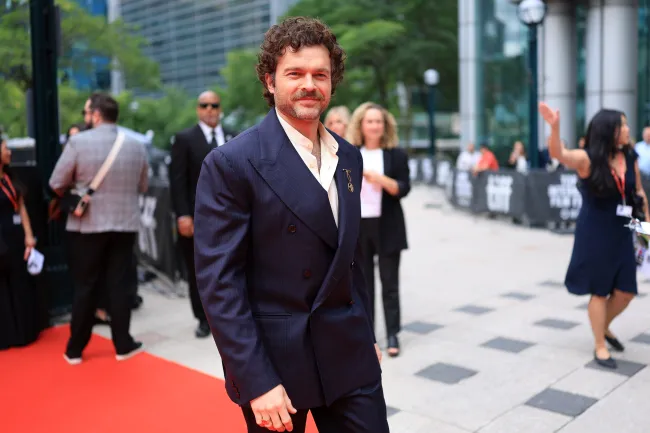

When I meet Alden Ehrenreich for breakfast inside a Toronto hotel, it’s way too early in the morning for this kind of music. It’s the kind of music that plays over the most dramatic parts of a movie. And it’s pretty loud. It’s the kind of music that plays when a character finally reveals the truth. I now needed Ehrenreich to reveal the truth, whatever that may be. This kind of music playing for us demanded such a thing, or what were we even doing here in the first place, except being slightly annoyed by it.
Ehrenreich is in Toronto in support of Anton Corbijn’s “A Talent for Murder,” which debuted at the Toronto International Film Festival earlier this week. He plays Edward, a representative for a New York City publishing house, who has been tasked with traveling to Switzerland to meet with Patricia Highsmith (Helen Mirren), to try and convince her to write a sixth Tom Ripley book. As things progress, very reluctantly at first, the pair start hatching a story idea that envisions Edward in the Tom Ripley persona. Ehrenreich points out this is a much more interesting way into that character than just it being “a Tom Ripley movie,” in which people would have their preconceived notions of what this character should be. (A path Ehrenreich has very much been down before.)


When I got to the restaurant, I didn’t know what to expect. Like, literally. I was just told “show up here at this time,” which at a film festival is really all the information that’s needed. But I didn’t know if this was going to be a quick interview where multiple journalists are shuffled in and out, or something more interesting to meet the dramatic music that was playing.
Over the course of 40 minutes, we had plenty of time to jump into a lot. From Ehrenreich’s recent Tony win for “Becky Shaw” (which I saw and was fantastic), his interpretation of his role in “Oppenheimer,” how he was told “Beautiful Creatures” would be the next “Twilight,” why he joined the MCU, and how and why he learned to stop reading about himself in the press.
Oh, and Steve Urkel. He had a lot to say about Steve Urkel.
When I arrived, I happened to be wearing a Mr. Roper t-shirt under a dress shirt and this immediately caught Ehrenreich’s attention and he asked about it…
The following interview has been edited and condensed for clarity and length.
IndieWire: The first day I wore this, a random superintendent in New York was doing some work outside and stopped me on the street and in a very serious voice said, “What a great shirt. You know, they never respected him.”
Alden Ehrenreich: Right! He relates to the super.
He relates to Mr. Roper.
He identifies as the landlord there. Yeah, that’s really funny. Crazy people with their sexual escapades. They’ve got to be stopped!
By the way, this is really dramatic music playing for 10:00 AM.
Right? This is not a room that you usually spend time in in the morning.

I feel like you need to say something profound because of the music.
Exactly.
Is it intimidating going head-to-head with Helen Mirren for an entire movie?
We did a week of rehearsal about a year in advance of shooting the movie, and she was just so lovely. I’m imagining that’s the way she is in an interview? She’s so kind of gentle and warm and soft-spoken and funny and personable…
And opinionated. Yes, I brought up “The Mosquito Coast” to her in an interview and she had some very strong opinions about the critics’ reactions to Harrison Ford playing that kind of role at the time.
Yeah. She is. but she just lets the environment be whatever it’s going to be. I just immediately really got along with her and we had a great time. Before the movie was supposed to go, it all fell apart. And then we didn’t know whether it was going to happen again. Then it happened a year later. It came back and we shot it again.
Why did it fall apart?
Just financing stuff. It was wild, because when we came back it was like let’s remember what it was we were doing a year ago…
[Our server, Amy, asks for our orders and asks if we have any allergies.]
I get in trouble with doctors because when they ask me if I have allergies, I say cyanide and they get mad. I’ve never made a doctor laugh at that.
Really? They don’t like it?
They do not.
I think it’s good. I like it. When I’m at a restaurant and they say, “Do you have any allergies?” Sometimes I say cats, which is true.
See, I’ve tried the cyanide line once at a restaurant and I got the look of scorn.
Restaurant is trickier.
And I understand, because they’re busy and they don’t have time for buffonery.
Tomfoolery.
Have you ever been at a Broadway show and it feels like the actor on stage is looking right at you and it’s really uncomfortable? You did that to me in “Becky Shaw.”
Oh, really? You were sitting up front?
Yeah, we had press tickets. In a scene in which your character is seething with rage. It’s very uncomfortable.
That’s really funny.
I don’t know if you can actually see anyone up there.
I can’t. Not until the curtain call. Technically I probably could, but I’m not. I mean, I’m avoiding it at all costs. And I try to keep my sight lines on other parts of the theater where I don’t look at somebody, because you could look down at somebody and they’re looking at their phone.
Oh, that’s rude.
It kind of takes you out of it. Yeah. I mean, I didn’t have that experience, but you want to try to, in a way, see the fourth wall that isn’t there basically.

There were literal headlines that read, “Alden Ehrenreich steals the show.” You had to know things were going well.
I had wanted to do a play for a really long time. I had this weird relationship with theater where I had a theater company in my twenties, I’m opening a theater in Los Angeles at the moment, and it’s a huge part of my life. But I’ve never done a professional play.
How’s that possible?
It just is weird. There are ones that have come around that I didn’t want to do. There are ones that I pursued that I didn’t get.
It does seem like a huge commitment.
Yes, it is that. And you do it far in advance. So you commit to a play a lot. My admiration for especially older theater actors in terms of just the physical cost and in terms of they’re really doing it for the love. Nobody’s getting rich at all. And I saw people work a lot harder for a lot less on stage than I’ve seen in many instances in film. Finding that particular play and that role, there’s just once in a while you find a role that you’re like, “I can’t wait to say this stuff. I can’t wait to do this. I know I’m this guy.” I didn’t expect it to go as well as it did necessarily…
I doubt anyone goes into it thinking, “Guess who’s getting a Tony for this?”
No. I mean, I remember when I signed up my agent being like, “And it’s kind of during award season.” So I was like, “Oof, OK.” And it’s such an interesting thing because when reviews for movies come out, like today, that will happen. I really try to avoid it and all that stuff. But when you’re in a play, you have to avoid it because you actually still have to go do it. So you are taking this gamble. If you are in something and it doesn’t go over well, it’s not like you go, “OK, on to the next one.” It’s like, “OK, another six months of this.”
Right, if a movie doesn’t go over well, you can just say, “OK, I’m in ‘Oppenheimer’ now. Here I go.”
Yeah, exactly. And the way I’ve worked has always been a little bit like a theater actor, a little bit, the way I work on roles. So it felt like, I don’t know, it just felt like I got to come into an environment that was always kind of a natural fit for me, but that I’d never experienced before.
Here’s what I noticed: When you came out for the curtain call you weren’t smiling or anything. You still looked like you were in character. You took a quick bow and got off stage.
I mean, I got that note when we were in dress rehearsal. They were like, “Try to look a little less miserable.”
Miserable’s not the word. It’s like you were still the character. But you didn’t look happy.
Totally. The emotional climax of the whole piece for my character happens 30 seconds before the play ends.
I like that you didn’t take their note.
Yeah, I think what you said is probably true. I’m still kind of in it at that point. It takes a little bit of a moment afterwards to… Little rituals and get out of it and shift gears a little bit, which is its own process that I was learning through that whole period. How do you balance your day-to-day life? It’s very different. In a movie you have a big scene on Thursday, and the hours, they’re longer. With a play, you do the whole thing, obviously, you’re living the whole story every day. And so you have more downtime, but in a way that downtime is more needed for recovery.
So you went straight from “A Talent for Murder” to “Becky Shaw” on Broadway? Is that how that worked out?
Oh, no. I went back to LA and was writing, and then we did a play reading at my theater with Robert Downey Jr. of “Our Town.”
So you got to steal some more scenes from him like in “Openheimer”?
I wasn’t in it. He was unbelievable. He played the stage manager.
But you know you did that in “Oppenheimer.” You know you got some big laughs.
I love my character.
Well, he’s great.
When I did that, I watched “Mr. Smith Goes to Washington,” because I think for all the gravitas of that movie, there’s a lot of a brooding quality to the movie. And Chris Nolan never said anything like this, but I felt a, kind of, I don’t know… almost like an old school classical sort of patriotism in the writing that I felt like Chris Nolan was moved by and mattered to him. And that was something that I felt a lot of as a kid. And obviously becomes more complicated as you grow up and as the world changes and as the country changes. But to be in that moment and get to play a character that was very much the sort of, to me, kind of a character that was in the world of a Jimmy Stewart or a person like that was very exciting.
And you got to deliver the big line about JFK and act like you have no idea who that is.
Yeah, that’s true. You have to downplay that. And even that is almost like that line I felt he’s invoking a kind of optimism. Because even though now we’ve lived so far past that moment, what Kennedy represented, the kind of hopefulness and optimism that Kennedy represented is probably comparable, in some way, to what Obama represented when he first came on the scene. It was like my character was like, “Oh, there’s a future past this era that we’re all going to move into that’s going to be a lot brighter for the country.” I’m curious how Chris Nolan actually feels about that, but there was almost a sentimental quality in a movie that feels very unsentimental at its face.
You mentioned how you always wanted to do a play, and “A Talent for Murder” is based on a play. Was this scratching that itch before you actually got to do it? I know it’s not the same. You’re not in front of a crowd.
No, it’s not, but it is sort of? I think some of the things that draw me to theater are the things that drew me to the movie because, when I read it, and I knew that Helen was doing it, it was like a little bit almost like… so, I did a movie called “Hail, Caesar!” 10 years ago or something…
I’m very familiar with “Hail, Caesar!,” yes.
So I got to do sort of…

You have one of the most famous lines of dialogue in that movie that will follow you the rest of your life. I love it when actors do that, “I did this little Coen brothers movie, ‘Hail, Caesar!’ I don’t know if you saw it or not.”
[Laughs] I don’t assume! But yes, it’s true. And that line follows me in the good times and the bad times. There’s a lot of different ways to use that line. But that felt a little bit like, oh, I would get to do this one act play with Ralph Fiennes almost inside of it. And this felt like, oh, I get to do almost a full play with Helen. Anton Corbijn is not a theater guy, but me and Helen kind of rehearsed it in the very limited amount of time we had. The way we rehearsed all that stuff was very much the way you would rehearse it if it was a play.
Can we talk about where this movie goes or not?
It’s a good question. I don’t know the answer to that. I’m happy to, but it’s really up to the people.
The way I always look at it, if it gets more people to watch it, knowing a bit where it goes…
Sure. Yeah, I think so. I don’t think there’s anything wrong with talking about it.
As the movie goes on, your character, Edward, starts envisioning a sixth Tom Ripley book with himself as Ripley. Did you know this before you read the script?
No, I didn’t know the play.
So you’re just reading the script like, “Oh, wow, this is who I’m playing?”
Exactly.
What’s that like?
Yeah. I mean, not only that, but also doing it in this way. It would be a different thing if I was just doing another Ripley thing because then it’s a much more direct comparison…
You’ve gone down that road before.
Exactly. Speaking of “The Mosquito Coast”…
Good callback.
But this is so different, because it’s basically a novel that never actually got written, that we’re working on together. And I was talking to the writer last night about this. I feel that the Ripley in this movie, even though age-wise, I’m closer to a “Talented Mr. Ripley” era, the way she wrote Ripley in the movie, in particular, feels to me more like the later Ripley novels where he’s kind of just a sociopath, basically. In the early novel, there’s a part of him that’s very wounded and some of this is coming out of rage and all this.
By the time you get to the later novels, that has been all so repressed that he’s very comfortable with himself. So I think the opportunity to do two roles — and two roles that are this different and on this different kind of spectrum? I’m trying to remember other movies and things where that happens. I mean, I know there are ones. I guess the Urkel show.
Wait, are you referencing “Family Matters”?
Yeah, exactly. He gets to play the cool version of Urkel.
Well, there’s the headline.
[Laughs] Exactly. That’s just what I was thinking. That’s going to be the headline, “Compares this to Steve Urkel.”
“Tom Ripley, he’s just like Urkel.”
Not on Urkel, on Stefan Urquelle, or whatever, you know what I mean? The cool guy version. God, I haven’t seen that show in a long time.
Jaleel White.
Yeah! That’s right. I mean, yeah, it’s a very exciting draw to get to do both of those things at the same time and figure out how to do them. And we shot basically all the Ripley stuff first in Italy, in Rome, and then did all the stuff in the room. So I had the advantage of knowing what that all feels like when I’m in the contained scenes with Helen.
At the end it tells us this is a fictional account of her life. I assume for legal reasons.
Well, you want the real legal thing?
What is it?
I’m never referred to as Ripley in the movie.
So we’re getting someone sued with this interview?
Not exactly, because I’m just a Ripley-esque character, isn’t it? But there was some back and forth with that. And I understand the people who have the rights to the book, this is not canon, this is a whole other book. It’s a whole other thing. And so there’s a fine line to draw there.
I’m going to say something controversial, but I don’t even think it’s that controversial, but I’m going to make a statement.
OK.
In your life, you will play Han Solo again.
No idea.
If you look at the way history works with all this stuff, no one expected to see Andrew Garfield as Spider-Man again. Also, last time we spoke a couple of years ago, you mentioned you felt you only got to play Han Solo as the Han we know for only about the last 15 minutes of that movie.
Oh, interesting. We’ll see.
You also joined the MCU. Was your experience good?
I liked it. I’m pretty illiterate when it comes to the MCU and how it all works or where all that all fits.
Well, you’re Jeff Bridges’ son.
Yes, that’s true. I have to remember for a second. Yeah, and I just worked with Downey when I did that, and so I called him and I was like, “Hey, what do you think of me doing this?” He was like, “Yeah, do it.” He was very encouraging and supportive and stuff, which was very nice. Shanaka Hansch, who was the showrunner, I thought had a really cool take on it and it was super interesting. And yeah, it was a kind of very easy-breezy, fun, lighthearted thing. It felt different than a movie. You throw yourself into it in the same way, but I approach it the same way I approach everything. So yeah, we’ll see if I show up there again. I don’t know.

So let me word it this way. Last time we spoke, you mentioned that of course it’s disappointing “Solo” didn’t do better. But now, smash cut, there’s you holding a Tony, big smile, “Ehrenreich steals the show.” Professionally, do you ever think, “I was kind of in a disappointing place,” compared to now where things seem to be going very well for you?
Yes.
But do you ever take stock of that?
Yeah…
Were you ever like, “Am I going to get to a place where I can even win a Tony?”
Right. I don’t know. I wasn’t really thinking that at that time. I mean…
Look, I ask this because if something bad happens to me professionally, I’m like, “Well, that’s it. I’m done.” So I can only kind of ask that based on how I’d be feeling.
Totally. I think, for me, the thing that is the most… The only thing that I can have any control over is what I show up for, which projects I choose to do, and the way I show up for them, and giving them my all in whatever way I can. And if I don’t put a wall between myself and how that ends up. For instance, later this afternoon, we’ll get the Roman — whoever’s in the stands of the coliseum will do thumbs up or thumbs down on the movie to some extent.
Yes, that’s how it works here. Some guy comes out and does a thumbs up or down after.
[Laughs] Exactly. But that’ll happen today. I have other creative stuff that I’m working on. And if I get involved with how that goes, it just kills you. To some extent, when things go well, the same thing is true. It’s like you don’t have any control over the outcomes of anything.
Is this something you had to learn not to do? When you were doing “Hail, Caesar!” And “Rules Don’t Apply,” you’re in that era, were you reading more about yourself? Because you were up and coming then. I would be tempted to be like, “Oh, things are starting to go pretty well.”
I did a movie called “Beautiful Creatures” that was supposed to be the next “Twilight.” It was not the next “Twilight.”
No, it wasn’t.
I was 22, 23. Even my first film was one of the greatest experiences of my life, maybe. But even the way that movie ended up coming out, not the movie itself. The movie itself was great and it got great press, but then when it came out, it was kind of a non-event. And so it’s been a gradual learning over the years that that side of things is just not my purview. And how well things or how poor things go changes in an instant on both cases. The main thing, honestly, the thing that I feel that’s real is I just feel really grateful that I get to work.
I know a lot of actors who can’t work, can’t get jobs, never get to have experiences like what I’m experiencing right now — going to this film festival and staying in a nice place and doing all this stuff.
Well, you’re going to get an ovation for this later.
OK, that’s nice.
You’re going to get an ovation when you walk out today.
The only way I think I can stay somewhat sane is by really focusing on whatever the next thing is and on the things that I have control over. And that’s really it. Because anytime the rest of it, even when the rest of it gets very loud, it’s just not in my control at all. And the reasons that something are successful or not almost never has anything to do with… well, I don’t know if that’s true, but all you can do is your best thing. And sometimes that comes across and sometimes it doesn’t. And there is no lesson to me other than that, really, I guess.
I interviewed Courteney Cox a couple days ago. I noticed on her Wikipedia page, after the “Friends” section, the next section was called “Continued Success.” I feel like that’s a good goal. To have that listed after a main thing.
[Laughs] Totally. Totally. The thing that I also find really reassuring is that the artists that I really love, the people who I find very, very inspiring? It’s very easy when I’m 16 reading their biographies and looking back at the whole scope of their career…
Who would this be?
Oh, I’m thinking people like Marlon Brando or John Cassavetes, where most of their career is spent in… Would be deemed like failure or disappointment, or this or that, in real time. You look at that…
Cassavetes is fascinating. Because he plays these scumbags in some movies, but then he makes “Faces.”
Exactly!
It’s insane it’s the same person.
It’s amazing. And my sense of somebody like him is his entire… Whatever the headlines were in his era were certainly not about him and about his movie being number one or about this or that or any of that. And yet, over the course of time, because he was so committed to what he was trying to do, we have this feeling about him. Because over the course of time, the flame at the center of that stayed lit. And so the short-term gain of a certain success next week can kind of cost you the integrity of a lifetime sometimes, if you chase it. And then no one really cares or remembers anyway about how the thing did or didn’t do. It really is about the thing itself.
So that’s another kind of thing I try to remember sometimes. And it’s not like… I’m presenting this like I have this perfect… I, by no means, am not vulnerable to caring or having my feelings hurt or giving a shit about these things. But, as best I can, it’s just not really useful. And at its best, it can be instructive on how to keep your focus on the stuff you do care about or get clearer about what that is.
See, I feel you met the moment right there with the dramatic music that’s playing.
I did.
That was profound.
Appreciate it. The Steve Urkel stuff probably most of all.
“A Talent for Murder” premiered at the 2026 Toronto International Film Festival. Bleecker Street will release the film in theaters on Friday, October 23.