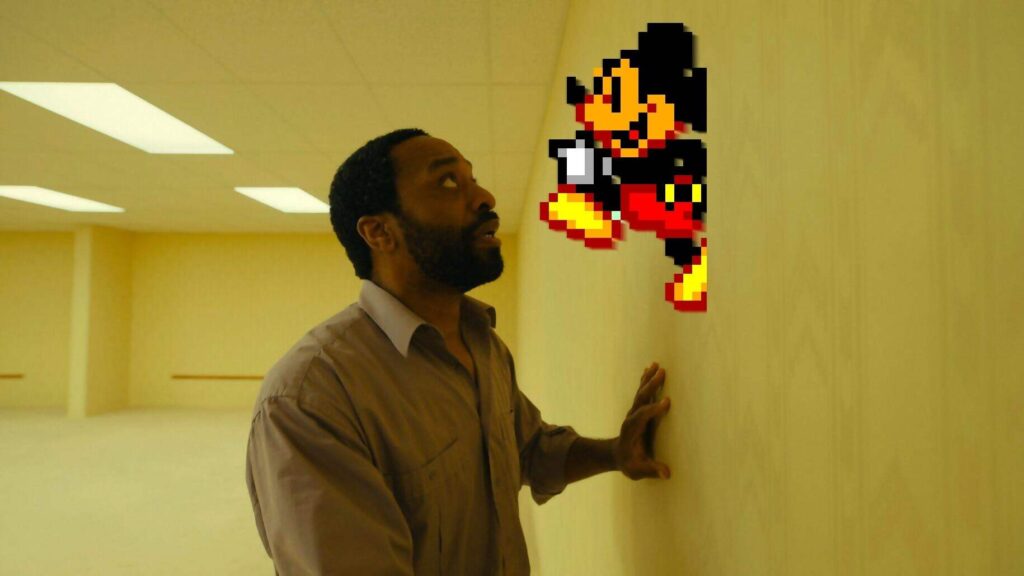

What does a 1990 Mickey Mouse game have to do with the horror phenomenon Backrooms and late-stage capitalism? Glad you asked…
It’s 1991, and I’m playing Castle Of Illusion on the Sega Game Gear. A breezy platformer starring Mickey Mouse, it’s one of Sega’s best 8-bit offerings of that era – not quite Super Mario Bros 3 levels of design ingenuity, but filled with engaging details and clearly put together with care by its developers.
There were one or two segments in the game where you can take short cuts and uncover secret areas if you know exactly where to look: what at first appears to be just another solid wall can be walked or leapt right through. It’s a simple enough trick for a game designer, since it merely involves turning off the collision detection on one particular background graphic. For a young, impressionable player, discovering one of these secret areas for the first time feels like magic.
Although Castle Of Illusion certainly wasn’t the first game to allow players to walk through walls, it did emerge a year before id Software’s Commander Keen introduced the term for it: noclip. A series of side-scrolling PC platformers, the Keen games contained a cheat code that turned off collision detection, allowing the player to pass through ‘solid’ objects.
The same noclip mode appeared in id’s 90s 3D shooters, including Doom and Quake, and was widely adopted by other developers – Valve’s similarly influential Half-Life also allowed players to walk through walls if you knew how to activate the mode.
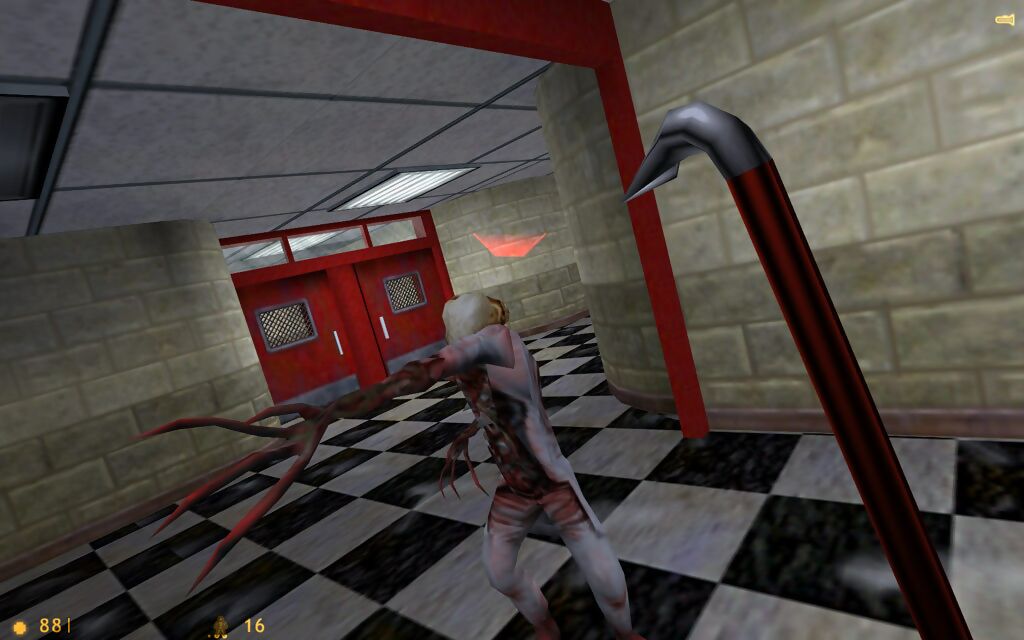
By now, entire generations of players have grown up with first-person videogames, and many will have experienced the strange thrill of noclip. Beyond providing a shortcut – skipping a particularly challenging or tedious part of a game, say – it also fulfils a second function: it allows the player to experience a virtual world in a different and faintly disturbing way.
With obstacles robbed of their solidity, the player’s free to observe previously hidden areas. There might be bits of furniture or random objects, either as deliberate Easter eggs or simply abandoned by developers too rushed to tidy them away. Viewed from unexpected angles, once convincing-looking game maps reveal their true artifice.
Developers soon began prodding at this feeling of uncanniness. In 2013, The Stanley Parable took the Half-Life 2 engine, stripped out all the sci-fi guns and enemies, and created a sardonic and quite spooky first-person game in which the player explores an empty office space filled with arcane puzzles and contradictory messaging. The Stanley Parable took the minimalism of the 1993 adventure game Myst into a new, post-modern arena, where a narrator constantly tries to tell the player what to do – and becomes increasingly angry when its orders aren’t followed.
The Stanley Parable has continued to exert a quiet influence since its release, with such games as Superliminal, Viewfinder and Antichamber taking its puzzle-filled, surreal interior worlds even further. The game also helped popularise the concept of the ‘liminal space’ – a place that looks familiar, but has certain qualities that make it feel as though it exists somewhere between dream and reality.

The concept of an industrial-looking space that feels somehow uncanny has bled into other media, famously in the Backrooms copypasta, which began with a single photo on 4chan in 2019, but also in Apple’s hit TV series, Severance. Series creator Dan Erickson has confirmed that he had The Stanley Parable in the back of his mind when he created Severance’s dystopian office drama, and the resulting series has some of that game’s sardonic humour. When asked what stories or shows influenced his writing during a Reddit AMA in 2022, the game was second on his list, behind The Truman Show but ahead of The Matrix, Brazil and Dark City.
The success of A24’s Backrooms movie has turned former YouTuber Kane Parsons into one of Hollywood’s most talked-about young directors – and now arguably the most famous explorer of these liminal spaces. Parsons began making Backrooms videos when he was still in his mid-teens, his YouTube channel also filling up with other, similarly unsettling short pieces that take place in abandoned shopping centres.
All are marked out by the way they simulate the look of grainy camcorder footage, making them the younger sibling of 1999’s The Blair Witch Project; some of the short films have monsters, but they’re mostly at their most effective when they provide a first-person view of an empty building where the architecture feels somehow off. There’s always questions about what happened here. What was it used for? Why was it abandoned? By whom?

It’s no accident that these videos take place in commercial places: abandoned malls, empty offices. These are places constructed for people to meet for commercial purposes – either to work or consume. Stripped of human movement, they become hollow.
Backrooms, and other recent films including Exit 8 and Skinmarink, use a similar visual language to describe the eeriness of the global pandemic era, in which city streets and public places lay empty under lockdown. It’s no coincidence that Parsons began to learn to use Blender, a free 3D graphics package, while he was stuck at home in 2020. He fused what he was seeing in the real world with the games he grew up playing, such as Portal, Minecraft and Half-Life.
Parsons has said himself that he “wasn’t someone who fell in love with film as a kid,” and that the imagery in his work is more drawn from what he’s found online, the videogames he’s played (Portal and Half-Life are “the biggest things in my DNA for everything I’ve made”, he told GQ) and the sensation of his own dreams.
“Most of my dreams are pretty architecturally centered, or fixated on spatial memory,” Parsons told Interview Magazine. “In my waking life, I’m very focused on buildings and spatial relationships. When I did the first short film for Backrooms, part of the creative direction was pursuing that feeling of having a dream in your childhood home, but you wake up and register that the place you just were was entirely different from the real world version. It’s like the semantic information of that place all got shuffled and applied to something else incorrectly, but you believed it and felt it all the same.”
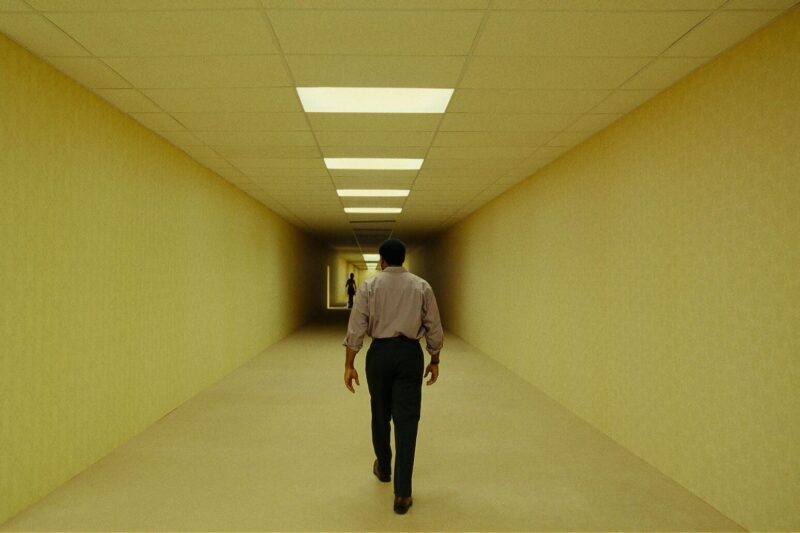
What Backrooms and pop cultural items all drive at is a similar, uncanny sense of modern emptiness. Even Backrooms’ setting (1991, coincidentally the year Castle Of Illusion came out) isn’t designed to make us feel nostalgia, as such, but to emphasise the story’s detached perspective. The furniture, the decor, the cars – all these things that might once have been objects of desire now look familiar yet outmoded.
Parsons almost certainly didn’t make Backrooms as some kind of anti-capitalist screed, but commerce and advertising run deep in its storytelling. Its protagonists, Clark (Chiwetel Ejiofor) and Dr Kline (Renate Reinsve) have both made TV ads – Clark dresses as a pirate for his furniture store; Dr Kline has a self-help book out. Clark, clearly, feels demeaned by his cheap commercial, designed to prop up a failing furniture business. It’s a negative emotion that physically manifests itself in the backrooms themselves.
Clark’s existence could be seen as a mirror of how someone in their teens or 20s (as Parsons is) views the modern world: an endless trudge of poorly-paid work, insecure housing and no sense of hope for the future. Capitalism has long been marketed as being as natural and vital as air and water, and just as vital. And yet, as we’ve lived through recessions and stock market bubbles and watched the accelerating wealth of the ultra-rich, there’s also the sense that the system isn’t working for everyone. Something is wrong with our modern reality, but we can’t always articulate what the problem is.
We’ve been raised as consumers who have a specific purpose: to work and to buy things. But increasingly, generations of people are finding that their work is paying less and less compared to the things they want or are expected to buy. And if they can’t afford to buy things, then society tells them, over and again, that they simply aren’t working hard enough. (Have you considered a job in cyber?)
Backrooms, through its videogame-inspired imagery, echoes that sensation of modern unease. Under capitalism, everything must have a function. But remove the people, and an office has no purpose. It’s devoid of meaning, and that emptiness is inherently disturbing.
Just as noclip allows us to see the artifice of a videogame, so Backrooms and stories like it allow us to step outside our mundane capitalist reality and see it for the empty stage it really is.