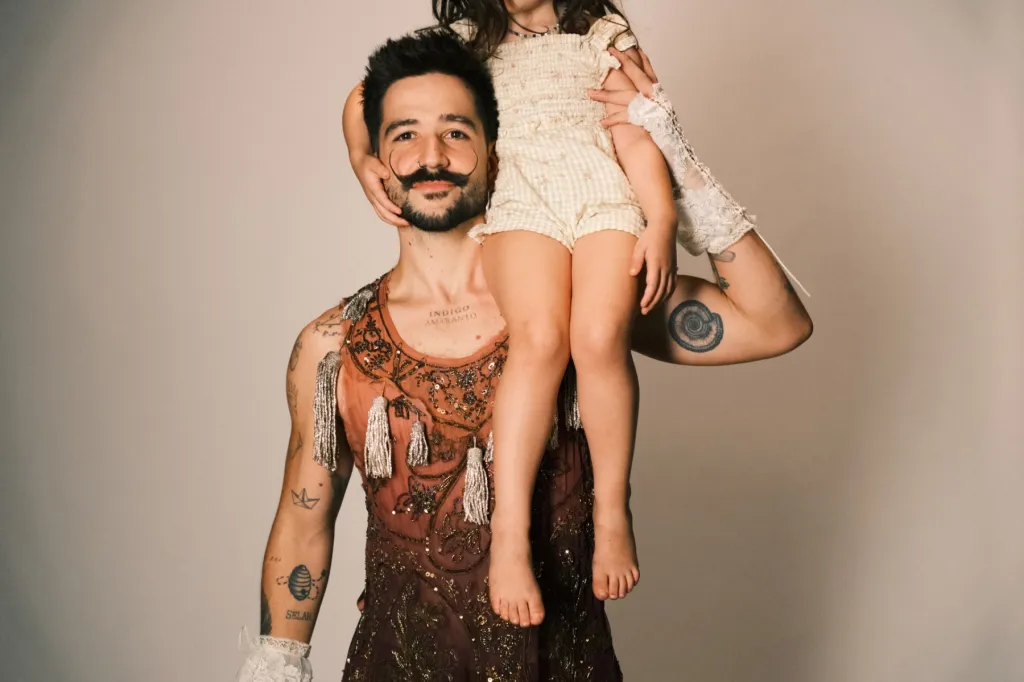

Camilo decided to write an album for his young daughters, and in the process, he ended up understanding the world and himself better. Perhaps that’s why Para Cuando Sean Mayores combines simple titles like “El Titiritero” (“The Puppeteer”) and “La Campana” (“The Bell”) with deeply profound themes such as sacrifice, the loss of innocence and the pain of growing up.
“The initial intention was to start writing songs that embraced sensitivities that are very important to me and that I thought were important to share with my daughters. Later, I discovered that these were not just for my daughters, but the most vital sensitivities I treasure, which are valuable to me and are also the pillars of what I consider important to share as an artist with people who listen to my music,” says the Latin pop star, who won Colombia’s Factor Xs talent competition at just 13 years old in 2007.
“It’s the first time I’ve managed to capture in my songs sensitivities, themes and messages that I had previously only been able to express through interviews, conversations, written texts, opinions—but never my music,” he adds.
Released Wednesday (Sept. 9) under El Taller Creativo and distributed by Sony Music Latin, Para Cuando Sean Mayores (which means “For When You Grow Up”) features 13 tracks whose titles could easily belong to fairytales. It opens with “Los Cuentos” (“The Stories”), a spoken-word introduction, and continues with “El Árbol” (“The Tree”), “La Nieve” (“The Snow”) and “El Cisne” (“The Swan”), among others.
It also includes a collaboration with his wife Evaluna Montaner, “La Medalla” (“The Medal”), as well as a love song dedicated to her, “For Eva,” featuring a sweet bilingual lyric: “This is for you/ Por más que llueva/ If I’m with you/ Es primavera/ Por siempre aquí/ We stay togetha… This is For Eva”. The title is a play on words that can be read as is or as “Forever”.
Musically, the set blends Camilo’s signature pop style with soft ballads, bolero and Brazilian rhythms.
“I feel like with this album, I was able to explore new places,” the musician notes. “Every time I finish an album, I go through this crisis of ‘Oh man, I’m out of ideas, I’ve got nothing left to explore because I gave it all.’ But when I started writing this album — bam! — infinite new doors opened up. I was like, ‘Creativity is endless, dude, how fun!’”
The album cover features his daughters Índigo and Amaranto sitting with their backs to the camera, facing a small puppet theater where all 13 music videos for the album were filmed. The shoot took place in Barcelona, Spain with the help of professionals specializing in puppet theater, finger theater, shadow theater, and more. “The visual concept is beautiful,” Camilo says with a smile. “My daughters were sitting in the front row enjoying it all for an entire week.”
Below, Camilo breaks down five essential tracks from Para Cuando Sean Mayores. To listen to the full album, click here.

El Taller Creativo
-
“El Titiritero”
This is a song that talks about how sometimes we sacrifice simple happiness for the pursuit of sophistication, greatness and grandeur. It’s the story of all artists, and it’s the story of my life in general: I sacrificed the simple joy of living in my house, playing the guitar and doing whatever I wanted for the dream of chasing immense things. Not everyone wakes up from that dream, but some of us do, and we realize that when you’re living all those things you dreamed of achieving, once you reach them, there’s always an internal feeling of, “This isn’t what they promised me, this isn’t what I imagined.”
You win the award you were dreaming of, but it doesn’t feel like you thought it would. You thought that when they handed it to you, you would feel, “Okay, I’ve made it.” But as soon as you receive it, your eyes are already set on the next thing. As soon as you fill the theater you wanted to fill, you’re already focused on having to fill an arena next. And suddenly, when you’re living all that, you realize that happiness is something much simpler and that you were already happy before — you just didn’t know it. So this song talks about returning to the simplicity of happiness. I would trade any award, any sold-out show, for a day where I could sit on the couch with my daughters jumping around; with my dad; my mom cooking ajiaco; my wife sitting next to me reading a book. That is happiness.
Musically, it has elements of bossa nova and pagode, but it’s a very interesting exploration because it also incorporates analog synthesizers. I produced it with Rafa Arcaute and Juan Pablo Vega in Colombia, and Rafa traveled to Brazil to record with a whole group of musicians specializing in this sound. It was a very beautiful adventure. (Dani Rondón and Eudis Ruiz are also credited as co-writers).
-
“El Árbol”
“El Árbol” talks about a problem we’re all facing right now, which is how the present slips away from us because our eyes are always focused on what’s next. This ties into everything happening on social media, where we’re constantly chasing the next stimulus, always dreaming about what’s coming, and never realizing when it’s the last time we’re experiencing something. For example, the other day I realized that Índigo, my 4-year-old daughter, no longer falls asleep in my arms. She says, “Let’s go to sleep,” lies down in her little bed and falls asleep. And I didn’t realize when the last day was that she fell asleep in my arms. I missed it. I didn’t live it because I didn’t realize I was living it.
And that happens to us in life all the time. When is the last time you take your kids to the park? When will it be? We released a snippet of this song on social media a few days ago, and someone commented: “If I had known it was the last Christmas I would spend with my dad, I would have invented another Christmas in February just to live it again.” And it gives me chills as I talk about it; it’s very powerful. Life passes us by, and we don’t realize when those last times are.
The song is more pop. We recorded it with Rafa Arcaute and Nico Cotton in Argentina. It’s the first time I managed to include a bass and a drum, what they call straight up, just the way I wanted. This song is also a bit of a whim in that sense. (Writing credits also include Nate Campany and Sara Schell as co-writers).
-
“Chiquita”
“Chiquita” is the song I wrote for my [2-year-old] daughter, Amaranto. My daughter Índigo has a song called “Índigo,” and Amaranto didn’t have a song because I still didn’t feel it was the right moment to write one for her. But if it were possible to turn my daughter Amaranto’s identity into a song — well, I’ve never done such a good job as a songwriter of capturing the essence of something in a song. Not just of a person, but anything.
“Chiquita” is my daughter. It’s exactly a representation of her: she’s curious, she’s independent, she wants me close but just enough so that, when she needs her space, she can let go and live her moment. She’s bouncy, and she has moments that don’t connect one to the next. She doesn’t have slow or gradual transitions between things; she jumps from one thing to silence, from silence to excitement, from tears to pure joy. And the song has that same movement. She is that kind of rhythm you hear in the chorus.
It starts with her voice [saying “a bailar, a bailar”] and then, when the chorus begins, there’s another rhythm. It has a very African-inspired rhythm, with several sounds I recorded while playing with her, making little sounds with my mouth. It has a bunch of samples of her voice. She knows it’s her song, and it’s her favorite — not just on the album but of her entire life. (Co-written by Camilo and Juan David Muñoz Avilés).
-
“La Medalla” with Evaluna
It’s a song that beautifully captures the big difference between my wife and me. My wife and I are very much alike, and we have an incredibly functional relationship, but we are diametrically opposed in some ways. I always live with this foolish need to prove that I exist, to demonstrate that I am real through my achievements, pursuits, habits and structures. It’s as if the message my heart feels is that I need to prove that I deserve what I am going to receive from God and the universe — I need to earn it. And my wife is the complete opposite. At the core of her heart, she knows that she is enough, that she doesn’t need to prove anything, that love is a gift that simply needs to be received. She lives in a calm tension, with an intrinsic sense of her worth that is very interesting and that I don’t have, but from which I am constantly learning.
So, this song talks about the love I receive from Evaluna, which is a love that is free, a love based on a sense of essential worth. She loves me because she loves me — not because I achieved something, not because I proved something, not because I reached a goal. Nothing I achieve in life surprises her. And when I come home after what I consider to be a defeat, for example, she is there waiting for me, and her hug, telling me that everything is okay, is the place I want to return to, to remember what my true worth is.
And I see this in my parents. My parents had different struggles that I don’t have today. Today, thanks to God, I have a much more abundant life than my parents had in economic terms. But I grew up watching my parents navigate that system, coming home one day and saying, “Well, we don’t have enough to pay rent, they’re going to cut off the water, they’re going to cut off the electricity, we can’t pay for the kids’ school anymore, they were sent home today and told they can’t return until we pay.” I saw that from a young age, and yet, their hug at the end of each day was like, “There’s no such thing as a bad day when the day ends with you.” That is “The Medal,” and it’s a kind of photographic sensation of God’s love, which is like that too.
I wrote “La Medalla” with a friend named Juan Muñoz and Daniel Rondón, another songwriter I had the opportunity to collaborate with on this album. (Also credited: Nabález and Rafa Arcaute).
-
“El Traje”
“El Traje” is a song I wrote with Edgar Barrera. It talks about how one day you look in the mirror and — I mean, I think if I showed up today at Parque La Bonga de Pasatiempo in Montería, where I lived in 1999 or 2000, and little Camilo saw me, he wouldn’t recognize me. And that hit me really hard, realizing that as we grow up, we make a really bad deal by trading happiness for a fantasy or an idea of growing up. Like when they say, “Don’t grow up, it’s a trap.”
I started pursuing music in 2007. That’s when I began appearing on television, releasing my first songs and living off my music to pay rent. I was 13 years old. So, of course, I still had a piece of my childhood left. I was a kid, but I made an internal deal where I traded my childhood to leap forward. And that’s what “El Traje” is about: “I looked in the mirror and said nothing/ Because I don’t talk to strangers/ But there’s something in your gaze that reminds me/ Of a kid who used to ride his bike around my neighborhood.”
It’s a very simple song; it’s a song of keys and voices. We didn’t want anything to interrupt what the lyrics and melody were saying. When I write something with Edgar Barrera, I always have the feeling that I want what we’ve written to be front and center, without distractions. Yes, the song is sad, but it makes you want to embrace that previous version of yourself again.