
Its unresolved, noncommittal conclusion is exactly the sort of anticlimactic reality Daayra wants to bring our attention to.
Neither justice nor revenge can undo the fate met by the world’s Nirbhayas or Arushis, observes Sukanya Verma.

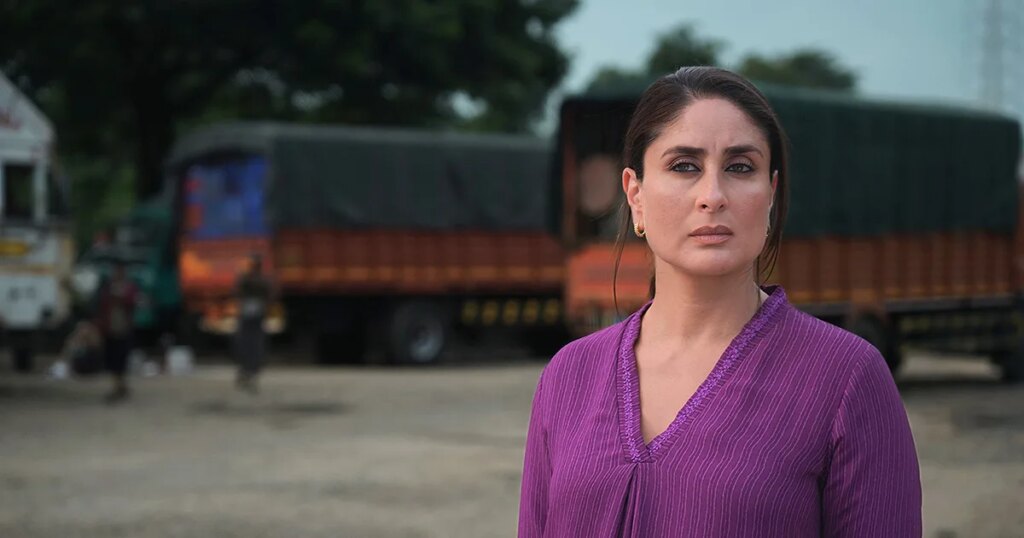
IMAGE: Kareena Kapoor Khan in Daayra.
Key Points
- We live in a culture of ‘she ‘invited’ it upon herself’ that will go all out to protect a minor or influential but does little to safeguard the interests of women.
- The worldview of two law enforcers is scrutinised in a straightforward, impartial manner.
The more you mull on it, the more understandable their perspectives seem. - When the scene of what transpired for these two ideologies to come into play finally unfolds, it juxtaposes the violence with the violation in such a spine-chilling fashion, it’s almost unbearable to look at the screen.
Meghna Gulzar studies the modus operandi of a pair of cops committed to justice in Daayra. While DCP Raman Kumar (Prithviraj Sukumaran) has no hesitation in playing judge, jury, and executioner, DCP Ajooni Kohli (Kareena Kapoor Khan) believes in the law following its own course.
A clash of this nature is not entirely new but in Daayra, it forms the centrepiece of Gulzar’s storytelling where the worldview of two law enforcers is scrutinised in a straightforward, impartial manner.
What lends Gulzar’s findings its complex appeal is, the more you mull on it, the more understandable their perspectives seem.
The Unchanging Scenario of Crime Against Women
At the centre of these ideological differences is the unchanging scenario of crime against women.
Though Daayra unfolds inside the fictional region of a Telangana-sounding Teerthana, its likeness to the 2019 Hyderabad gangrape and murder, involving a 25-year-old veterinarian whose charred body was discovered by the toll plaza and led to a much feted encounter killing of the accused quartet, is unmistakable.
Debated hotly back then for the ethical and moral repercussions of extra judicial punishment as well as delayed, deferred court trials and FIR filing lapses prompting such extreme measures in the first place, Daayra mediates on the need of the hour in its cops versus cops exploration.
‘They just had to do their bloody jobs,’ one of them says in a tone that’s as frustrating as felt in the gut from a man disgusted by his own ilk.
There’s valid cynicism among common folk, too, suspecting a sense of futility around an exhausted, loopholed legal system, which hurts more than it helps. We live in a culture of ‘she ‘invited’ it upon herself’ that will go all out to protect a minor or influential but does little to safeguard the interests of women.
It becomes fodder for the media tamasha, which gains by dramatising a victim’s plight instead of shaming the perpetrators and suffering long-drawn-out trials with nothing but hopelessness in sight.
Meghna Gulzar grimly notes the media and society’s perverse tendency to sensationalise the horrors Nirbhaya and Arushi underwent by turning them into buzzwords, or even worse, a brand.
Parallel Paths To Justice
But first, she builds Raman and Ajooni’s persona as parallel tracks moving to and fro over a dense timeline as one reassesses another’s actions over events of the past after a Special Investigation Team is set up by the Human Right Commission to confirm the truth about a planned encounter reported as retaliatory shootout.
Prithviraj’s introduction scene shows him as an Avenger of sorts, receiving a hero’s welcome for using brute force and taking the rapists to task, while Kareena apprehends a corrupt cop showering VIP treatment on a convict by treating them to spa services and avocado tikkis. Interesting how both make it a point to acquaint themselves with each other’s temperament but don’t meet right till the end.
Daayra, co-written by Gulzar, Yash Keswani and Sima Agarwal, lays out a board game of one move at a time as Ajooni methodically probes into the incident while Raman ensures his alibis are foolproof.
They are veterans of slippery grounds but there’s a danger of monotony.
And Gulzar’s non-linear narrative avoids it skillfully.
Flashbacks of Raman and his squad hunting down and detaining offenders through claustrophobic alleys and cramped homes against the backdrop of Diwali lights gives Daayra a raw, throbbing, electric texture.
Ketan Sodha’s synthwave-heavy background music proves a perfect foil for its understated drama.
On the other hand, Ajooni’s investigation is as systematic as her beliefs.
Confirming Team Raman’s accounts and corroborating it with facts whilst recreating the encounter scenario doesn’t quite have the sizzling energy or sardonic sharps yet makes its point without beating about the bush.
Character Depth And Performances
Ajooni’s father (Kanwaljeet Singh) and Raman’s wife (Anuja Sathe) do find a mention but their personal lives don’t matter in the broader picture.
Unlike Gulzar’s Talvar, to which Daayra‘s police-procedural comes closest to in soul, Raman and Ajooni remain emotionally aloof. Whatever objective Ajooni’s forced subplot concerning her dad’s judiciary woes is meant to achieve only winds up as a flimsy argument between its leads.
Gulzar notes the ineptitude within the system with wry humour in scenes of Ajooni’s ongoing challenges — expected to operate from rundown accommodation and zero amenities, delays in paperwork, and resistance from every corner. Raman’s well thought out non-cooperation and Ajooni’s unruffled reaction to it makes for an interesting fire and ice tussle.
When the scene of what transpired for these two ideologies to come into play finally unfolds, it juxtaposes the violence with the violation in such a spine-chilling fashion, it’s almost unbearable to look at the screen.
Restrained Performances
Gulzar’s restrained creativity spills on her actors as well.
As the cop doling out no-holds-barred justice, Prithviraj conveys a clarity that has zero doubt or remorse over what he does. Aggression of this extent could borderline on arrogance but Prithvi deftly tempers it down to righteous rage that justifies his actions as means to an end without glorying them.
Kareena has a tougher role.
It’s a less popular, less crowd-pleasing argument she’s endorsing even if she’s not completely oblivious to the anomalies in the very system she protects.
As somebody not at the liberty to share her feelings, the actress does a wonderful job of withholding even as her eyes smoulder with anger on hearing the agonising account from the victim’s family.
One of the most internalised portrayals of Kareena’s career, her calm, sarcastic, solution driven cop creates a distinct space from the melancholic officer in The Buckingham Murders and hot-headed policewoman in Angrezi Medium.
Systems change, attitudes don’t, she scoffs.
As the mother of the girl bearing the brunt of this reality, Kshitee Jog’s devastated gaze haunts long after you leave the theatre. As do the choice of words of the rounded up suspects — a nondescript lot whose ordinariness only makes the monstrosities they are capable of all the more chilling.
Daayra culminates in Raman and Ajooni’s long awaited, tad underwhelming face-off.
What works is the gentle tone of their dialogue, which respectfully hears out each other’s point of view yet holds on to one’s style of taking the trash out. Its unresolved, noncommittal conclusion is exactly the sort of anticlimactic reality Daayra wants to bring our attention to. Neither justice nor revenge can undo the fate met by the world’s Nirbhayas or Arushis.
Daayra Review Rediff Rating: