
DJ Screw was in his teens when he learned to control time.
On his turntables, he would reduce the tempo of a beat until it felt like teetering so slow on a bike, barely touching the pedals, that you might hit the ground any time. On top of that he added fast-twitch scratches, so you’d race as you dragged. Then he injected spare, melodic hooks, glimmers of love and hope, so you felt in the past, present and future all at once.
On Saturday, he manipulated time again. People crowded into Houston’s Deluxe Theater to hang on Screw’s every word and scratch — as if he were still alive.
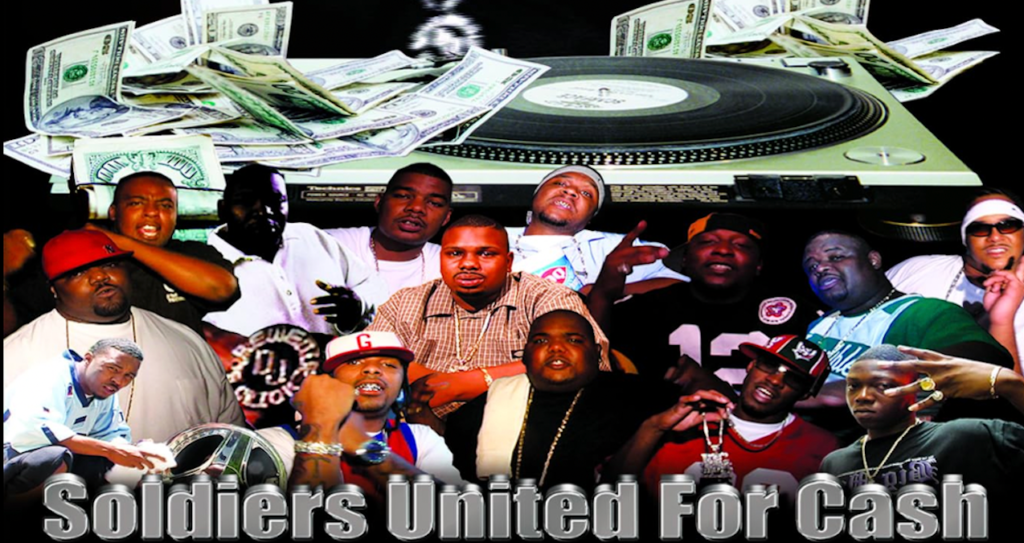
The occasion was a Houston Cinema Arts Festival screening of Ariel Santschi’s documentary Soldiers United for Cash, released in 2001, months after DJ Screw’s funeral. Santschi takes a patient approach, letting DJ Screw spin his own tales, then turning his attention to collaborators in the Screwed Up Click like the Botany Boyz, Big Pokey, Lil Keke, Big Hawk, Fat Pat. Z-Ro, Trae tha Truth and Lil’ Flip.
The back half of the film features an array of performances by the S.U.C., whose skills sneak up on you. Even if you’ve never heard of them, by the end of the doc you may wonder why some aren’t household names far beyond Houston. I though I understood Houston hip-hop because of a working knowledge of the Geto Boys, Chamillionaire, and Mike Jones. Soldiers United for Cash taught me that I’ve missed out on many others.
The Legacy of DJ Screw
DJ Screw tells his own origin story in Soldiers United for Cash: He was mixing records with his trademark chopped and screwed technique when a friend offered him $10 to record him. Soon people were lining up outside his door for tapes. Cops assumed he must be selling drugs, but when they seached his house, they only found turntables and record crates.
Before long he had founded half a dozen indie record labels and Screwed Up Records and Tapes, which still sells DJ Screw music and merch.
Chopped and screwed music quickly became associated with lean or purple drank, a mix of soft drinks, prescription cough syrup and sometimes hard candy, often sipped from a styrofoam cup. DJ Screw died in 2000 at just 29 of an overdose of codeine, the key ingredient in cough syrup, which only added to the association.
But in the film, DJ Screw himself says you could be stone sober and appreciate his sound. Which was true Saturday.
Near the end of the film is a dazzling, head-nodding, transfixing display of his skills, He works his hands, expressionless, and takes the music places you could never anticipate. It’s hypnotic.

So was a post-screening set by DJ Red, in the Deluxe Theatre’s gallery space. Decades after DJ Screw’s death, his grown-up fans and the next generation gathered to listen to the music as pure art, with no distractions. DJ Red studied his monitor, meticulously matching beats, dropping surprise after surprise, a master of his craft.
I saw a styrofoam cup or two, I guess as a joke. Most people sipped a beer if they sipped anything at all. People with gray hair did elaborate dances. Mostly we just nodded our heads.
One woman were a shirt that said “I Wish Screw Was Here.” But he was.
You can read more about the Houston Cinema Arts Festival here, read more of our festival coverage here.
Main image: The partial DVD cover of Soldiers United for Cash.