
Everybody may dig Bill Evans, but by the end of Everybody Digs Bill Evans, you won’t necessarily be any the wiser as to why. Credit to Grant Gee’s film that it doesn’t go for an obvious biopic portrait. By narrowing its focus to a tragedy, it aims for a broader audience than the fans, and in doing so risks alienating everyone. For a film about a piano virtuoso, it’s surprisingly one-note, and only some keen performances and a polished look keep the viewer onside.
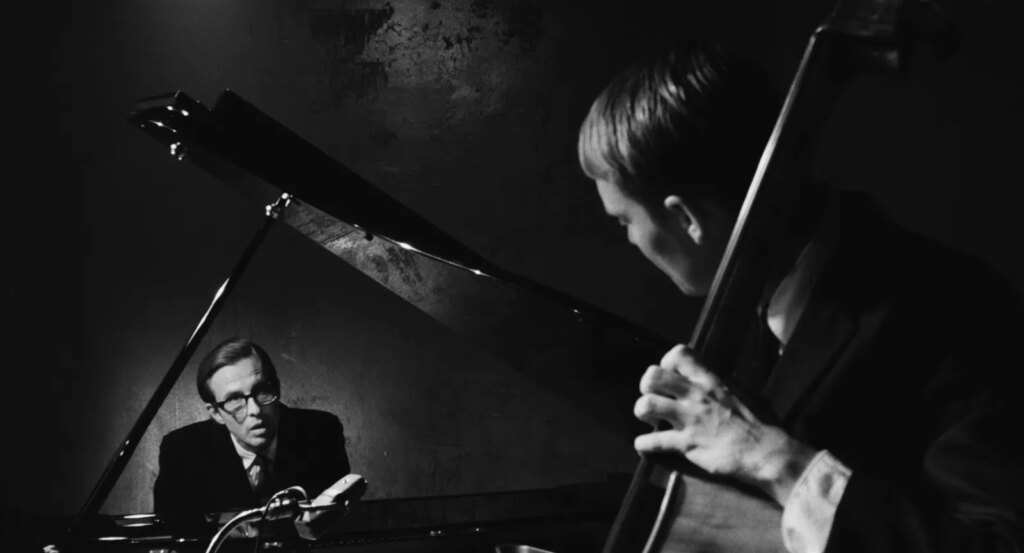
Everybody Digs Bill Evans is named after the pianist’s 1959 album, his second as the head of a trio. However, the film’s emphasis lies two years later. In June 1961, Evans appeared for a series of performances at New York’s Village Vanguard jazz club with his then-trio of drummer Paul Motian and bassist Scott LaFaro. This session led to the release of two live albums to accompany the two studio albums they’d already recorded together. The film opens with a recreation of the gigs, with the bespectacled Evans (Anders Danielsen Lie) gliding his fingers along the ivories with precision. Even with the exquisite music of Evans and co., it’s readily apparent that the unsung hero of Everybody Digs Bill Evans is cinematographer Piers McGrail. He creates a polished black-and-white world, filled with cigarette plumes and elegant spot lighting. This colour scheme firmly establishes the film’s emotional register even before the plot kicks off: Evans inhabits a monochrome world, with a monochrome mindset to go with it.
Ten days after the Vanguard performances, LaFaro died in a car crash, aged just 25. It’s a tragedy that effectively broke Evans, leading him to stop performing for several months. This timeframe is the primary focus of Everybody Digs Bill Evans, with a despondent Evans forced to seek solace by staying with his brother Harry (Barry Ward) and sister-in-law Pat (Katie McGrath). Despite not being a native Anglophone, Danielsen Lie is ideal casting as Evans. His lanky physicality stealthily masks a capacity for quietly simmering angst, a trait that Joachim Trier has put to good use in his oeuvre. He can sell a character’s inner turmoil with a subtle shift in his stance, with his relative silence echoing Evans’ refusal to play. It is a quietly enrapturing performance, with Danielsen Lie’s inscrutability urging the audience to dig deeper.
The same inscrutability that defines Danielsen Lie’s performance can also be found in the script. Mark O’Halloran adapts Owen Martell’s 2014 novel Intermission almost too faithfully. The leap from page to screen always risks losing the interiority of prose, but Everybody Digs Bill Evans clings too closely to its source’s tight timeframe, and thus its protagonist’s emotionally crippled mindset. Evans is a broken man, and the script struggles to offer a reason to stick with him, other than hoping to evoke a vague sense of pity. There’s too little of the man’s music here to endear him to existing fans, or to create new ones. Gee intends for the audience to side with the people who care for Evans.
Ward, McGrath and Valene Kane (as Evans’ girlfriend Ellaine Schultz) do their best to offer plot points (talking sense, tempting with heroin), but it’s all told in the same grim register. Grief overwhelms Evans and this entire film. Even brief flashforwards only offer moments of grief to come.
If the film gets any lift at all, it’s in the second half, when poor Bill decamps to Florida to stay with his parents in an effort to alleviate his depressive funk. The senior Evanses are played with charm and warmth by Laurie Metcalf and Bill Pullman, and offer an energetic contrast to their offspring and everyone else here. While they have their share of travails and regrets, the charming performances from the veteran actors are just enough to stand out from the misery that shrouds the rest of the film. Furthermore, Evans’ parents offer the most compelling insights into their son’s malaise. Her frustrated ambition and his fragile sense of masculine self are the most relatable elements of Everybody Digs Bill Evans, offering partial explanations for their son’s precocious talents and muted personality.
Everybody Digs Bill Evans is not a bog-standard biopic, but what we get makes you wonder why this story warrants being told at all. Specific genres are already overwhelmed with opportunities to process trauma, which makes this film feel late to its own party. It’s stylish and well-acted, and a great advertisement for Irish film production (It’s produced and written by Irishmen, and was partly shot in Co. Cork), but it never breaks free of the shackles of the sadness that enslaves its lead.
Everybody Digs Bill Evans is in cinemas from 11 September.