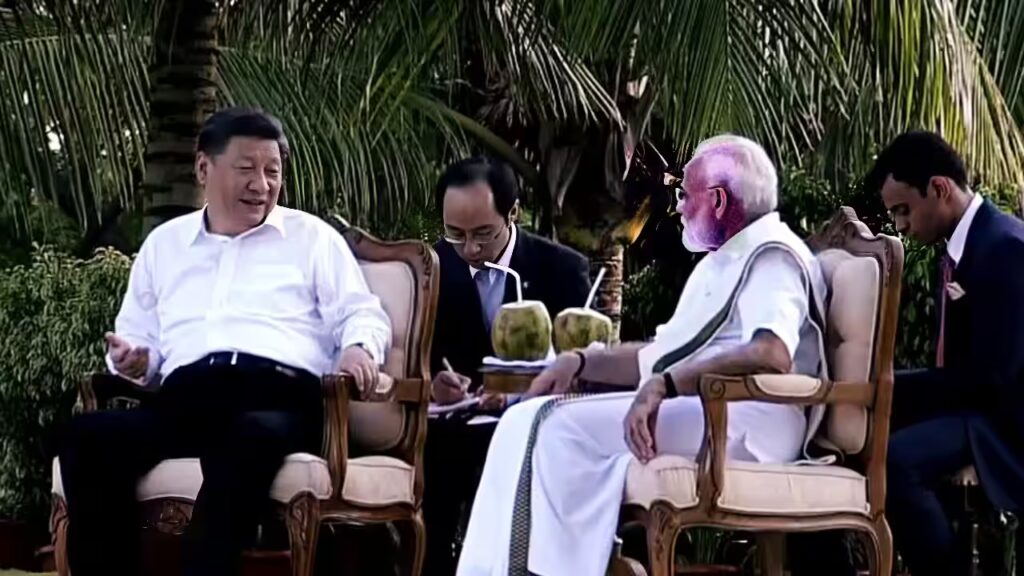


Seven years, one deadly border clash, and a long diplomatic freeze later, China’s Xi Jinping is finally landing in Delhi again. The Chinese President arrives for the two-day BRICS Summit at Bharat Mandapam on September 12-13, his first visit to India since 2019, a gap defined by the 2020 Galwan Valley clash and years of frozen high-level contact. A planned 45-minute to one-hour bilateral with Prime Minister Narendra Modi is also on the cards. And strategists and skeptics still can’t agree on what any of it is actually worth.

For India, the visit is really an exercise in balancing several relationships at once. Einar Tangen, Senior Fellow at the Center for International Governance Innovation, frames New Delhi’s approach as an attempt to strengthen ties with Washington while preserving Moscow, managing competition and trade with Beijing, and expanding partnerships in the Gulf — “strategic game theory in practice,” as he puts it, aimed at maximising India’s room to manoeuvre without becoming dependent on any one power centre.
The caveat, he tells Times Now Digital, is that Washington’s “increasingly binary approach to strategic alignment” could make that balancing act harder. For Tangen, India’s core interest is ensuring BRICS+ “does not become a proxy for any single major power, particularly China or Russia” — and strategic autonomy, in his reading, is less about opposing the US than about preserving the freedom to pursue national interests in a fragmented global order.
That helps explain why Delhi has kept its BRICS presidency studiously non-aligned even while rolling out the carpet for Xi. What it doesn’t settle is the harder question: what does the outreach actually deliver?

Namrata Hasija, Research Fellow at the Centre for China Analysis and Strategy, is far more circumspect. She credits the 2024 disengagement at Depsang and Demchok as real movement, but points out that of roughly 14 friction points that flared after 2020, only two have been resolved. De-escalation and troop de-induction haven’t followed, with “50 to 60,000 soldiers on each side” still dug in. Her underlying question is blunt: what has actually changed since 2020, when Beijing’s roadmap for the “great rejuvenation” of the Chinese nation by 2049 remains untouched?
She sees a consistent pattern of assurances outrunning delivery. When India pressed Chinese Foreign Minister Wang Yi on tunnel-boring machines, fertiliser and railroad equipment, he promised within a day to restart supply — yet “till date, there has been no supply of urea,” she says, with imports at zero. Around 95% of Indian visa applications from the tech and manufacturing sectors have been rejected, and on technology her charge is sharper still: China is sending only “second-hand machinery” and openly refusing to train Indian workers on first-hand equipment “so that the manufacturing doesn’t go up.”

Talking to Times Now Digital, she flags similar fog around “early harvest” trade concessions — accepted by India but never clearly defined, and framed in Beijing’s own readout as part of a broader “package deal” that doesn’t match the language in the two sides’ joint statement. Layered on top, she says, are ongoing Chinese influence operations across South Asia — reason enough, in her view, to doubt that Beijing’s underlying intentions have shifted.
Her larger point is about proportion: trade dependency, not diplomatic optics, is where this relationship is really tested. India’s revised Press Note 3 rules have barely moved the needle — Chinese FDI into India sits at just 0.32%, she notes — even as everyday imports, from umbrellas to human and animal blood products, show how little the dependency has shifted since 2020.
Despite their different emphases, both experts land on the same caution: don’t let one summit carry more symbolic weight than it can bear. “Let’s not really make BRICS all about India-China relationship. It’s just a summit,” Hasija argues — a nod to how optimism after the Wuhan and Chennai summits preceded Galwan. Tangen arrives at the same place from the opposite direction: BRICS+ only serves India if it resists becoming any single power’s proxy.

That’s the needle Delhi has to thread this weekend, opening channels on trade, investment and border de-escalation without mistaking one bilateral for a resolved relationship. Xi’s delegation, reportedly built around a large business contingent, will be watched closely for early signals on investment intent.
Whether Saturday’s meeting produces more than photographs may hinge less on what’s said in the room than on what follows it: will fertiliser shipments resume, will investment rules actually move Chinese FDI, will troop de-induction finally begin? The tensions are down, as Hasija concedes — the real question is how long they stay down. Delhi’s answer over the coming months may say more about this relationship than the visit itself.