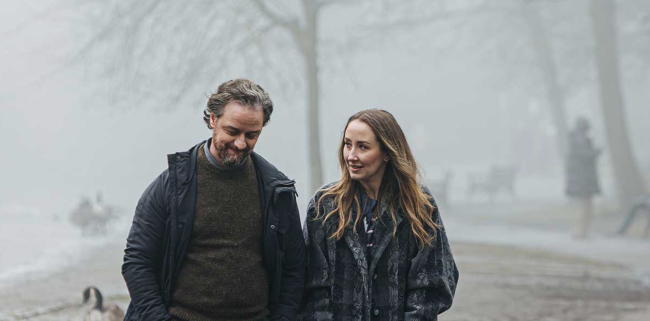

If “Faith,” British director Paul Andrew Williams’ new chamber drama, were a book, it might be reviewed as a monograph on sublimating grief. Or perhaps as a slender volume whose first chapter signals its interest in parenting and dating in a blue collar Yorkshire town cast in a permanent pall of mist. Both descriptions would be true of this drama thriller that does well in its stealth tactics to foreshadow its themes, somewhat similarly to Williams’ previous directorial effort, “Dragonfly.”
As a piece of cinema, though, the storytelling is more poised to suggest an intriguing thesis about working class consciousness that might (or might not) need saving. Via alternately warm and intense scenes of dyadic interrogation, primarily through the lens of Erin Doherty’s (“Adolescence,” “The Crown”) electric rendition of Gina, a single mom put through a most difficult test, it knows when to raise the volume on its whispers and mute its cries of helplessness.


It begins quite jovially at a trivia night at the local bar. Gina, who works on the assembly line in a candy factory, meets Michael (James McAvoy), a buttoned up newcomer to the town, and is drawn immediately to his weathered intellect and silver fox lineaments. He walks her home, but politely declines her overture to spend the night. She might be a tad offended, but not enough to stop her from flashing him from upstairs. Michael laughs, and in that same moment, the teenage girl Gina had hired to watch over her young son Jamie, walks out the door. In one of the character’s several flash turns, Michael’s tone flickers from boyish to paternalistic, warning her, “You’re standing at a crossroads, young lady. You want to think very carefully about what you did today.”
In morbid actuality, it’s Gina who doesn’t know she’s been stood at a crossroads, having met Michael, the least creepy priestly bloke there was who somehow knows things he couldn’t have possibly seen. Their second date, a walk around the lake from the food bank where he volunteers to a teahouse, quickly turns into a pivotal moment of a therapy session. Michael catches Gina off guard by grasping her hands and asking her, ever so intentionally, if she likes herself. Doherty, whose ability to pierce back rivals Viola Davis’s — not quite a death glare but more hard-edged than, say, Kate Winslet’s gazes — reveals Gina’s tenderness and defiance in the twenty seconds she takes to respond, a disposition that will serve the character well in the valleys of despair the story will soon unexpectedly plunge her into.
Everyone sees that Michael’s a bit odd. When he visits for an evening of board games, Gina’s protective younger sister Pops (Liv Hill) asks him point blank what he does for money. Amused, Michael says he’s in a position to not worry about that particular material matter. Gina, at some point, wonders aloud whether Michael’s a stoner; again, he laughs it off while staring down her soul. Even Jamie (Smylie Bradwell), not yet ten, shoots him a glance after Michael abruptly faces him as they play a video game in his bedroom and says, “Your mum really loves you, you know that, don’t you?” In this manner, McAvoy masters Michael’s articulation as a series of pointed interjections, conjuring little disturbances within this family unit which crescendo as “Faith” casts its spell.
The thematic tightrope the film walks and the sleight of genre it nearly pulls off are a responsibility Williams wisely places on Doherty’s expert shoulders, somehow, in a small feat of irony, allowing us to experience her vicissitudes through Michael’s (of all people’s) eyes. McAvoy, for his part, is more than game to cede the duty. In the second half of the movie, with the camera positioned on a devastated Gina at the floor level — be it in the lived out interiors of her flat’s bedroom, bathroom, or kitchen, as Michael and Pops check in on her — the consciousness we access is potent and multi-faceted.
Hers is a rational grief, retaining a sharpness and a forensic curiosity even as she languishes. Gina confronts Michael, her hair thin as spikes, saying that she does notice how he won’t eat, kiss, or fuck. Williams intermittently cuts to ominous exterior shots of a dark church and layers in a score of hymnal lament. Little though can distract from Gina’s ache and need to be embraced, which feel eternal and are communicated unforgettably in a rare resort to an overhead shot in the final act of the film. Doherty’s performance makes for an astonishing accompaniment to her memorable role in the hit limited series, “Adolescence,” where too the minor she can’t cross the distance with is named Jamie.
What “Faith” does well is the traps and extremes it does not fall into. Other movies would have made a religious ideal of the suffering mother, attempted to proselytize its audiences, or wallowed in the melodramatic urge for a father figure. In that sense, “Faith” is less a traditional chamber drama. Its grief is processual, a crucible that takes the shape its actors and characters mold of it while defying mere mortal charge.
For those not as attuned to certain texts of monotheism, their readings of “Faith” will decided be more plural. And indeed, something more primal is awash here than just the possibility of divine substantiation within attachments and relationships. Not everyone will agree and avid world builders will complain about the lack of “rules,” but it is more than fair to say that “Faith” crosses the chasm, and some viewers will traverse along with it.
Grade: B
“Faith” premiered at the 2026 Toronto International Film Festival. It is currently seeking U.S. distribution.